This fall, in our Sunday school class at church, we are studying a book called “Is God on America’s Side?” The book looks at the thinking that God somehow reserves his blessing for American because it is a “Christian nation.” We’ve just started it, but I think it will be a good thing to clear up some attitudes about how God’s will is not always what we think it is.
In light of that, I want to add an essay by Joe Carter, who is the managing editor for Culture11. Carter, in what he calls “an open letter to the religious right,” lays out 11 thoughts he wants to share with them about religion and politics. You may agree or disagree with his points, but his conclusion is well worth noting:
(F)inally, we must recognize that America is not a “Christian nation”, though we should aspire to be a nation where those of us who are Christians are admired as good and noble citizens. America is not a “shining city on a hill”, though we should let our light of freedom be a shining example for the entire world. America is not the “greatest blessing God gave mankind”, though it is a great nation worthy of our conditional adoration. Patriotic sentiment has its place but we mustn’t let it expand beyond its acceptable borders. We are citizens of both the City of God and the City of Man and must always be careful not to confuse the one for the other.
From Rasmussen Reports comes an interesting poll revealing the public’s opinion about the Supreme Court. Of particular interest was this portion of the report there:
During his acceptance speech last night at the Republican National Convention in Minnesota, John McCain told the audience, “We believe in a strong defense, work, faith, service, a culture of life, personal responsibility, the rule of law, and judges who dispense justice impartially and don’t legislate from the bench.” Most American voters (60%) agrees and says (sic) the Supreme Court should make decisions based on what is written in the constitution, while 30% say rulings should be guided on the judge’s sense of fairness and justice. The number who agree with McCain is up from 55% in August.
While 82% of voters who support McCain believe the justices should rule on what is in the Constitution, just 29% of Barack Obama’s supporters agree. Just 11% of McCain supporters say judges should rule based on the judge’s sense of fairness, while nearly half (49%) of Obama supporters agree.
When you have people who’s idea of “fairness” includes a fundamental right to kill unborn babies you can see why elections are so critical. The people who make these decisions serve for life, but the people who appoint them don’t.
Recently, on “Meet The Press,” Joe Biden said that, as a Roman Catholic, he’s “prepared to accept the teachings of the church” and that “I’m prepared as a matter of faith to say that life begins at the moment of conception.” Yet he also says he is unwilling to impose his religion on anyone.
First question: What, specifically, is Biden’s religiously based conviction on abortion? Since he said in the interview that he was “prepared to accept the teachings of his church”—and he specifically confirmed his belief that human life begins at conception—then I take it he thinks abortion ends the life of an innocent human being and is therefore an act of homicide. If not, why oppose it?
Second question: Does Joe Biden believe that his belief is true? Does he hold that his conviction is correct, that as a matter of fact human life actually does begin at conception and that abortion really does snuff out the life of a defenseless human person?
Koukl, who admits that his second question is really a trick question, but says he does that to bring up an important point about what passes for political discussion these days:
The reason for this question is tactical. I’m taking away the weasel-room that this way of talking affords to duplicitous politicians. The query sets up a logical dilemma to show that the modified pro-choice view is simply political double-talk.
If Biden denies his beliefs are true, then I have no idea what he means when he says he believes anything, whether religiously motivated or otherwise. If he doesn’t believe his beliefs are true, then what is the difference between believe and make-believe, between fantasy and reality?
But if Biden actually believes abortion truly takes the life of an innocent human being before birth in a way that is not morally distinct from killing a newborn immediately after birth, why would he not vote against such a thing? Would it make any sense to say that as a matter of religious conviction I believe that all men are endowed with inalienable rights, but I could never impose such a personal belief on slave owners?
Here is Biden during his “Meet The Press” interview:
Jennifer Rubin at RealClear Politics details 10 ways Sarah Palin has shaken up the race for president since her introduction as John McCain’s running mate. Rubin notes:
Palin has taken the GOP faithful by storm, captured the attention of the largest audience ever to watch a VP acceptance speech, and potentially created an entirely new presidential race. If the Obama camp seems flummoxed and floundering, alternating between horrid insults and praise for the new Republican VP nominee, it is easy to see why: she has completely shaken up the race.
Only a few days after her landmark speech, we can spot at least ten ways in which she may have altered the political landscape.
Readers have been blasting US Weekly for their “Babies, Lies and Scandal” Sarah Palin cover. Now, when people are writing to cancel their subscriptions, they are advising readers to be reasonable and “take the time to read the story before deciding to cancel.” In my business, that’s a weak apology. If they’re saying the headline doesn’t match the story, then that’s poor work by some editor and, regardless of the story, someone needs to apologize in a very public way.
Gov. Sarah Palin's job performance as a mother has come under scrutiny.
Albert Mohler weighs in on the uncomfortable announcement that Alaska Gov. Sarah Palin’s 17-year-old daughter Bristol is five months pregnant:
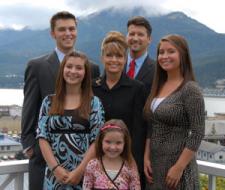
The Palin family asked to be left to deal with this privately, an understandable impulse for any family. But this isn’t just any family at the present. The moment Sen. John McCain announced Gov. Palin as his running mate, the entire Palin family became a public issue. This was amplified by the fact that the entire Palin family (except for the oldest son, Track, soon headed for deployment in Iraq) stood there before the public.
One central feature of the public introduction to the Palins was the presence of Trig, the 4-month-old baby boy who is the couple’s fifth child. Trig was diagnosed with Down syndrome prior to his birth, and the Palins translated their pro-life beliefs into a beautiful portrait of human dignity. As the couple said, they never even considered aborting the baby, but considered him a gift from God.
Now there is another gift — this time in the form of a pregnant daughter and a child conceived outside of marriage. The Palins spoke of their pride in the fact that their daughter would keep her baby and marry the father. Once again, the Palin family chooses life over death, birth over abortion, when aborting the baby would be justified by many and considered the easy way out of an embarrassing situation. Yes, that baby is a gift, as is every single living human being, born and unborn.
But the entire nation felt the awkwardness of the situation, and even part of the embarrassment. Yes, as Steve Schmidt said, “Life happens,” but not always like this. And Mark Salter is certainly correct in describing the situation as “an American family.” Still, this is not the script many families would choose — especially evangelical families who had been most encouraged by Gov. Palin’s choice as Sen. McCain’s running mate.
And, as Gov. Palin is scrutinized far and wide following this announcement, Mohler raises a concern that many of us have:
A more interesting angle on this story has to do with the question of motherhood. In this case it is the Governor as mother that is the issue, rather than the daughter. As Jodi Kantor and Rachel L. Swarns of The New York Times frame the issue:
When Gov. Sarah Palin of Alaska was introduced as a vice-presidential pick, she was presented as a magnet for female voters, the epitome of everymom appeal.
But since then, as mothers across the country supervise the season’s final water fights and pack book bags, some have voiced the kind of doubts that few male pundits have dared raise on television. With five children, including an infant with Down syndrome and, as the country learned Monday, a pregnant 17-year-old, Ms. Palin has set off a fierce argument among women about whether there are enough hours in the day for her to take on the vice presidency, and whether she is right to try.
It’s the Mommy Wars: Special Campaign Edition. But this time the battle lines are drawn inside out, with social conservatives, usually staunch advocates for stay-at-home motherhood, mostly defending her, while some others, including plenty of working mothers, worry that she is taking on too much.
I was asked about this on Friday in an interview with Stephanie Simon of The Wall Street Journal. As that paper reported:
So Ms. Palin’s decision to accept the nomination for vice president just four months after the birth of her disabled son gave pause to a few conservatives. But just for a moment.
“If I were her pastor, I’d be very concerned for her and her family,” Mr. Mohler said. “But it looks as though she’s found a way to integrate it all in a way that works.”
Well, I would be even more concerned now. Do I believe that a woman can serve well in the office of Vice President of the United States? Yes. As a matter of fact, I believe that a woman could serve well as President — and one day will. Portraits of significant men of history hang on the walls of my library –but so do portraits of Queen Elizabeth I of England and former British Prime Minister Margaret Thatcher.
The New Testament clearly speaks to the complementary roles of men and women in the home and in the church, but not in roles of public responsibility. I believe that women as CEOs in the business world and as officials in government are no affront to Scripture. Then again, that presupposes that women — and men — have first fulfilled their responsibilities within the little commonwealth of the family.
Mohler encourages us to think hard about this situation. It is definitely a knotty issue, but one we should all think about and address in our own families.
OK, I’m kind of wearing out the Sarah Palin posts today, but this article in the Wall Street Journal gives a good summary of her political style while she’s been governor in Alaska:
When she ran for governor as a Republican outsider in 2006, she took on not only a sitting governor from her own party but Alaska’s Republican establishment — vowing to clean up a political system that had been rocked by an FBI corruption investigation.
After winning handily, her popularity in Alaska has soared as high as 83% as she has gone on to sack political appointees with close ties to industry lobbyists, shelved pork projects by fellow Republicans and even jumpstarted a campaign by her lieutenant governor, Sean Parnell, to unseat veteran Rep. Don Young of Alaska in the Republican primary held this past Tuesday. The winner has yet to be declared in that contest, as Mr. Young currently leads by less than 200 votes and a recount seems likely.
Gov. Palin has shown similar fearlessness in going after Big Oil, whose money has long dominated the state. She appears, for example, to have forced Alaska’s dominant oil producers, ConocoPhillips and BP PLC, to finally get serious about a natural-gas pipeline — without making any tax or royalty concessions.
“People see her as the symbol of purity in an atmosphere of corruption,” says Anchorage pollster Marc Hellenthal. “She’s more like Saint Sarah.”
We will hear much in the coming days and weeks about Sarah Palin. In her own words, she considered herself “an extreme longshot” to be chosen as John McCain’s pick for vice president. She is decidedly conservative and a strong family person.
After she had her fifth child this past April and the child was diagnosed as a Down syndrome child, this is what she said about how she and her husband felt about it:
“We’ve both been very vocal about being pro-life,” Governor Palin said. “We understand that every innocent life has wonderful potential.”
“I’m looking at him right now, and I see perfection,” Palin told the Associated Press. “Yeah, he has an extra chromosome. I keep thinking, in our world, what is normal and what is perfect?”
Fox News has just reported that Sarah Palin, 44, the governor of Alaska, will be John McCain’s choice as vice president. This according to Fox News as confirmed by senior McCain sources.


 Rockstanding
You must be logged in to post a comment.