Is Joe Biden saying what he means on abortion?

Recently, on “Meet The Press,” Joe Biden said that, as a Roman Catholic, he’s “prepared to accept the teachings of the church” and that “I’m prepared as a matter of faith to say that life begins at the moment of conception.”  Yet he also says he is unwilling to impose his religion on anyone.

Gregory Koukl, at Stand to Reason, has some questions for Biden:

First question:  What, specifically, is Biden’s religiously based conviction on abortion?  Since he said in the interview that he was “prepared to accept the teachings of his church”—and he specifically confirmed his belief that human life begins at conception—then I take it he thinks abortion ends the life of an innocent human being and is therefore an act of homicide.  If not, why oppose it?

Second question:  Does Joe Biden believe that his belief is true?  Does he hold that his conviction is correct, that as a matter of fact human life actually does begin at conception and that abortion really does snuff out the life of a defenseless human person?

Koukl, who admits that his second question is really a trick question, but says he does that to bring up an important point about what passes for political discussion these days:

The reason for this question is tactical.  I’m taking away the weasel-room that this way of talking affords to duplicitous politicians. The query sets up a logical dilemma to show that the modified pro-choice view is simply political double-talk.

If Biden denies his beliefs are true, then I have no idea what he means when he says he believes anything, whether religiously motivated or otherwise.  If he doesn’t believe his beliefs are true, then what is the difference between believe and make-believe, between fantasy and reality?

But if Biden actually believes abortion truly takes the life of an innocent human being before birth in a way that is not morally distinct from killing a newborn immediately after birth, why would he not vote against such a thing?  Would it make any sense to say that as a matter of religious conviction I believe that all men are endowed with inalienable rights, but I could never impose such a personal belief on slave owners?

Here is Biden during his “Meet The Press” interview:
Ten ways Sarah Palin changes the race

Jennifer Rubin at RealClear Politics details 10 ways Sarah Palin has shaken up the race for president since her introduction as John McCain’s running mate. Rubin notes:

Palin has taken the GOP faithful by storm, captured the attention of the largest audience ever to watch a VP acceptance speech, and potentially created an entirely new presidential race. If the Obama camp seems flummoxed and floundering, alternating between horrid insults and praise for the new Republican VP nominee, it is easy to see why: she has completely shaken up the race.

Only a few days after her landmark speech, we can spot at least ten ways in which she may have altered the political landscape.

Olbermann, Matthews out at MSNBC

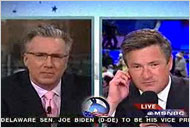
MSNBC anchor Keith Olbermann (left, seen with colleague Joe Scarborough) has been removed as co-anchor for political coverage along with Chris Matthews.

MSNBC, after enduring a public soap opera last week involving celebrity men-children Keith Olbermann and Chris Matthews, has decided to replace them as co-anchors of political night coverage, the Associated Press reports:

The change reflects tensions between the freewheeling, opinionated MSNBC and the impartial newsgatherers at NBC News. Throughout the primaries and summer, MSNBC argued that Olbermann and Matthews could serve as dispassionate anchors on political news nights and that viewers would accept them in that role, but things fell apart during the conventions.

Of course, they’ll still be around as commentators, so they won’t have to continue their weak act of pretending to be objective and unbiased. Is that harsh? Consider this from the same story:

Perhaps most embarrassing, Joe Scarborough was discussing positive developments in John McCain’s campaign at one point when Olbermann was heard on an offstage microphone saying: “Jesus, Joe, why don’t you get a shovel?”

Scarborough, a former Republican congressman and host of MSNBC’s “Morning Joe,” got in another nasty on-air exchange with MSNBC reporter David Shuster, and Matthews snapped at Olbermann on-air when it appeared Olbermann was criticizing him for talking too much.

Sarah Palin owns those words

The National Review’s John O’Sullivan, who wrote speeches for Margaret Thatcher, gives great insight into the complaints from those who belittle Sarah Palin’s speech at the Republican National Convention was little more than reading from the teleprompter:

Speakers have to make speeches their own. They have to feel the sentiments and know the facts. After all, if they get something wrong, it will be quoted against them for years — these days on YouTube.

Even then the most sincere speaker may lack the skills to put across a good speech well. Matt Scully is a superb speechwriter, but his best work was sometimes awkwardly delivered.

Not this time.

I devised a small test while watching.

Matt has a slightly aggressive sense of mischief. How would Mrs. Palin deliver his mischievous thrusts? So whenever I heard a hint of Matt’s mischief in the words, I would check out the Governor’s expression.

Invariably there was a glint of mischief in her eyes.

Matt, I think this is the beginning of a beautiful friendship.

College survival tips

From Justin Taylor at Between Two Worlds:

John Mark Reynolds has a helpful column here offering 10 tips for college students getting ready for Fall.

What follows is the barebones outline, but if the topic is of interest, you’ll want to read the whole thing.

1. Ignore advice to “remake” yourself the first day you get to college.

2. Do something each week that puts you in contact with people older and younger than your peer group.

3. If you have a decent relationship with your parents keep it up.

4. If you are going to college, then go. You are in college to learn. In America, education often includes getting a job skill, but should also be about becoming a good, civilized citizen.

5. Find a faculty mentor during your first year.

6. Take classes that are hard from full-time professors that love to teach.

7. Secretaries and support staff are overworked, underpaid, and very powerful. You should be good to them out of virtue, but you must do it to thrive. The friendship you make with the department secretary now will pay dividends over the years. (One way I judge the character of a student is by how they treat the support staff.)

8. Books are not yet antiques. Go to the library. Talk to librarians. They are faculty members that are often under-utilized.

9. Don’t be too quick to pick a major, but try to do so by the end of the first year.

10. Live like an adult in college which includes moderating your passions.

What do you mean by ‘got saved’?

John Piper answers the question: Do I need to understand the nuances of how I got saved?

Well, it depends on what you mean by nuances. If you mean the distinction between being judged according to works and being judged on the basis of works, that’s a huge and significant difference.

That’s because the Bible is so clear—and our own consciences bear witness—that if our acceptance with God is grounded finally in our performances of the law, in doing good deeds, then I’m not going to have any security here and I’m not going to be accepted with God in the end. God demands a perfect righteousness, which is what Christ provides for us in his own obedience; and he demands that we be forgiven for our sins, which is what Jesus’ blood provides for us on the cross.

Click below for Piper’s whole answer.

How important is it to understand the details of how God saved me?

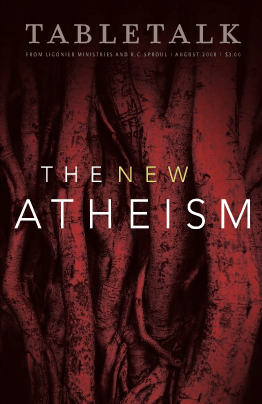
New issue of Tabletalk now online

“True faith involves trusting the evidence that God has amply provided in and through His Word.”

The folks at Ligonier Ministries have graciously provided the August issue of their devotional online. Click on the image below to see it.

Ligonier Ministries is now offering the August issue of its Tabletalk devotional online

US Weekly blows it and then condescends

Readers have been blasting US Weekly for their “Babies, Lies and Scandal” Sarah Palin cover. Now, when people are writing to cancel their subscriptions, they are advising readers to be reasonable and “take the time to read the story before deciding to cancel.” In my business, that’s a weak apology. If they’re saying the headline doesn’t match the story, then that’s poor work by some editor and, regardless of the story, someone needs to apologize in a very public way.

The Presidents on PBS

Since we are in the election season, I just thought I’d pass along this: You can download, for free, PBS’ American Experience: The Presidents series from iTunesU. There you will find biographies of presidents Roosevelt (FDR), Truman, Johnson, Nixon, Carter and Reagan.

Today’s new eugenicists

Of the blogs I look at regularly, one that I have often visited and am often enlightened by is Wesley J. Smith’s Secondhand Smoke. Smith says his blog “considers issues involving assisted suicide/euthanasia, bioethics, human cloning, biotechnology, and the dangers of animal rights/liberation.” There are a lot of issues he deals with that are not isolated to the world of science but rather intersect with our lives every day.

For example, the whole furor around the nomination of Alaska Gov. Sarah Palin to be vice president by John McCain has brought to the forefront the issue of Down syndrome children and the divergent views about whether people should knowingly give birth to children with this condition. I have already given my views on the subject on this blog, but there are certainly those who disagree as seen just by comments posted here.

Physician and writer Rahul K. Parikh gives what by all appearances is a concerned response to Palin’s decision in an article in Salon:

By knowingly giving birth to a Down syndrome child, Palin represents a minority of women. A 2002 study found that about 90 percent of pregnancies in the United States where the fetus was diagnosed with Down syndrome were terminated.

Rabid anti-choice activists have called that trend eugenics via medicine. But try telling that to a mother who is told early on in her pregnancy that she will be raising a child who will have a host of medical and developmental problems, requiring intense medical and social attention for the rest of his or her life. It can be tragic and nearly impossible news to bear.

Kids with special needs require and deserve intense therapies and attention to their needs. That’s likely something Palin, with her political and social stature, can afford both financially and emotionally. But that may not be the case for other families, who have to struggle to balance work with home and family. They simply may not be up to the challenge of raising a child with Down syndrome. Sadly, kids with developmental problems like Down syndrome are at a higher risk for being abused by parents and other caregivers.

And if you can’t provide that, what should you do? Well Parikh doesn’t say, but by labeling Palin “anti-choice” gives the reader a pretty good idea. Yes, let the mother choose, but not the child. Of course it seems compassionate to consider the poor mother and family of a Down syndrome child and what they will have to face. Smith addresses such “compassion” in an article “Waging War on the Weak” that he wrote for the Discovery Institute:

(The “new eugenics”) perceives some lives as having greater value than others, and which in some cases sees death—including active euthanasia and assisted suicide—as an appropriate “solution” to the problems of human suffering. The original eugenics movement expressed this relativistic view of human life through hate-filled rhetoric; for example, eugenicists described disabled babies like Miracle in terms that today would be considered hate speech. Thus, as recounted in Edwin Blacks’ splendid history of eugenics, War Against the Weak , Margaret Sanger took “the extreme eugenic view that human ‘weeds’ should be ‘exterminated.’”

Today’s new eugenicists are not that crass, of course. Indeed, rather than screaming hate and pejoratives from the rooftops, they instead ooze unctuous compassion as they croon about a “quality of life” ethic and preventing the weak—against whom they are secretly at war—from “suffering.” But behind the politically correct language, and indeed, hiding within the hearts of those who perceive themselves as profoundly caring, lurks the same old disdain of the helpless who offend because they remind us of our own imperfections and mortality.

This kind of thinking is subtle but deadly. Smith does a great job of exposing this kind of thinking in his blog. Are these issues important or is this just a big fuss over little things? No, not when you consider that health care is a major issue in this election.