Does Revelation scare you? Does Jesus?

Then I saw heaven opened, and behold, a white horse! The one sitting on it is called Faithful and True, and in righteousness he judges and makes war. His eyes are like a flame of fire, and on his head are many diadems, and he has a name written that no one knows but himself. He is clothed in a robe dipped in blood, and the name by which he is called is  The Word of God. And the armies of heaven, arrayed in fine linen, white and pure, were following him on white horses. From his mouth comes a sharp sword with which to strike down the nations, and he will rule them with a rod of iron. He will tread the winepress of the fury of the wrath of God the Almighty. On his robe and on his thigh he has a name written, King of kings and Lord of lords.

— Revelation 19:11-16

Could you please assure me that the Jesus that I meet in Revelation matches with the Jesus in the Gospels? He seems harsher.

That was the question addressed to Pastor John Piper recently. After all, the passage above is quite different than Luke 19, where we see Jesus coming into Jerusalem on a donkey while people throw palm branches and shout Hosanna. So, the question is important, especially as we are in this important season when we think about Jesus’ life and what it means. Watch below as Pastor John, in effect, explains that Jesus is both to be loved and feared, depending on where your heart is.

piperqa

God, marriage and family

A recommendation from Mark Driscoll:

About the book, from Crossway Books:

We live in a time of crisis regarding marriage and the family, and only by a return to the biblical foundation can these institutions be rebuilt. To provide an integrated, biblical treatment of the full range of marriage and family issues, the authors of God, Marriage, and Family examine what Scripture says about God’s purposes for humans in their marriage and family interactions. Their examination covers the special issues stemming from marriage, childrearing, singleness, homosexuality, and divorce and remarriage. With study questions and points for further discussion, this book is a comprehensive yet concise resource for anyone seeking a Scriptural response to our culture’s complex challenges to God’s intentions for marriage and family.

To get Andreas Kostenberger’s “God, Marriage and Family: Rebuilding the Biblical Foundation,” go here.

ESV Online Study Bible to be sold by itself

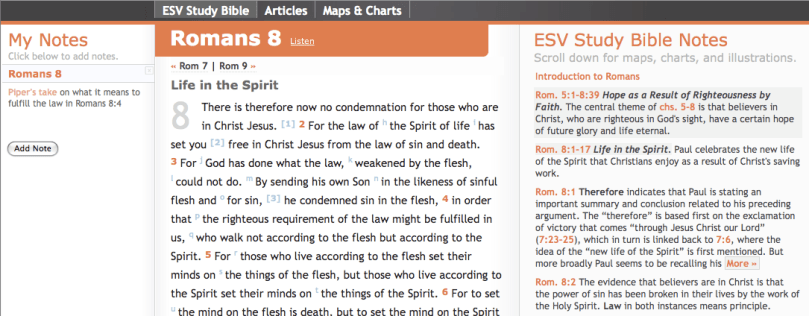
As a followup to yesterday’s post, Crossway Books has announced that it will be selling the ESV Online Study Bible as a standalone for $19.99. As you may recall, you can access the ESV Online Study Bible this month free of charge. It is also offered for free for those who purchased an ESV Study Bible in print. This standalone option is good way for those who would want to try it out without necessarily purchasing the print study Bible.

Why consider this? Here is what the Crossway Web site says:

ESV Online Study Bible provides additional unique features, including the ability to create personal online notes; to search and follow interactive links between notes, maps, articles, charts, timelines, illustrations, and cross-references; to listen to audio recordings of the ESV; and to access additional resources not available in the print edition.

How the ESV Online Study Bible helps daily devotions

ESV Study BibleI use the ESV daily reading plan as I do my devotions. In many of the versions you get from Crossway these days, those plans are often printed right in the Bible, so it’s a great way to keep track of where you should should be for that day. Lately, as I’ve done more Bible study online, I’ve come to appreciate the tools the ESV and other groups have to aid in devotions.

As you well may know, this month the ESV is offering a free tryout of its ESV Online Study Bible. I can’t tell you how much this is a great way to study the Bible. One advantage of using the study Bible online over the print version is having the audio Bible available. I love this feature. It is good to have the capable voice of David Cochran Heath when you are going through Old Testament passages where unfamiliar names can often cause you to stumble.

Another great way the online study Bible aids devotions — and especially daily reading as you go through the Bible — is its ability to group diverse passages on one Web page. So, for instance, today I was able to take the four passages I was reading in my daily reading plan — Psalm 83; Exodus 27:20-28:43; Nehemiah 9; 1 Corinthians 1:18-31 — and have them (and all the accompanying notes!) on the same page. The key to doing this is to make sure you put the semicolon between passages to separate them. This is a great way to go through them without having to flip from section to section. Plus you can also listen to each of them this way to.

God’s word is a treasure, and I am so thankful that I can have it and read it and listen to it and memorize it and share it with others. There are so many ways you can have it, especially in our culture, that there should be no excuse to not read it.

Don’t be dumb about praise, let it out

Psalm 34:1

I will bless the Lord at all times; his praise shall continually be in my mouth.

Here is how Charles Spurgeon comments on this verse in the collection The Treasury of David:

“His praise shall continually be in my mouth,” not in my heart merely, but in my mouth too. Our thankfulness is not to be a dumb thing; it should be one of the daughters of music. Our tongue is our glory, and it ought to reveal the glory of God. What a blessed mouthful is God’s praise! How sweet, how purifying, how perfuming! If men’s mouths were always thus filled, there would be no repining against God, or slander of neighbours. If we continually rolled this dainty morsel under our tongue, the bitterness of daily affliction would be swallowed up in joy. God deserves blessing with the heart, and extolling with the mouth – good thoughts in the closet, and good words in the world. (Volume 1, pp. 122-123)

HT: Fighter Verses

God speaks through your iPod: Carry the ESV Study Bible in your pocket

Confession: I own an iPod and am happy with it. I can listen to songs, sermons (yes, I like sermons) and podcasts. My son has an iPod Classic and my wife and daughter also have iPods. We have a lot of stuff.

But, since I love God’s Word and have absolutely loved the ESV Study Bible we got last month, I am thrilled with the idea of having the entire ESV Study Bible available right there on an iPod (or iPod Touch). Olive Tree Bible Software offers this for Bible lovers who are also iPod owners. This blows my mind. And the ESV also offers this for those who want to view it through their iPhone, iPod Touch or PDA. Either way you can’t go wrong. From what I’ve read, Olive Tree’s latest software version adds split screen viewing, which is wonderful with the ESV Study Bible when looking at accompanying notes. See the video below, which shows how it works:


The second coming of Christ: good news and bad news

Since this is the season where we celebrate the first coming of Christ and his sacrificial death for sinners, we should also think about his second coming when it will be much different. You can reasonably say it will be both good news and bad news for everyone who has ever lived.

It will be good news for those who have trusted him with their life and have accepted his death as payment for their sins. We should eagerly look forward to it, for this world is not our final destination and as children of God we long to be with the one we belong to for eternity.

But, as John Piper points out, we should not be quick to believe rumors about his second coming:

Jesus is going to return to earth. I pray very soon. He said that before he comes—periodically throughout history—some people would think he has already come.

If they say to you, “Look, he is in the wilderness,” do not go out. If they say, “Look, he is in the inner rooms,” do not believe it. (Matthew 24:26)

Then he gave two reasons not to believe such rumors.

The first is that his coming will be globally unmistakable. It will be as publicly unmistakable as lightning.

For as the lightning comes from the east and shines as far as the west, so will be the coming of the Son of Man. (Matthew 24:27)

And that brings us to the bad news. For those who don’t believe, it will be a terrible time of realization that all hope is gone:

The second reason for not believing these rumors is that he will come like vultures come on a corpse.

Wherever the corpse is, there the vultures will gather. (Matthew 24:28)

When the world is as ready for judgment as road kill is for the vultures, then he will come in great wrath.

The Lord Jesus is revealed from heaven with his mighty angels in flaming fire, inflicting vengeance on those who do not know God and on those who do not obey the gospel of our Lord Jesus. (2 Thessalonians 1:7-8)

This will not be private, secret, or pleasant for unbelievers. He will come “on the clouds of heaven with power and great glory” (Matthew 24:30). And the judgment will be like vultures sweeping in on the corpse of human rebellion.

Meditation: Why it’s not about clearing your mind

When you talk about meditation with someone you can often be talking about different things entirely. The other day in the paper there was an article about yoga which mentioned the benefits of a healthy mind and body.

As a Christian, I want to have a healthy mind and body. I want to bring glory to God through doing my best to be healthy because our bodies are temples of the Holy Spirit. But for Christians to practice yoga is a misunderstanding about what the Bible means by meditation and the way the world sees meditation. They are two different things entirely.

In the article, it is briefly explained that yoga was developed as a way of preparing the body for meditation. And while it goes on to say that the Western practice of yoga is a set of postures, there is more to it than that. Even the instructor, while trying to deflect concerns, hints at the real reason behind yoga:

“Some are skeptical of yoga at first — some think it’s a religion or something, but are surprised to find the movements and breathing exercises help them.”
Frazier said she hopes her students derive some of the same benefits from practicing yoga she has.
“Yoga brought me a new compassion for my self,” she said. “Yoga is embracing what is, an acceptance of reality.”

The idea of embracing yourself and “acceptance of reality” is not harmless exercise talk but in fact echoing tenets of Hinduism and Buddhism. That, and the fact that yoga brings “compassion for my self” should sound alarms for any Christian. Is that what yoga and meditation brings? Compassion for ourselves? When I am alone with my thoughts, rather, this is what confronts me: I am not good. Consider what the Bible says about how we should meditate:

  • This Book of the Law shall not depart from your mouth, but you shall meditate on it day and night, so that you may be careful to do according to all that is written in it. For then you will make your way prosperous, and then you will have good success. (Joshua 1:8)
  • but his delight is in the law of the Lord, and on his law hemeditates day and night. (Psalm 1:2)
  • I will ponder all your work, and meditate on your mighty deeds. (Psalm 77:12)
  • I will meditate on your precepts and fix my eyes on your ways. (Psalm 119:15)
  • I remember the days of old; I meditate on all that you have done; I ponder the work of your hands. (Psalm 143:5)

Notice in those verses what is lacking? Yes, any reference to self or self worth. Instead, we are to focus on God’s greatness and his majesty. Why? Because only He can save us from our terrible conditions. “Clearing” your minds won’t make it go away, it’ll just mask the problem.

While yoga may not be advertised as a religion class, by going through the routine you get the same effect. Even in the “non-religious” Western world. Christians should beware.

What discipline looks like in the life of Jerry Bridges

Today at the weekly men’s group that I attend (not as regularly as I would like, but as much as I can), we talked about praciticing the presence of God in our lives. Particularly, we talked about cultivating spiritual discipline in our lives — things like Bible study, prayer, fasting, solitude.

With that in mind, I was pleased to come across this interview that C.J. Mahaney, who leads Sovereign Grace Ministries, did with Jerry Bridges. If you are not familiar with Jerry Bridges, he has served with The Navigators for 50 years and has authored many helpful books including The Pursuit of Holiness, The Discipline of Grace and Respectable Sins: Confronting the Sins We Tolerate. Mahaney did a short Q&A with Bridges, asking him about how he did his devotions and what books he read or had influenced him.

In all, it was a good glimpse into the life of a man who has worked hard to develop discipline into his life. We often shy away from discipline, but, as it is good to be reminded of what it says in Hebrews 12:11: For the moment all discipline seems painful rather than pleasant, but later it yields o the peaceful fruit of righteousness to those who have been trained by it.

The ESV Online Study Bible — for free

Crossway Books has announced today that, for a limited time, the ESV Online Study Bible will be available to everyone for free. This means that the complete ESV Study Bible with all its notes, charts, articles and maps can be accessed for free.

I have had access to it for about a week now since my ESV Study Bible arrived and I can say that it is a tremendous research tool for indepth study of the scriptures and extremely helpful in understanding the scriptures and answering questions. An added benefit of the ESV Online Study Bible is the ability to take notes and have them available anywhere you have Internet access.

Thanks so so much to the folks at Crossway Books for making this available. I would strongly encourage all to take advantage of this offer and check out this resource.

The ESV Online Study Bible is now available for free for a limited time.