If we call ourselves Christians, then we are to take to heart the Bible’s instructions to bear one another’s burdens. And, in this day and age, there are many things we are burdened with whether it’s finances, relationships, family, health or career. At the Desiring God blog, pastor John Piper gives great counsel about what to say to those who are depressed, angry, doubting or skeptical:
1. Don’t be offended.
First, resist the temptation to be offended. Don’t pout or take your ball and go home. That’s what you may feel like. They wanted to talk, and here they are throwing my suggestions back in my face with a dismissive attitude. Don’t leave. Not yet. “Love suffers long” (1 Corinthians 13:4, NKJV).
2. Listen.
Second, listen to their responses. Part of your power is not only what you say, but how they feel about the way you listen. If your truth produces empathetic ears, it will feel more compelling. This listening will be a witness. In 2 Timothy 2:24-26, Paul describes the kind of engagement that may set people free from sin and error. One feature is “patiently enduring evil.”
3. End with hope.
Third, when you have spoken all the experiential counsel you can think of, and they seem to have demeaned it all, don’t let them have the last word of despair. You leave the last word of hope.
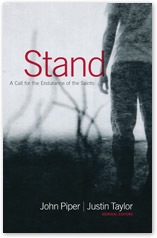
"Stand: A Call For the Endurance of the Saints" is a collection of messages from the 2007 Desiring God National Conference.
As they have done in past years, the folks at Desiring God have collected the talks given at the national conference and put them in book form. The 2007 conference, Stand: A Call For the Endurance of the Faith, is now being offered as a book.
Here is what it says about the book from the DG site:
Many people seek to better their lives by leaving, changing, swapping, or modifying their commitments. But God’s Word holds up a beautiful value that, while difficult, leads to deep satisfaction and great reward: endurance. Such long, steady, hold-the-course perseverance is especially needed within our vacillating generation.
This thoughtful series, taken from the Desiring God 2007 National Conference, not only elevates the virtue of godly endurance but bears witness to its power in the Christian life through the exhortations of John Piper, John MacArthur, Jerry Bridges, Randy Alcorn and Helen Roseveare. Each contributor represents a different kind of endurance: from MacArthur’s longtime, faithful shepherding of a church to Alcorn’s radical obedience in the culture wars, from Bridges’ unswerving patience through suffering to Roseveare’s courageous constancy on the war-torn mission field.
Stand will awaken and solidify rugged, Christ-exalting endurance in people who are weary in their faith journey or who simply long to remain firm to the end. And for everyone who dreams of a Christian culture-shift from brief trial runs to lifelong commitments, this latest offering is a watershed that will serve to seal that vision in people’s minds and hearts.
You can order the book here or, if you want, you can go here to listen, view or download the messages. The topics include:
Certainties that Drive Enduring Ministry, Part 1 (John MacArthur)
A Conversation with John Piper and John MacArthur
Four Essentials to Finishing Well (Jerry Bridges)
Certainties That Drive Enduring Ministry, Part 2 (John MacArthur)
Today’s Decisions Determine Who You’ll Be Tomorrow (Randy Alcorn)
Speaker Panel Q&A (Various)
A Call for the Perseverance of the Saints (Helen Roseveare)
There are times when I wonder what exactly the Bible means when it tells us not to be anxious. I mean, where does being careful or prudent turn into being anxious?
John Piper, after almost being run over while walking across the street one day, wondered about the same thing and wrote a great article on it. Here is his conclusion:
“Do not be anxious for your life” (Luke 12:22) does not mean: Walk on red (at least not always). It means: 1) don’t fantasize nervously about getting pasted in the crosswalk; 2) believe that if you do get pasted, God is still in control and you will be with him and he will take care of your family; 3) if a carton of gold is across the street and the kingdom of God is on this side, don’t cross even on green; 4) if a red light tries to stop you from giving a big missions offering this week, walk on red! (Financial precautions are almost always too conservative.) After blue, God’s favorite color is green. Consider the lilies.
John Piper's latest book is "Spectacular Sins and Their Global Purpose in the Glory of Christ"
PIPER’S NEW BOOK: You can now pre-order John Piper’s latest book, “Spectacular Sins and Their Global Purpose in the Glory of Christ” from the Desiring God Web site for only $5. The 144-page book comes from a series of sermons Piper preached in 2007 at Bethlehem Baptist Church in Minneapolis. From the site:
“What does the fall of Satan reveal about Christ’s glory? How does Adam’s sin magnify our Lord? How does the glory of Jesus shine through in Judas’ betrayal? How is the honor of Jesus at stake in the sin and evil, the suffering and the calamities and the wickedness, which abound in the world today? In this book John Piper seeks to provide a biblical perspective on God’s sovereign and righteous governance over even the sinful acts of men. History’s greatest sins do not thwart God’s purposes to save his people and glorify his Son; they fulfill them. And being grounded in this hope is the key to “Christ-exalting strength in calamity and Christ-exalting courage in conflict.”
RESPONDING TO THE POET: Abraham Piper, on the DG site, shares an encounter a missionary doctor had with a Muslim man recently at a wedding. It is a great example of how the Holy Spirit gives us the right words at the right time. It reminds me of the sermon today at church on Acts 4 and how Peter spoke before the religious leaders.
PRAY FOR CHINA: Again, from the DG site, we are reminded to pray for China during the Olympic Games and the Paralympic Games in the coming weeks. A good resource, mentioned there, is the China Games and Beyond 40-day prayer journal.
STOP TINKERING WITH YOUR SOUL: From the wonderful Of First Importance site, great words today from A.W. Tozer:
“While we are looking at God we do not see ourselves – blessed riddance. The man who has struggled to purify himself and has had nothing but repeated failures will experience real relief when he stops tinkering with his soul and looks away to the perfect One. While he looks at Christ, the very thing he has so long been trying to do will be getting done within him.”
– A.W. Tozer, The Pursuit of God (Camp Hill, PA: Christian Publications, Inc., 1993), 85.
Desiring God is now offering what it terms the “essential Piper trilogy” of Desiring God, The Pleasures of God and Future Grace for $22.50. What are these books about? Glad you asked.
DESIRING GOD: MEDITATIONS OF A CHRISTIAN HEDONIST
The message of Desiring God is that God is most glorified in us when we
are most satisfied in him. In this book, Piper calls this worldview
“Christian Hedonism” and explains why pursuing maximum joy is essential
to glorifying God. He discusses the implications of this for
conversion, worship, love, Scripture, prayer, money, marriage,
missions, and suffering.
THE PLEASURES OF GOD: MEDITATIONS ON GOD’S DELIGHT IN BEING GOD
One way to see the glory of God is to meditate upon the object of his
delight. In this reissued version with a new cover design, John Piper
unfolds for us a vision of God through the lens of his happiness. What
most delights the happiest Being in the universe? God’s gladness in
being God. If God’s excellencies can be admired in his pleasures, and
if we tend to become like what we admire and enjoy, then focusing on
these pleasures can help us to be gradually conformed to his likeness.
In other words, we will be most satisfied in God when we know why God
is most satisfied in God. This version includes the same content as the
revised and expanded edition published in 2000.
FUTURE GRACE: THE PURIFYING POWER OF LIVING BY FAITH IN FUTURE GRACE
What is future grace? It is all that God promises to be for us from
this second on. Saving faith means being confident and satisfied in
this ever- arriving future grace. This is why saving faith is also
sanctifying faith. The power of sin’s promise is broken by the power of
a superior satisfaction; namely, faith in future grace. Gratitude for
past grace was never meant to empower future obedience. Tomorrow’s
crisis demands tomorrow’s grace. And faith that future grace will be
there is the victory that overcomes the world. Future Grace contains 31
chapters – one for each day of the month – including practical chapters
on how faith in future grace defeats anxiety, pride, shame, lust,
despondency and more.
AMAZING GRACE AT AMAZON: Amazon.com has put the 2007 theatrical release of “Amazing Grace” on sale. It was a great movie and a definitely worth checking out.
WHAT BIBLICAL MANLINESS LOOKS LIKE: Phil Johnson over at Pyromaniacs lays it on the line when it comes to being a man:
Biblical manliness is about authentic character. It’s not about bravado, and it’s not about boyishness. Going out into the woods with a bunch of other men, putting on war paint, making animal noises, telling scary stories around a campfire, and then working up a good cry might be good, visceral fun and all, but that has nothing to do with the biblical idea of manliness.
WORSHIPING SUMMER: John Piper offers some good counsel about how not to let the pleasures of summer turn you from worshiping God instead:
Don’t let summer make your soul shrivel. God made summer as a foretaste of heaven, not a substitute. If the mailman brings you a love letter from your fiancé, don’t fall in love with the mailman. That’s what summer is: God’s messenger with a sun-soaked, tree-green, flower-blooming, lake-glistening letter of love to show us what he is planning for us in the age to come—“things which eye has not seen and ear has not heard, and which have not entered into the heart of man, God has prepared for those who love him” (1 Corinthians 2:9). Don’t fall in love with the video preview, and find yourself unable to love the coming reality.
A lot about what it means to have a tender heart for God. Consider David in Psalm 51:
Have mercy on me, O God, according to your steadfast love; according to your abundant mercy blot out my transgressions. Wash me thoroughly from my iniquity, and cleanse me from my sin! For I know my transgressions, and my sin is ever before me. Against you, you only, have I sinned and done what is evil in your sight, so that you may be justified in your words and blameless in your judgment. Behold, I was brought forth in iniquity, and in sin did my mother conceive me. Behold, you delight in truth in the inward being, and you teach me wisdom in the secret heart. Purge me with hyssop, and I shall be clean; wash me, and I shall be whiter than snow. Let me hear joy and gladness; let the bones that you have broken rejoice. Hide your face from my sins, and blot out all my iniquities. Create in me a clean heart, O God, and renew a right spirit within me. Cast me not away from your presence, and take not your Holy Spirit from me. Restore to me the joy of your salvation, and uphold me with a willing spirit. “Then I will teach transgressors your ways, and sinners will return to you. Deliver me from bloodguiltiness, O God, O God of my salvation, and my tongue will sing aloud of your righteousness. O Lord, open my lips, and my mouth will declare your praise. For you will not delight in sacrifice, or I would give it; you will not be pleased with a burnt offering. The sacrifices of God are a broken spirit; a broken and contrite heart, O God, you will not despise. Do good to Zion in your good pleasure; build up the walls of Jerusalem; then will you delight in right sacrifices, in burnt offerings and whole burnt offerings; then bulls will be offered on your altar.
What has led David to this lowly state of remorse? Turn back to 2 Samuel 11:2-5 to see where it started:
It happened, late one afternoon, when David arose from his couch and was walking on the roof of the king’s house, that he saw from the roof a woman bathing; and the woman was very beautiful. And David sent and inquired about the woman. And one said, “Is not this Bathsheba, the daughter of Eliam, the wife of Uriah the Hittite?” So David sent messengers and took her, and she came to him, and he lay with her. . . . Then she returned to her house. And the woman conceived, and she sent and told David, “I am pregnant.”
And not only does David do this, he compounds his sin by bring Bathsheba’s husband, Uriah, back from battle so he can sleep with his wife and thus cover up David’s sin. It doesn’t work and so David has Uriah killed in battle. It is only when the prophet Nathan confronts him that David repents.
And what is God’s response? “The Lord has taken away your sin; you shall not die.” (2 Kings 12:13). From here, John Piper picks up the story and why it matters that we should care why God answers in this way:
Dr. Martyn Lloyd-Jones, the great preacher of the 20th Century, wrote “Spiritual Depression: Its Causes and Its Cure,” a collection of 21 sermons he originally delivered at Westminster Chapel in London. “Christian people.” writes Lloyd-Jones, “too often seem to be perpetually in the doldrums and too often give this appearance of unhappiness and of lack of freedom and absence of joy. There is no question at all but that this is the main reason why large numbers of people have ceased to be interested in Christianity.”
Believing that Christian joy was one of the most potent factors in the spread of Christianity in the early centuries. Lloyd-Jones not only lays bare the causes that have robbed many Christians of spiritual vitality but also points the way to the cure that is found through the mind and spirit of Christ.
This summer, John Piper is going through the Psalms in a sermon series at Bethlethem Baptist Church in Minneapolis. Last week’s sermon, “Spiritual Depression in the Psalms,” leans on Lloyd-Jones’ work and looks at how Psalm 42 is an antidote for depression. Below is an excerpt, go here for the whole sermon.
Alex and Brett Harris, teen authors of “Do Hard Things: A Teenage Rebellion Against Low Expectations,” recently were interviewed about their book and other things on Tell Me More on NPR. Here are some things they talked about:
Can you do hard things yet still find time to relax?
How does doing hard things relate to their faith?
What five types of hard things do they say you should do?
What’s the hardest thing they’ve done lately?
What’s next for them?
Their involvement with the Mike Huckabee campaign
What motivated them to think about “doing hard things.”
Dr Martyn Lloyd-Jones (1899 – 1981) has been described as ‘a great pillar of the 20th century Evangelical Church’. Born in Wales, and educated in London, he was a brilliant student who embarked upon a short, but successful, career as a medical doctor at the famous St Bartholemew’s Hospital. However, the call of Gospel ministry was so strong that he left medicine in order to become minister of a mission hall in Port Talbot, South Wales. Eventually he was called to Westminster Chapel in London, where thousands flocked to hear his ‘full-blooded’ Gospel preaching, described by one hearer as ‘logic on fire’. With some 1600 of his sermons recorded and digitally restored, this has left a legacy which is now available for the blessing of another generation of Christians around the world – ‘Though being dead he still speaks’.
You can hear sermons from this great preacher for free! at OnePlace.com (with registration). If you own an iPod or an MP3 player, this is a great way to fill it with awesome encouragement, teaching and counsel. If you don’t you can still listen online for free.



 What is future grace? It is all that God promises to be for us from

 Rockstanding
You must be logged in to post a comment.