Dangerous living: The danger of unprotected text while driving

Because we have built our automobiles to resemble living rooms (comfy seats, radios, AC, cupholders, etc.) rather than vehicles, it is not surprising that people want to bring their phones and TVs along for the ride as well. The idea that we could make a trip of any length without being pacified by songs, movies or texting seems unthinkable to most children, as well as many adults.

But think it over: How in the world do people expect to drive competently when they are trying to send the latest text message about what they’re going to be doing in the next five minutes? Yes, cars are easier to manipulate these days then in the past, but traffic is still traffic and goodness knows it would be nice to give some attention for the sake of those around you.

With that in mind, Car and Driver has done a study as to just how texting affects a driver’s ability to react. The test was pretty straightforward: Two subjects were tested in their response to a mounted red light (meant to simulate a brake light in a lead car). They were tested driving on a straight route with no other traffic. Their results were tested based on no impairments, when legally intoxicated, while reading texts and while sending texts. The results were clear:

The results, though not surprising, were eye-opening. Intern Brown’s baseline reaction time at 35 mph of 0.45 second worsened to 0.57 while reading a text, improved to 0.52 while writing a text, and returned almost to the baseline while impaired by alcohol, at 0.46. At 70 mph, his baseline reaction was 0.39 second, while the reading (0.50), texting (0.48), and drinking (0.50) numbers were similar. But the averages don’t tell the whole story. Looking at Jordan’s slowest reaction time at 35 mph, he traveled an extra 21 feet (more than a car length) before hitting the brakes while reading and went 16 feet longer while texting. At 70 mph, a vehicle travels 103 feet every second, and Brown’s worst reaction time while reading at that speed put him about 30 feet (31 while typing) farther down the road versus 15 feet while drunk.

Alterman fared much, much worse. While reading a text and driving at 35 mph, his average baseline reaction time of 0.57 second nearly tripled, to 1.44 seconds. While texting, his response time was 1.36 seconds. These figures correspond to an extra 45 and 41 feet, respectively, before hitting the brakes. His reaction time after drinking averaged 0.64 second and, by comparison, added only seven feet. The results at 70 mph were similar: Alterman’s response time while reading a text was 0.35 second longer than his base performance of 0.56 second, and writing a text added 0.68 second to his reaction time. But his intoxicated number increased only 0.04 second over the base score, to a total of 0.60 second.

The upshot? We all know that driving while drunk is terrible. But driving while texting is way worse. How much? Consider the time it takes to break at 70 mph:

  • Unimpaired: .54 seconds to brake
  • Legally drunk: add 4 feet
  • Reading e-mail: add 36 feet
  • Sending a text: add 70 feet

I haven’t heard about any group called Mothers Against Texting Drivers yet, but the more we hear about accidents and deaths caused by texting, inattentive drivers, the likelier it may be.

Wrongful birth: Parents sue over doctor’s ‘mistake’

From Wesley J. Smith, who has moved his Secondhand Smoke blog to First Things, comes the story of an Oregon couple who are suing because a test during missed that their child had Down syndrome. Had they known, they would have aborted the child. From the story:

In the months before their daughter was born in 2007, Deborah and Ariel Levy worried the baby might have Down syndrome. They say a doctor at the Legacy Center for Maternal-Fetal Medicine assured them that a sample of tissue taken from the placenta early in the pregnancy ruled out the developmental disability, despite the results of later testing that showed the fetus might have it. But within days of the birth of their daughter, the Southwest Portland couple learned the baby did have Down syndrome. Had they known, they say, they would have terminated the pregnancy. Now they’re suing in Multnomah County Circuit Court, seeking more than $14 million to cover the costs of raising her and providing education, medical care, and speech and physical therapy for their daughter, who turned 2 this month. The suit also seeks money to cover her life-long living expenses.

In the story the parents, who declined to be interviewed, say they love their daughter as much as her older siblings. Yet they are also aware of being seen as heartless for wanting to sue because she was born instead of being terminated by abortion. There is an indication that there is something in these people’s souls that tells them what they were seeking was wrong — after all, they realize that killing the child is a heartless act, at least in the eyes of some. However, the idea that suing for a botched test, even if that test would have led to something like killing your own child, supersedes  their moral hesitancy.

Even with tests that are highly accurate, there is no guarantee that parents can definitely know whether their child will have Down syndrome or not. It is not about botched tests all the time. Sometimes you just can’t tell. But where science or medicine falls short, others can step in. Instead of covering doubt with abortions or recommending abortions, perhaps doctors should be pointing parents to places that can help them cope with life with a Down child. In the Oregonian article, a word of hope and of caution is sounded:

The Northwest Down Syndrome Association in Portland encourages doctors to send parents expecting a baby with Down syndrome to her organization, said Executive Director Angela Jarvis-Holland, because it is equipped to answer questions about what life will be like.

“Because what constitutes a good life?” Jarvis-Holland said. “I don’t think doctors can answer that in a two-minute conversation.”

Prenatal tests can’t discern the severity of Down syndrome, and it varies widely by individual. Jarvis-Holland said involved parents with the right resources can greatly improve their child’s development.

She said the ability to test for a growing array of conditions means many more women will be faced with the question of whether they want to be tested for everything from autism to an alcoholism gene (tests are in the works), and what they’ll do if the results come back positive.

“Down syndrome is really the canary in the coal mine,” Jarvis-Holland said. “It will be everybody’s question before we know it.”

Jarvis-Holland, who has a 10-year-old son with Down syndrome, worries about what she calls the “tyranny of perfection” if parents one day will be able to test for virtually every conceivable disadvantage facing their fetus.

“If you keep growing the list, where and when do we grow uncomfortable about that list?” Jarvis-Holland said. “I’m not sure where this is taking us.”

HT: Zach Nielsen

Take Five: Still cool 50 years later

Dave Brubeck, now at 89, explains in an NPR interview the thinking behind his classic jazz hit “Take Five,” which topped the charts in 1959. I enjoyed listening to Brubeck and his music in the interview, and it reminded me of what I’ve told to my children as they’ve grown up and learned to play instruments that music is a lifelong skill. What I mean is that you can learn to play or sing and it is something you will have your entire life. Brubeck, talking about playing as much as he can and looking forward to his next gig, is an example of that. On the other hand, Brett Favre, at age 40, is nearing the end of his athletic career.

Don’t let your mind get flabby. Give it some exercise.

I do a lot of pointing at this blog. I know it. There is a lot of garbage out there and you don’t have to look hard to find it. Conversely, there are many good things that people are writing and saying that I feel are worthwhile and worth not only reading but passing along. That said, I want to remember for myself and point out to you, the reader, that reading worthwhile things (or some not so worthwhile) isn’t a substitute for using the brain God gave you.

Kevin DeYoung, blogging at DeYoung, Restless and Reformed, follows up a great post by John Piper with some great thoughts concerning hero worship and emulation that happens among Christians. Here is a part I found hit home with me, maybe you too:

Learning from a great teacher does not eliminate the need to think for ourselves. We need to make sure we are really convinced of the things we espouse, that we don’t simply believe what the men and women we respect believe. Don’t make the “celebrities” into a new magisterium. Respect their wisdom and experience, but always go back to the Scriptures. And don’t expect them to settle all your issues, because they haven’t faced all your issues. And besides, the men we look up to don’t always agree with each other on how to tackle certain issues.

This is something to really think through. We can appreciate great people we know, but ultimately remember that it’s God who is great and him we need to know best.

Great technology at your fingertips

ESV Study BibleIn these heady days of new technology, it is easy to get caught up in the latest great must-have new gadget. As Exhibit A I would present myself. Ignoring the gentle jabs lobbed my way, I tote my MacBook to men’s Bible study on Friday mornings so I can view the ESV Study Bible online and quickly jump to passages. I love it.
That said, I can appreciate this post by Tim Challies talking about how he fell out of love with his Kindle. It did it’s job, but couldn’t quite match the technology it was trying to replace:

Something changed between then and now—I came to see that all of the things that frustrated me about the Kindle were things that made it not like a book. It’s book-like qualities were it’s best qualities; it’s non-book-like qualities were the ones that got to me. All of the things that annoyed me were the things that made the experience more like operating a computer and less like reading a book. Pages took too long to turn; I could not splash yellow highlighter on the pages; I could not skim through the book looking quickly for a word or phrase or note; I could not scrawl notes in the margins. Sure, there were a few advantages—the notes I did take (saved in a text file on the Kindle) could be exported to my computer simply by plugging in a USB cable; books were less expensive and instantly added to my collection; hundreds of classics were available for free. But overall, the Kindle experience paled in comparison to the happy, familiar, comforting experience of sitting down with a book. Everything I wanted the Kindle to do, a book could do better.

He goes on to list more reasons why the book is the perfect technology. Perhaps this will change one day, but for now I can see his point. I work at a newspaper, which I hear every day is a dying industry. Yet, there is a feeling of holding a newspaper in your hand or the anticipation of picking up the day’s news off your front porch (or wherever it lands!) or handing a section to your wife so you can have the sports pages that so far has not been replaced. A common joke in our family is that an e-mail doesn’t exist for my in-laws until it is printed out and held in their hands. Some things are hard to replace.

So, we can appreciate new technology, but don’t be so quick to trash the old technology (or the people who are devoted to it). God works in mysterious way.

New iPhones: Apple wants you to stimulate the economy

A little silver lining on the dark economy cloud as reported by the Associated Press:

SAN FRANCISCO (AP) — Apple Inc. slashed the entry price for an iPhone in half and rolled out new laptops for $300 less than previous models Monday, the company’s first dramatic price cuts since the recession began a year and a half ago.

Apple unveiled two new models of the iPhone – the 3G S – that will sport a faster processor and sought-after features like an internal compass, a video camera and an improved photo camera. A 16-gigabyte version of the 3G S will cost $199 and a 32-gigabyte model will be $299. The 8-gigabyte iPhone 3G, which came out last year, will be cut to $99 from $199.

All those people who dished out $599 two years ago for lesser phones will be really glad to hear this news. Or not.

Your pride just makes you look silly

Pride goes before destruction, and a haughty spirit before a fall. — Proverbs 16:18

so that, as it is written, “Let the one who boasts, boast in the Lord.” — I Cor. 1:31

HT: Andy Naselli

Inflicting pleasure: Perhaps Huxley was right?

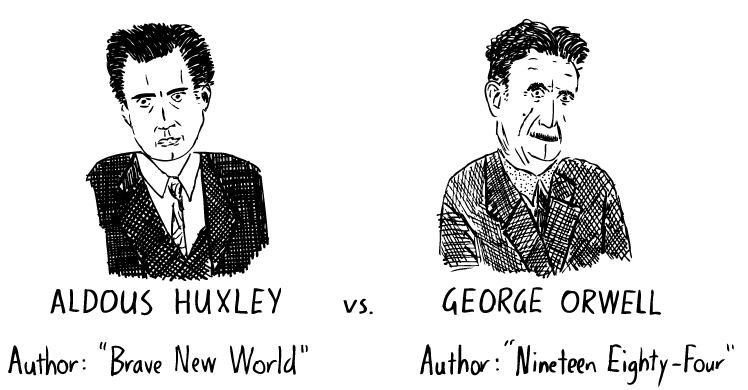
From the foreward of Neil Postman’s Amusing Ourselves to Death: Public Discourse in the Age of Show Business, where he suggests that Aldous Huxley may have had a better idea of what the future held than George Orwell did in his classic 1984:

But we had forgotten that alongside Orwell’s dark vision, there was another – slightly older, slightly less well known, equally chilling: Aldous Huxley’sBrave New World. Contrary to common belief even among the educated, Huxley and Orwell did not prophesy the same thing. Orwell warns that we will be overcome by an externally imposed oppression. But in Huxley’s vision, no Big Brother is required to deprive people of their autonomy, maturity and history. As he saw it, people will come to love their oppression, to adore the technologies that undo their capacities to think.

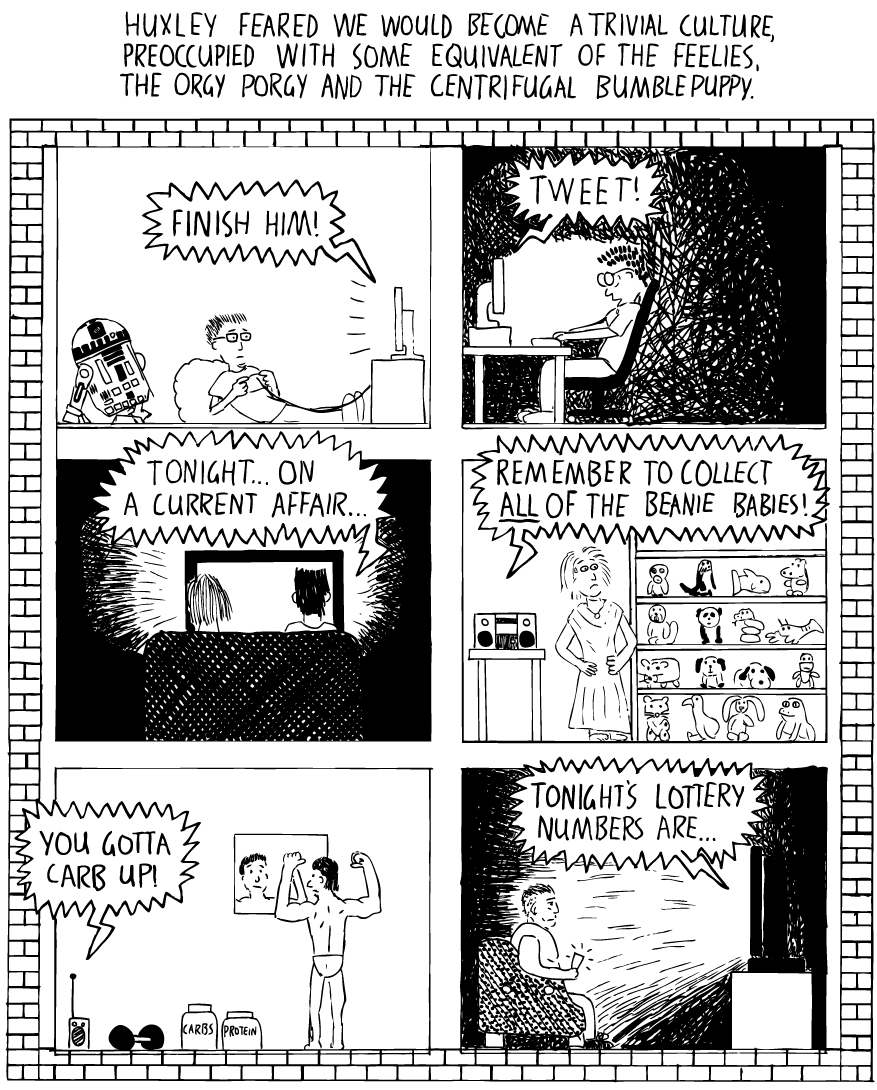
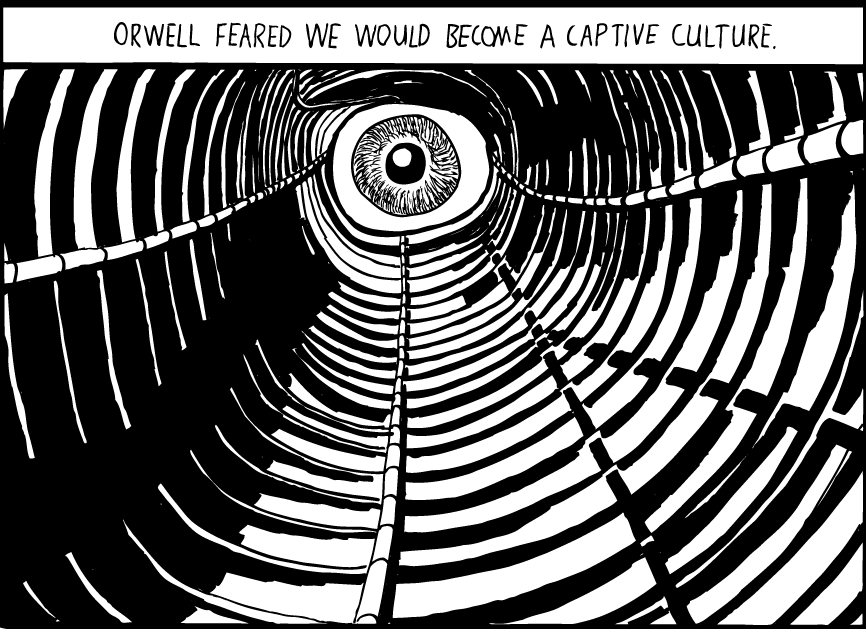
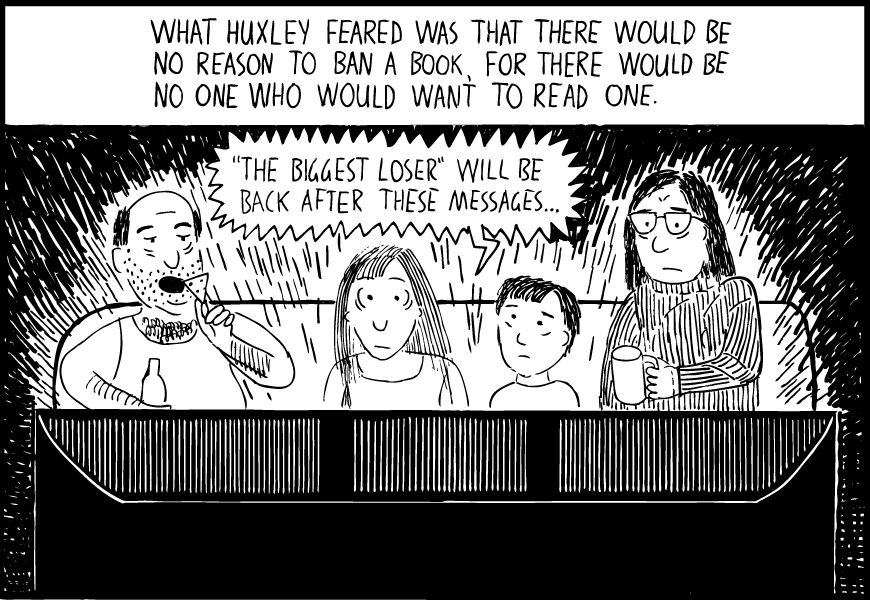
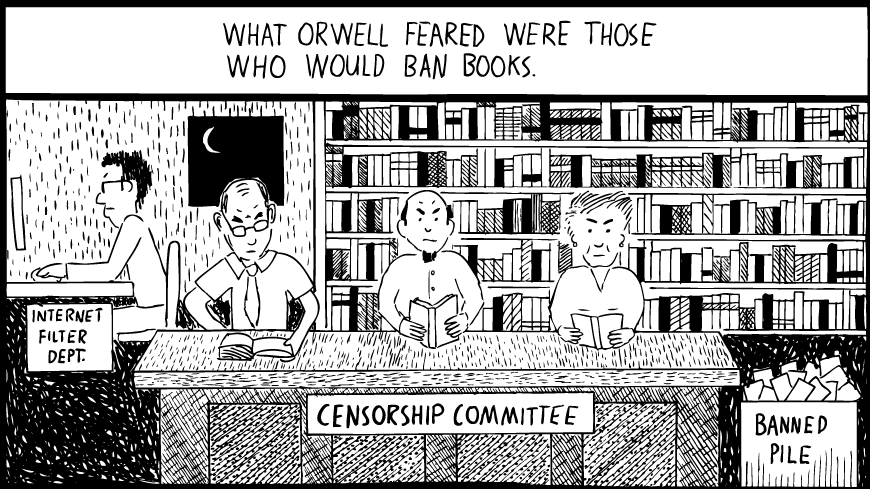
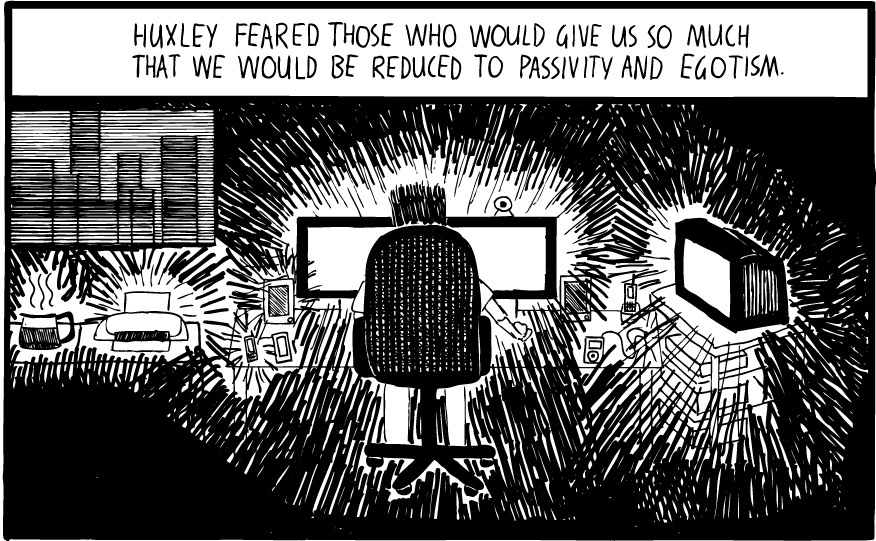
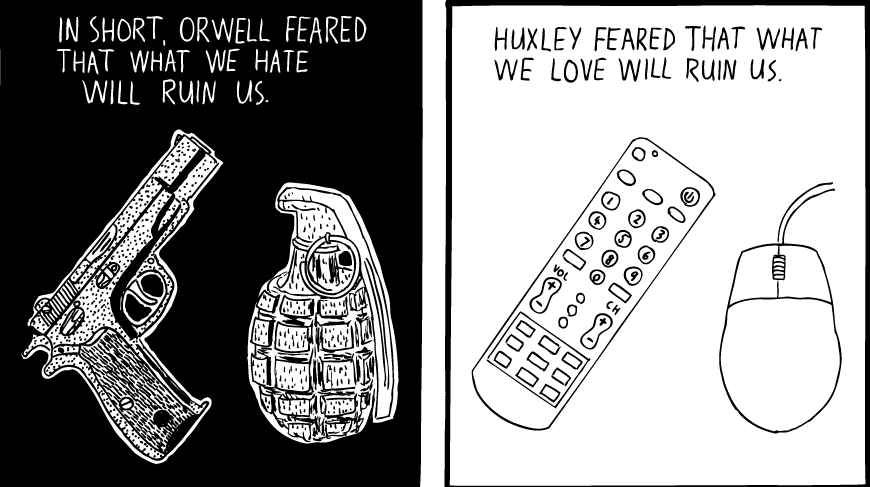
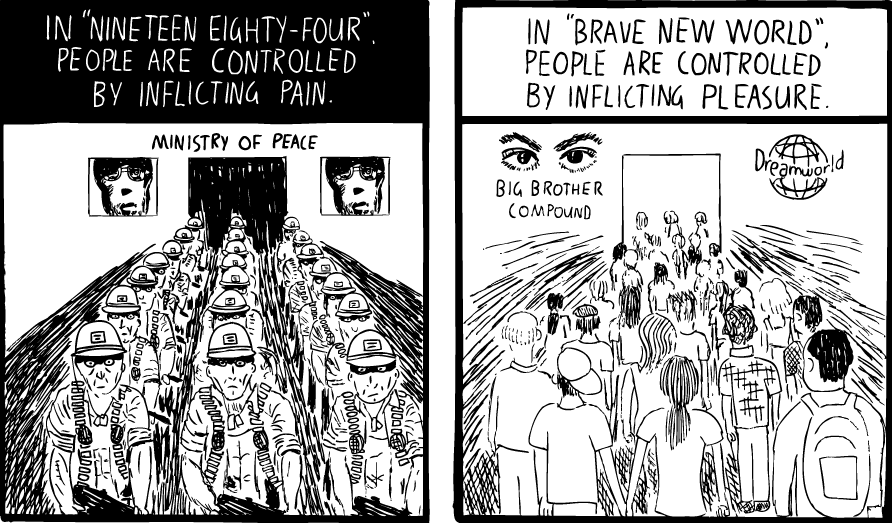
What Orwell feared were those who would ban books. What Huxley feared was that there would be no reason to ban a book, for there would be no one who wanted to read one. Orwell feared those who would deprive us of information. Huxley feared those who would give us so much that we would be reduced to passivity and egoism. Orwell feared that the truth would be concealed from us. Huxley feared the truth would be drowned in a sea of irrelevance. Orwell feared we would become a captive culture. Huxley feared we would become a trivial culture, preoccupied with some equivalent of the feelies, the orgy porgy, and the centrifugal bumblepuppy. As Huxley remarked in Brave New World Revisited, the civil libertarians and rationalists who are ever on the alert to oppose tyranny “failed to take into account man’s almost infinite appetite for distractions”. In 1984, Huxley added, people are controlled by inflicting pain. In Brave New World, they are controlled by inflicting pleasure. In short, Orwell feared that what we hate will ruin us. Huxley feared that what we love will ruin us.

This book is about the possibility that Huxley, not Orwell, was right.

Drawings by Stuart McMillen, Recombinant Records


“Do not lay up for yourselves treasures on earth, where moth and rust [1] destroy and where thieves break in and steal, but lay up for yourselves treasures in heaven, where neither moth nor rust destroys and where thieves do not break in and steal. — Matthew 6:19-20


HT: Justin Taylor

Boomer flu on social networks: Fear the pandemic

FacebookIt’s out there and there’s no stopping it. I mean old people taking over Facebook and Twitter:

Still, there’s no shortage of anecdotal evidence that sharing the online world can be a source of intergenerational strife. Take Will Smith (no, not the actor), for example. When this 33-year-old tech professional received a Facebook friend request from his father in March, he was floored. Not because he didn’t want to connect with his dad, but because doing so on the same network that he shared with so many peers and colleagues raised a host of complex concerns.

“My father, who I dearly love, has a tendency to forward e-mails that are off pretty off-color,” says Smith. “It’s probably nothing that would get me fired, but stuff that could earn me a trip to HR, if I ever opened them [at work]. My concern was that he would post that type of message on my Wall or in another public venue on Facebook without realizing it was a public venue. Since everyone from my immediate supervisor to the president of my company is in my friend list, there’s potential for bad things to happen. I don’t think anything actually would, but there was strong potential for embarrassment.”

To reduce the likelihood of a career-damaging dust-up, Smith sent his dad an e-mail in which he laid out what he considered reasonable limits for their online father-son bonding. Off-limits: “Politics, sex, jokes, things you find funny but offend me, comments about family members, any combination of the aforementioned items, and pretty much every e-mail you’ve ever sent me.”

Ultimately, Smith’s worst-case scenario never came to pass and—perhaps because that e-mail—his father never logged back into Facebook. But according to data from the Pew Internet & American Life Project, people of the same age as Smith’s father are logging onto Facebook in droves, and Baby Boomers are now the fastest growing population on the social network.

Ultimately, disaster was averted in this case. But it’ll only be a matter of time before mom or dad is tweaking you with a “Yoo hoo, honey!” for all your friends to see.

No, Mr. President. Killing is killing

As the president comes out today to tell us that we need comprehensive health care reform in our nation, I think this is something we should think on. Who will make reforms for the most defenseless in our country?

John Piper’s response to President Obama on abortion

On the 36th anniversary of Roe v. Wade, he released this statement,
We are reminded that this decision not only protects women’s health and reproductive freedom, but stands for a broader principle: that government should not intrude on our most private family matters.
To which I say:
* No, Mr. President, you are not protecting women; you are authorizing the destruction of 500,000 little women every year.
* No, Mr. President, you are not protecting reproductive freedom; you are authorizing the destruction of freedom for one million little human beings every year.
* No, Mr. President, killing our children is killing our children no matter how many times you call it a private family matter. You may say it is a private family matter over and over and over, and still they are dead. And we killed them. And you, would have it remain legal.
Mr. President, some of us wept for joy at your inauguration. And we pledge that we will pray for you.
We have hope in our sovereign God.

From the transcript:

On the 36th anniversary of Roe v. Wade, [President Obama] released this statement,

We are reminded that this decision not only protects women’s health and reproductive freedom, but stands for a broader principle: that government should not intrude on our most private family matters.

To which I say:

* No, Mr. President, you are not protecting women; you are authorizing the destruction of 500,000 little women every year.

* No, Mr. President, you are not protecting reproductive freedom; you are authorizing the destruction of freedom for one million little human beings every year.

* No, Mr. President, killing our children is killing our children no matter how many times you call it a private family matter. You may say it is a private family matter over and over and over, and still they are dead. And we killed them. And you, would have it remain legal.

Mr. President, some of us wept for joy at your inauguration. And we pledge that we will pray for you.

We have hope in our sovereign God.