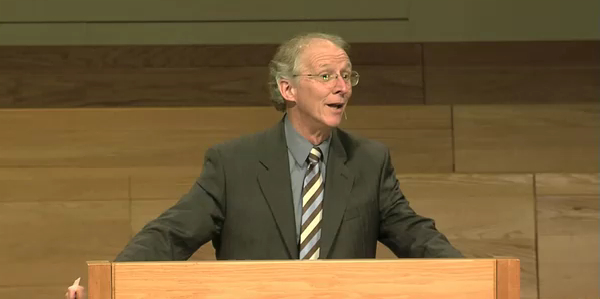
MacArthur’s answer on gay marriage

This was John MacArthur’s answer after the California court ruling last year (which was later amended by California voters), I think it still applies after the ruling in Iowa today regarding gay marriage:

As you interact with homosexuals and their sympathizers, you must affirm the Bible’s condemnation. You are not trying to bring damnation on the head of homosexuals, you are trying to bring conviction so that they can turn from that sin and embrace the only hope of salvation for all of us sinners—and that’s through faith in the Lord Jesus Christ. Homosexuals need salvation. They don’t need healing—homosexuality is not a disease. They don’t need therapy—homosexuality is not a psychological condition. Homosexuals need forgiveness, because homosexuality is a sin. …

What should be your response to the homosexual agenda? Make it a biblical response—confront it with the truth of Scripture that condemns homosexuality and promises eternal damnation for all who practice it. What should be your response to the homosexual? Make it a gospel response—confront him with the truth of Scripture that condemns him as a sinner, and point him to the hope of salvation through repentance and faith in Jesus Christ. Stay faithful to the Lord as you respond to homosexuality by honoring His Word, and leave the results to Him.

Just Do Something

Just out from Amazon.com is a new book from Kevin DeYoung, who previously gave us Why We’re Not Emergent (By Two Guys Who Should Be). DeYoung, who is the senior pastor at University Reformed Church in East Lansing, Mich., has written his latest book, Just Do Something: A Liberating Approach To Finding God’s Will or How to Make a Decision Without Dreams, Visions, Fleeces, Impressions, Open Doors, Random Bible Verses, Casting Lots, Liver Shivers, Writing In The Sky, Etc., for those in this day and age who have become paralyzed by indecision. DeYoung will be one of the speakers at the Next conference May 23-26 in Baltimore. From an excerpt from Just Do Something, he explains why being decisive matters:


We’re not consistent. We’re not stable. We don’t stick with anything. We aren’t sure we are making the right decisions. Most of the time, we can’t even make decisions. And we don’t follow through. All of this means that as Christian young people we are less fruitful and less faithful than we ought to be. … 

The hesitancy so many of us (especially the young) feel in making decisions and settling down in life and therefore diligently searching for the will of God has at least two sources. First, the new generations enjoy—or at least think they enjoy—“unparalleled freedom.” Nothing is settled after high school or even college anymore. Life is wide open and filled with endless possibilities, but with this sense of opportunity comes confusion, anxiety, and indecision. With everything I could do and everywhere I could go, how can I know what’s what?  Enter a passion to discern “God’s will for my life.” That’s a key reason there is always a market for books about the will of God.

Second, our search for the will of God has become an accomplice in the postponement of growing up, a convenient out for the young (or old) Christian floating through life without direction or purpose. Too many of us have passed off our instability, inconsistency, and endless self-exploration as “looking for God’s will,” as if not making up our minds and meandering through life were marks of spiritual sensitivity.

As a result, we are full of passivity and empty on followthrough. We’re tinkering around with everyone and everything. Instead, when it comes to our future, we should take some responsibility, make a decision, and just do something.

To learn more about Kevin DeYoung, who he is and what Next is all about go here.

Self-worship is stupid

For everyone who exalts himself will be humbled, and he who humbles himself will be exalted.
— Luke 14:11

For whoever wants to save his life will lose it, but whoever loses his life for me will find it.
— Matthew 16:25

Thanks to Jared Wilson for his post yesterday “The Kingdom is For Those Who Know How to Die“:

[T]he real beatitudes are today the powerful scandal they were in Jesus’ day. Because the kingdom is for the hurt, the grieving, the mourning, the poor and poor in spirit, the meek, the downtrodden, the marginalized, the discarded, the weary, the torn, the broken . . .

And why? Why is that?
I believe it is because those people have a keener sense of their own need. When you are on the drug of money or power or success (or any kind of drug), you can be numb to your basic, fundamental deficiency. Why do we keep trying to fill the God-shaped hole with any god but God? Because the other gods are just ways to believe we have no needs, that we have the power inside of us. Any worship directed to anyone or anything other than God is essentially self-worship.

And those who keenly feel and know their own brokenness know self-worship is stupid.

“Blessed are the poor in spirit,
for theirs is the kingdom of heaven.
Blessed are those who mourn,
for they will be comforted.
Blessed are the meek,
for they will inherit the earth.
Blessed are those who hunger and thirst for righteousness,
for they will be filled.
Blessed are the merciful,
for they will be shown mercy.
Blessed are the pure in heart,
for they will see God.
Blessed are the peacemakers,
for they will be called sons of God.
Blessed are those who are persecuted because of righteousness,
for theirs is the kingdom of heaven.
Blessed are you when people insult you, persecute you and falsely say all kinds of evil against you because of me.

— Matthew 5:3-11

Is God our lover? Our daddy? How should we love Him?

John Piper considers the question “Should our love for God be more like the love between a child and a father or the lover between two lovers?”:

What you look for for health—in a soul and in a church—is biblical proportion. So when it comes to intensity, it is high level intensity on each of the kinds of relationships. When it comes to which relationship is emphasized, let’s read the whole Bible and try to shape our hearts and our minds around the kinds of relationships that are highlighted in the Scriptures.

See his whole answer here.

Nightline debate: Does Satan exist?

Mark Driscoll, preaching pastor at Mars Hill Church in Seattle, will be one of the participants on tonight’s program. If you can’t stay up to watch, the program is also online. Here is how ABC promoted the event:

The devil — also known as Satan, Lucifer and Beelzebub — has become the primary antagonist in almost every major religion. He is seen as the rebel, a serpent and a fallen angel who tempts mortals into committing sin, and preys upon their despair. But does Satan really exist?

That question will be debated Friday, March 20, when “Nightline” tackles the controversial and sensitive issue in the third installment of the “Face-Off” series.

The “Nightline Face-Off” launched two years ago by asking the question “Does God Exist?” The Face-Off aired on ABCNews.com and more than 15,000 comments were posted on the Web site as viewers engaged in the debate.

The conversation will pick up with a debate on the devil in Seattle at the Mars Hill Church, moderated by Dan Harris, who covers faith issues for the network.

Watch the “Nightline Face-Off” Thursday, March 26, 2009, on ABCNews.com and at 11:35 p.m. on “Nightline”


Click on the image to go the Nightline site to see the program.

ESV Online Study Bible to be sold by itself

As a followup to yesterday’s post, Crossway Books has announced that it will be selling the ESV Online Study Bible as a standalone for $19.99. As you may recall, you can access the ESV Online Study Bible this month free of charge. It is also offered for free for those who purchased an ESV Study Bible in print. This standalone option is good way for those who would want to try it out without necessarily purchasing the print study Bible.

Why consider this? Here is what the Crossway Web site says:

ESV Online Study Bible provides additional unique features, including the ability to create personal online notes; to search and follow interactive links between notes, maps, articles, charts, timelines, illustrations, and cross-references; to listen to audio recordings of the ESV; and to access additional resources not available in the print edition.

How the ESV Online Study Bible helps daily devotions

ESV Study BibleI use the ESV daily reading plan as I do my devotions. In many of the versions you get from Crossway these days, those plans are often printed right in the Bible, so it’s a great way to keep track of where you should should be for that day. Lately, as I’ve done more Bible study online, I’ve come to appreciate the tools the ESV and other groups have to aid in devotions.

As you well may know, this month the ESV is offering a free tryout of its ESV Online Study Bible. I can’t tell you how much this is a great way to study the Bible. One advantage of using the study Bible online over the print version is having the audio Bible available. I love this feature. It is good to have the capable voice of David Cochran Heath when you are going through Old Testament passages where unfamiliar names can often cause you to stumble.

Another great way the online study Bible aids devotions — and especially daily reading as you go through the Bible — is its ability to group diverse passages on one Web page. So, for instance, today I was able to take the four passages I was reading in my daily reading plan — Psalm 83; Exodus 27:20-28:43; Nehemiah 9; 1 Corinthians 1:18-31 — and have them (and all the accompanying notes!) on the same page. The key to doing this is to make sure you put the semicolon between passages to separate them. This is a great way to go through them without having to flip from section to section. Plus you can also listen to each of them this way to.

God’s word is a treasure, and I am so thankful that I can have it and read it and listen to it and memorize it and share it with others. There are so many ways you can have it, especially in our culture, that there should be no excuse to not read it.

Behold the Lamb of God, the precious wrath remover for all who believe

Click on the image to view the message    Click on the image to view the message


There are three weeks until Easter, when we celebrate the resurrection of Jesus Christ after his sin-atoning death on the cross outside of Jerusalem approximately 2,000 years ago. Let us not forget or slight the magnitude of what that death means for all of us. From John Piper, pastor at Bethlehem Baptist Church in Minneapolis:

[W]e see this precious wrath-removal in John 3:36: “Whoever believes in the Son has eternal life; whoever does not obey the Son shall not see life, but the wrath of God remains on him” (John 3:36). This means that when John says, “Behold the Lamb of God who takes away the sin of the world,” he doesn’t mean that every person in the world is saved. He means every person in the world—Jew or Gentile—will be saved if they believe in Jesus and follow him. If they believe, their sin has been taken away by the Lamb. If they believe, God’s wrath has been removed by the Lamb.

There is no race, no nationality, no ethnicity, no socio-economic status excluded. To as many as receive him, who believe on his name (John 1:12), their sins are taken away (John 1:29; 1 John 3:5) and the wrath of God is removed (John 3:36; 1 John 2:2) and they are made the children of God (John 1:12) and given eternal life (John 3:16).

Don’t be dumb about praise, let it out

Psalm 34:1

I will bless the Lord at all times; his praise shall continually be in my mouth.

Here is how Charles Spurgeon comments on this verse in the collection The Treasury of David:

“His praise shall continually be in my mouth,” not in my heart merely, but in my mouth too. Our thankfulness is not to be a dumb thing; it should be one of the daughters of music. Our tongue is our glory, and it ought to reveal the glory of God. What a blessed mouthful is God’s praise! How sweet, how purifying, how perfuming! If men’s mouths were always thus filled, there would be no repining against God, or slander of neighbours. If we continually rolled this dainty morsel under our tongue, the bitterness of daily affliction would be swallowed up in joy. God deserves blessing with the heart, and extolling with the mouth – good thoughts in the closet, and good words in the world. (Volume 1, pp. 122-123)

HT: Fighter Verses

God speaks through your iPod: Carry the ESV Study Bible in your pocket

Confession: I own an iPod and am happy with it. I can listen to songs, sermons (yes, I like sermons) and podcasts. My son has an iPod Classic and my wife and daughter also have iPods. We have a lot of stuff.

But, since I love God’s Word and have absolutely loved the ESV Study Bible we got last month, I am thrilled with the idea of having the entire ESV Study Bible available right there on an iPod (or iPod Touch). Olive Tree Bible Software offers this for Bible lovers who are also iPod owners. This blows my mind. And the ESV also offers this for those who want to view it through their iPhone, iPod Touch or PDA. Either way you can’t go wrong. From what I’ve read, Olive Tree’s latest software version adds split screen viewing, which is wonderful with the ESV Study Bible when looking at accompanying notes. See the video below, which shows how it works: