Myanmar didn’t go away

Last week I posted about the tragedy in Myanmar and how, although reported on the by the media regularly, we tend to turn away from tragedies that occur out of our comfort area. Well, it’s still there and it still a major tragedy. I posted a link the American Red Cross, but there are several organizations out there reaching out to people who are needy.

\One such organization is a Michigan-based group called Christian Freedom International. This group’s mission is based on Hebrews 13:3, which says: “Remember the prisoners, as though in prison with them, and those who are ill-treated, since you yourselves also are in the body.” Thousands upon thousands in Myanmar have been affected by the effects or Cyclone Nargis. Among those are the Karen Christians. Even among the suffering, these are singled out. This from CFI:

Residents in the Irawaddy Delta, which bore the brunt of the cyclone that tore through the country on May 3, 2008, are now claiming that the Burmese military is diverting aid from areas heavily populated by ethnic Karen villagers — a claim consistent with the government’s longstanding history of discriminatory practices against the Karen, the largest and mostly Christian minority ethnic group in the country.

So, for those who call themselves Christians, how does that make you feel? Bad? Uneasy? Something? How do you explain it to your children? Do you? Maybe there’s more you could do. Perhaps you might show them that a little sacrifice for the good of the body is really not a sacrifice but a way to honor God.

You want more examples? Perhaps you may want to consider the Macedonians from Paul’s letter to the Corinthians (II Cor. 2:1,2 and 8 ) when he was taking aid to the starving believers in Jerusalem:

We want you to know brethren about the grace of God which has been shown in the churches of Macedonia, for in a severe test of affliction, their abundance of joy and their extreme poverty have overflowed in a wealth of liberality on their part . . . I say this not as a command, but to prove by the earnestness of others that your love also is genuine.

OK, you get the point. Go here to Christian Freedom International and see what you can do.

C.S. Lewis was more than The Chronicles of Narnia

\Ligonier Ministries has graciously made available its January issue of Tabletalk magazine, which looked at the life and writings of C.S. Lewis. With Prince Caspian opening this weekend, it is as good a time as any to look at the man whose writing have inspired many people, myself included.

It has been a treasured memory of mine the time I spent reading through the Chronicles of Narnia books (in the originally published order, not the modern order) with my children. First of all, Lewis was a great writer, and it is good for children to hear and read (when they could) what good literature looks like. Secondly, the Christian message is clear throughout the books in telling the story of Narnia, Aslan and the struggle that ultimately ends in the triumph of good over evil.

But Lewis wrote much more than children’s books, and you would be missing much if you didn’t look into his other writings. Books like “Mere Christianity” or “The Screwtape Letters” or essays like “The Weight of Glory” or “The Four Loves.” Lewis is a writer who puts your mind to work and points you to God.

So, while watching a movie is enjoyable, it would also be good to pull out a good book by C.S. Lewis and stretch your mind a little.

HT: Ligonier Ministries

Hollister, the Bible and teenagers

I’ve been reading through Alex and Brett Harris’ book “Do Hard Things” and I can’t overstate how much I like it and strongly recommend it. As a parent of a teenager, I am constantly doing battle with our culture’s low expectations for them so it is encouraging to see two young men who are giving a great message that we all need to hear.

\"Join The Rebelution\"

One of the things Alex and Brett talk about is that the whole idea of a special class of people called “teenagers” is a 20th century idea that has strongly taken root. In their research for the book, they discovered that even the word “teenager” did not exist publicly until 1941 and that, in an effort to protect children from cruel labor laws at the turn of the 20th century and instill universal education, we created a period where children are not yet adult but no longer children. We created the low expectations. In “America in So Many Words,” it is described this way:

Thus the years ending in -teen became something new and distinctive … The teenager remade our world. The concept is … subversive: why should any teenager enjoying freedom submit to the authority of adults? With the discovery of this new age, ours has been the century of the teenager ever since.

What does the Bible say about teenagers? Absolutely nothing. But it is not silent about youth and expectations. Instead, in I Corinthians 13:11 it says: “When I was a child, I spoke as a child, I thought as a child, I reasoned like a child. When I became a man, I gave up childish ways.” Furthermore, in I Timothy 4:12 it says: “Don’t let anyone look down on you because you are young, but set an example for believers in speech, in life, in love, in faith and in purity.” And finally, in Romans 12:2: “Do not conform any longer to the pattern of this world!”

What does our culture say? There is a joke that if Hollister (or American Eagle) said breathing was uncool, 92 percent of all teens would be dead. So, maybe it’s time for all of us to start thinking more highly and expecting more from these people we call teenagers. I leave you with the wisdom from I Corinthians 14:20:

Brothers, stop thinking like children. In regard to evil be infants, but in your thinking be adults.

There are no ordinary people

This is a piggyback post, based on something I read earlier today. The question is: Do people bore you? And is so, why? It is hard to show Christ’s glory when the only person we find interesting is ourselves. Here is what C.S. Lewis says:

It is a serious thing to live in a society of possible gods and goddesses, to remember that the dullest and most uninteresting person you talk to may one day be a creature which, if you saw it now, you would strongly be tempted to worship, or else a horror and a corruption such as you now meet, if at all, only in a nightmare. All day long we are, in some degree, helping each other to one or other of these destinations. It is in the light of these overwhelming possibilities, it is with the awe and the circumspection proper to them, that we should conduct all our dealings with one another, all friendships, all loves, all play, all politics. There are no ordinary people. You have never talked to a mere mortal. (The Weight of Glory, 14-15)

Our evangelism suffers when we can’t put away worship of ourselves long enough to engage someone else. Perhaps their view of Christ in us is being clouded by our own love for ourselves.

HT: Desiring God

Larry Norman and a musical interlude

As I look at this blog I get a sense that you can sometimes overdo the video. That’s said, I’m going back to the video vault for a little refreshment for you all.

I saw this video a few months back after Larry Norman passed away. If you’re not familiar with Larry Norman, he was a guy who lived off the fringes of Christianity and then came to Christ. Larry was prone to be rough around the edges, but he spoke clearly for all to hear.

Larry, in poor health for several years, went to be with the Lord on Feb. 24 of this year. I would suggest checking in at ChristianDiscs.com to hear more of what Larry had to say. Musical tastes are personal, so I can’t say that everyone will appreciate the music he made. But I can say that his was a voice that deserves to be heard.

And now, a small dose of Larry Norman (with help from 77’s front man Mike Roe):

Do hard things. Don’t be sheeple

Alex and Brett Harris

Alex and Brett Harris are two awesome teenagers who have written a great book called “Do Hard Things,” which is an attack against the tyranny of low expectations. Read more about them on their blog.

Love bears all

I cry easily. The emotion is very close to the surface, you don’t have to scratch very far and it comes to the surface. But, that said, if you don’t feel something after watching this video, you should see if your heart is still there.

Love bears all things, believes all things, hopes all things, endures all things. — I Corinthians 13:7

HT: Irish Calvinist

Are you comfortable? Should you be?

Last weekend, Cyclone Nargis raged through Myanmar, causing widespread damage and killing at least 22,000. Twice as many people are missing. Let that sink in. 22,000 people. Gone. And, there are thousands more who have not been found yet. From the Associated Press comes a report from Yangon, Myanmar:

Hungry crowds of survivors stormed the few shops that opened in Myanmar’s stricken Irrawaddy delta, where food and international aid has been scarce since a devastating cyclone killed more than 22,000 people, the U.N. said Wednesday.

Corpses floated in salty flood waters and witnesses said survivors tried desperately to reach dry ground on boats using blankets as sails. The U.N. said some 1 million people were homeless in the Southeast Asian country, also known as Burma.

“Basically the entire lower delta region is under water,” said Richard Horsey, Bangkok-based spokesman for the U.N. Office for the Coordination of Humanitarian Aid.

“Teams are talking about bodies floating around in the water,” he said. This is “a major, major disaster we’re dealing with.”

Suffering is all around us. We can’t escape it. But we try hard. After all, I had a good night’s rest, woke up to see my family and live comfortably in a nice house. In my local paper, Myanmar is a place far away, buried on page 8. The message is clear: If it doesn’t happen in my back yard, it is filed way back somewhere in that category of tragedies that happen to people I don’t really know. Besides, we have problems of our own. We aren’t making money as fast as we used to be. It costs more money to put gas in our cars. Our lives are not as comfortable as they could be.

We all are happy to thank God for our blessings. But God did not bless us to live more comfortable lives. We are blessed so that we may bring more glory to His name and show that we live for him and not for our own comfort. Sometimes I need to ask myself, “Would I trust God as much if I didn’t have food, clothing, a house, my health?”

I came across this from John Piper about ways to react to the tragedy in Myanmar. These are all good things to consider. For a great meditation on why God allows suffering of this, or any, magnitude, read this. The point is, we can’t ignore suffering. See it, react and tremble before God.

Here’s one way to help right now: The American Red Cross

Mother’s Day and the Culture of Death

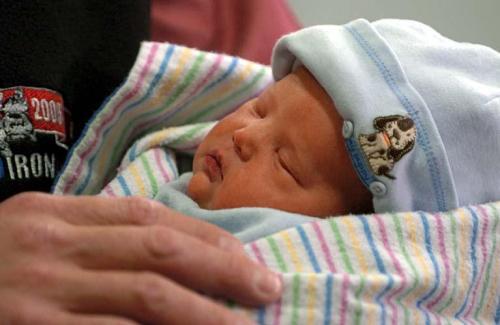
Trig Paxson Van Palin

This coming Sunday is Mother’s Day, and we will take time out to honor the people who mean so much in our lives.

And while we will spend a lot of money and energy honoring our mothers, there will be those who will have great discomfort on this day. Some will be reminded that they had children and instead chose to end their lives through abortion. But we know that God is merciful and that there is forgiveness of sin and there can be restoration to those who come to him through Christ. After all, we are all tainted before him.

The picture included in this post is of Trig Paxson Van Palin, whose mother Sarah will be especially happy on this Mother’s Day. You see, Trig was born April 18 to Sarah and her husband Todd. Besides being a beautiful baby boy, he was also born with with an extra chromosome, which means he has Down syndrome. Albert Mohler picks up the story

The Palins never considered aborting the baby. That means that Trig Palin is now is a very rare group of very special children, because it is now believed that the vast majority of babies diagnosed with Down syndrome before birth are being aborted.

Modern diagnostic tests are driving a “search and destroy mission” to eliminate babies judged to be inferior, disabled, or deformed. Some experts now believe that up to 90 percent of all pregnancies diagnosed as having a likelihood of Down syndrome end in abortion.

Back in 2005, ethicist George Neumayr commented: “Each year in America fewer and fewer disabled infants are born. The reason is eugenic abortion. Doctors and their patients use prenatal technology to screen unborn children for disabilities, then they use that information to abort a high percentage of them. Without much scrutiny or debate, a eugenics designed to weed out the disabled has become commonplace.”

These kind of stories catch my attention because, first of all, I do not want to see any child’s life ended through abortion. Secondly, in my own family we have been blessed with a special child with Down syndrome. People like the Palins and my brother-in-law and his wife are heroes to me because they stand in the face of what our society tells us is right — that these children have a life that is not worth living.

So, be thankful for your mother and love this coming Sunday. But also love those around you. People who have made mistakes and now regret them. People who don’t understand but still need love. People who are living difficult lives but who are witnesses that God is great and we are all needy people.

Come to Jesus

Today was a great day at church, and it was something different. First of all, I had the opportunity to lead the first- and second-graders in Sunday school. Our lesson was based around the passage in Mark 2:1-11 where Jesus heals the man who is paralyzed, but not before he forgives the man’s sins.

The way the lesson went, we talked about what the man’s biggest problem was. He was paralyzed, but Jesus did something else first. He forgave him. Now, there are many ways you can look at that passage, and it’s a great one. What we talked about was that we have to realize that we have a need greater than anything we can see about our lives: our sinful hearts. And there is only one person who can heal us: Jesus Christ. So we all need to come to him. Whether he solves all the things we see as wrong with our lives is not as important as our heart problem.

Another thing we talked about, which fit in nicely with the main service, was the friends who lowered the paralyzed man through the roof so he could get to Jesus. These men didn’t heal him, but they did something great for the man. As part of our battleship series, we prayed for the list of people we call POWs — prisoners in the spiritual battle for our souls. Even though these images aren’t the same, the idea is in that we need to bring people to Jesus so he can save them. It’s not us, but God uses our efforts to save sinners.

I asked the boys and girls if there was something that was special to them that they could tell me about. I heard about special birthday presents, their pets, their family. We then talked about how Jesus is more special than any of those things. If that’s the case we should want to share him with those we meet. Otherwise, we are not loving. That is the goal before us.

For while we were still weak, at the right time Christ died for the ungodly. For one will scarcely die for a righteous person—though perhaps for a good person one would dare even to die— but God shows his love for us in that while we were still sinners, Christ died for us.

Romans 5:6-8