A Guy’s Guide to Marrying Well

MarryWellThanks to the folks at Boundless and Focus on the Family for providing A Guy’s Guide To Marrying Well. The 32-page booklet (a free download at the link) is a collection from several really good books and sources. This is what the folks at Focus on the Family  hope the guide will do for young men:

The simple purpose of this booklet is to present a path that is as Biblical as possible in order to help you marry well. But not just so that you can experience all the happiness, health and wealth that guys who marry well enjoy, but so that your marriage can point to God’s glory and His greater purposes.

This guide is based on a few timeless concepts — intentionality, purity, Christian compatibility and community — that we rarely encounter in popular culture but are a proven path to marrying well.

In a world where we get garbage like The Bachelor, it’s good to know that young men can have something more trustworthy when it comes to giving clear, sound advice.

What’s the problem with the church?

Why We Love the ChurchKevin DeYoung and Ted Kluck, who brought us “Why We’re Not Emergent (By Two Guys Who Should Be), have teamed up for a new book that looks at the local church and its biblical mandate. The book, called “Why We Love the Church: In Praise of Institutions and Organized Religion,” is due out July 1 and is described this way by the publisher:

Why We Love the Church presents the case for loving the local church.  It paints a picture of the local church in all its biblical and real life guts, gaffes, and glory in an effort to edify local congregations and entice the disaffected back to the fold.  It also provides a solid biblical mandate to love and be part of the body of Christ and counteract the “leave church” books that trumpet rebellion and individual felt needs. 

DeYoung, in lead up to the book’s release, looks at reasons people are disillusioned with the church. He breaks those reasons into four groups:

  • Missiological — it doesn’t work any more and is making no difference whatsoever
  • The Personal — it’s views are too harsh toward certain groups and unloving and has an “image problem”
  • The Historical — the church is corrupted from its original pristine state
  • The Theological — the modern view of the church is foreign to what Jesus came for in the Bible

Over the coming weeks, DeYoung will post excerpts from the book and address these concerns. I look forward to reading them and the book’s release.

Debating Christianity: A Collision of worldviews

I don’t know when this will come out on video or theaters, but it promises to be an interesting event nonetheless. Renowned author and avowed “anti-theist” Christopher Hitchens and pastor and author Douglas Wilson are the subjects of a documentary that looks at their exchanges over the question “Is Christianity good for the world?” The documentary, called “Collision: Christopher Hitchens vs. Douglas Wilson,” follows the men as they debate one another and make public appearances during their book tour for “Is Christianity Good for The World.”

Collision — Christopher Hitchens vs. Douglas Wilson

HT: Justin Taylor

Free stuff for graduates — and anyone

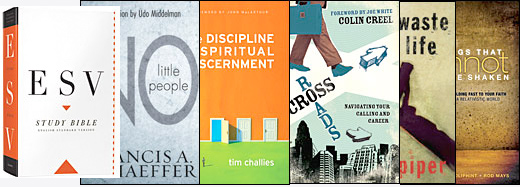
Free-Stuff FridayTim Challies, as part of his regular Free-Stuff Fridays, is offering a great collection of books that would make a fine gift to a graduate or maybe just a great collection to your personal library. From Crossway Books:

As part of the contest, all you need to do is sign up for a free drawing by midnight tonight. Thanks much to Tim for offering these great books! Go to the link above to sign up.

An alternative to Strunk and White, for you nerds out there

Merriam-Webster's Concise DictionaryBecause I am one of those nerds who cares about what is the right word to use, I have taken note that today is the 50th anniversary of the publication of Strunk and White’s Elements of Style.  

I read this article a few days ago and have to admit was amused by the writer’s vehemence against EoS. I was also in agreement on some points. Abraham Piper, the Web content editor at Desiring God, today offers this helpful post over at Between Two Worlds that doesn’t come down so hard on Elements of Style but points to the usefulness of Merriam-Webster’s Concise Dictionary of English Usage.

If you care about presenting your words in a clear way and how they fit together, then this book is worth your time. You just may be a nerd, too, but that’s all right.

God, marriage and family

A recommendation from Mark Driscoll:

About the book, from Crossway Books:

We live in a time of crisis regarding marriage and the family, and only by a return to the biblical foundation can these institutions be rebuilt. To provide an integrated, biblical treatment of the full range of marriage and family issues, the authors of God, Marriage, and Family examine what Scripture says about God’s purposes for humans in their marriage and family interactions. Their examination covers the special issues stemming from marriage, childrearing, singleness, homosexuality, and divorce and remarriage. With study questions and points for further discussion, this book is a comprehensive yet concise resource for anyone seeking a Scriptural response to our culture’s complex challenges to God’s intentions for marriage and family.

To get Andreas Kostenberger’s “God, Marriage and Family: Rebuilding the Biblical Foundation,” go here.

Just Do Something

Just out from Amazon.com is a new book from Kevin DeYoung, who previously gave us Why We’re Not Emergent (By Two Guys Who Should Be). DeYoung, who is the senior pastor at University Reformed Church in East Lansing, Mich., has written his latest book, Just Do Something: A Liberating Approach To Finding God’s Will or How to Make a Decision Without Dreams, Visions, Fleeces, Impressions, Open Doors, Random Bible Verses, Casting Lots, Liver Shivers, Writing In The Sky, Etc., for those in this day and age who have become paralyzed by indecision. DeYoung will be one of the speakers at the Next conference May 23-26 in Baltimore. From an excerpt from Just Do Something, he explains why being decisive matters:


We’re not consistent. We’re not stable. We don’t stick with anything. We aren’t sure we are making the right decisions. Most of the time, we can’t even make decisions. And we don’t follow through. All of this means that as Christian young people we are less fruitful and less faithful than we ought to be. … 

The hesitancy so many of us (especially the young) feel in making decisions and settling down in life and therefore diligently searching for the will of God has at least two sources. First, the new generations enjoy—or at least think they enjoy—“unparalleled freedom.” Nothing is settled after high school or even college anymore. Life is wide open and filled with endless possibilities, but with this sense of opportunity comes confusion, anxiety, and indecision. With everything I could do and everywhere I could go, how can I know what’s what?  Enter a passion to discern “God’s will for my life.” That’s a key reason there is always a market for books about the will of God.

Second, our search for the will of God has become an accomplice in the postponement of growing up, a convenient out for the young (or old) Christian floating through life without direction or purpose. Too many of us have passed off our instability, inconsistency, and endless self-exploration as “looking for God’s will,” as if not making up our minds and meandering through life were marks of spiritual sensitivity.

As a result, we are full of passivity and empty on followthrough. We’re tinkering around with everyone and everything. Instead, when it comes to our future, we should take some responsibility, make a decision, and just do something.

To learn more about Kevin DeYoung, who he is and what Next is all about go here.

Don’t put your faith in science

To me, it is deeply disturbing when the president puts his faith in scientists, saying things like “promoting science isn’t just about providing resources — it is also about protecting free and open inquiry.  It is about letting scientists like those here today [on March 9] do their jobs, free from manipulation or coercion, and listening to what they tell us, even when it’s inconvenient — especially when it’s inconvenient.  It is about ensuring that scientific data is never distorted or concealed to serve a political agenda – and that we make scientific decisions based on facts, not ideology.”

To divorce any kind of ideology from science is to give science a free rein that leads to frightening results. In a review of Pamela Winnick’s book “A Jealous God: Science’s Crusade Against Religion,” Wesley Smith points out what kind of work scientists are capable of when human life is disregarded. From his review published in the Discovery Institute’s First Things:

Early on, Winnick wrenchingly demonstrates the potential antihuman consequences of pursuing scientism’s view of scientific research. During the late 1960s and into the 1970s, scientists conducted human experiments on living fetuses, justified by the philosophical assertion that fetuses are only “potential” human life. 

One such experiment, which won the Foundation Prize Award from the American Association of Obstetrics and Gynecology, is described by Winnick in sickening detail: “In a 1968 study called the ‘Artificial Placenta,’ a twenty-six-week-old fetus, weighing more than a pound, was obtained from a fourteen-year-old girl, presumably from a therapeutic abortion. Along with fourteen other fetuses, it was immersed in a liquid containing oxygen and kept alive a full five hours.” The study itself explains that the fetus made”irregular gaspmg movements, twice a minute, … but there was not proper respiration.” Once the pumping of oxygenated blood was stopped, however, “the gasping respiratory efforts increased to 8 to 10 times a minute …. The fetus died 21 minutes after leaving the circuit.”

So, for those of you who feel squeamish or think I’m overstating it when I mention Nazi doctors in regard to therapeutic stem cell research, I’d ask you to read that last paragraph again and remember that we’re talking about 1960s America and not 1940s Nazi Germany. Smith notes that the experiments were stopped when an outraged public and Congress — led by Ted Kennedy — demanded they be stopped. But we live in a different age where the drumbeat call for cures has drowned out any thought of human exceptionalism. In other words, it matters not that embryos are human, it only matters what cures can (possibly) be found.

The idea that science is somehow benign and trustworthy left untethered from any kind of ideological guidelines is naive and will lead to situations like the one described above. Smith, in his review of Winnock’s book, says science of is not the target in “A Jealous God” but rather a belief (scientism she calls it) that “promotes a stark materialistic utilitarianism as the way to achieve progress.” Science is not our savior, and we can never forget that.

ESV Online Study Bible to be sold by itself

As a followup to yesterday’s post, Crossway Books has announced that it will be selling the ESV Online Study Bible as a standalone for $19.99. As you may recall, you can access the ESV Online Study Bible this month free of charge. It is also offered for free for those who purchased an ESV Study Bible in print. This standalone option is good way for those who would want to try it out without necessarily purchasing the print study Bible.

Why consider this? Here is what the Crossway Web site says:

ESV Online Study Bible provides additional unique features, including the ability to create personal online notes; to search and follow interactive links between notes, maps, articles, charts, timelines, illustrations, and cross-references; to listen to audio recordings of the ESV; and to access additional resources not available in the print edition.

God speaks through your iPod: Carry the ESV Study Bible in your pocket

Confession: I own an iPod and am happy with it. I can listen to songs, sermons (yes, I like sermons) and podcasts. My son has an iPod Classic and my wife and daughter also have iPods. We have a lot of stuff.

But, since I love God’s Word and have absolutely loved the ESV Study Bible we got last month, I am thrilled with the idea of having the entire ESV Study Bible available right there on an iPod (or iPod Touch). Olive Tree Bible Software offers this for Bible lovers who are also iPod owners. This blows my mind. And the ESV also offers this for those who want to view it through their iPhone, iPod Touch or PDA. Either way you can’t go wrong. From what I’ve read, Olive Tree’s latest software version adds split screen viewing, which is wonderful with the ESV Study Bible when looking at accompanying notes. See the video below, which shows how it works: