What is Hitchens thinking? Doug Wilson discusses ‘Collision’ with John Piper

‘Collision’ premiered Friday at the 2009 Desiring God National Conference. If you’re not familiar with it, “Collision” is a documentary on the series of debates between pastor/theologian Doug Wilson and atheist/author Christopher Hitchens on their book “Is Christianity Good for the World?”

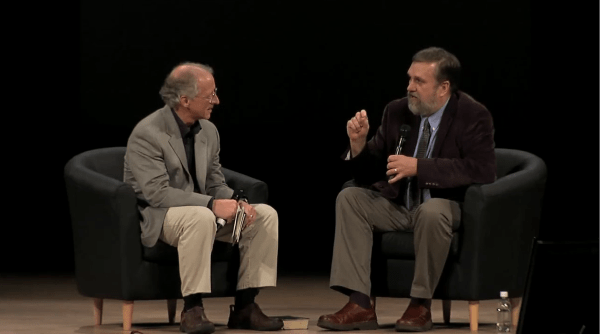
After the movie was shown, Wilson sat down with pastor John Piper to answer a few questions about the film:

  • Christopher Hitchens said at the end of the movie that, given the chance, he wouldn’t convert the last theist. Why do you think he said that?
  • What is Hitchens’ best counterpoint to the claim that he is getting his morality for judging Christianity from Christians?
  • What is the relationship between doing apologetics and evangelizing?
  • In the video you speak about having “copiousness.” Describe what that is and whether you think it is important for pastors to cultivate.
  • What is your hope for this film?
  • What about the “s” word at the end of the film? Why do you allow for it here but don’t tolerate it from your children?
  • Why the recent upsurge in the New Atheism?
Click on the image to view the video

The 2009 Desiring God National Conference is going on this weekend in Minneapolis. The theme of this year’s conference is “With Calvin in the Theater of God.” You can follow along with the conference’s messages and find audio and video here.

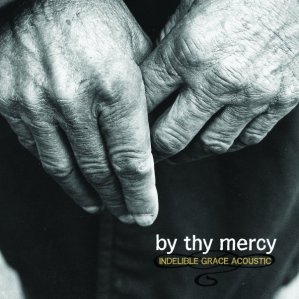
By Thy Mercy: Indelible Grace Acoustic is almost here

By Thy MercyOne of my favorite groups of artists, Indelible Grace, is just about to release its fifth album, called “By The Mercy: Indelible Grace Acoustic.”  To hear the title track, you can go here.

If you have spent any time here, you know that I deeply appreciate the work of these artists. The group’s stated purpose is “to help the church recover the tradition of putting old hymns to new music for each generation, and to enrich our worship with a huge view of God and His indelible grace.

Kevin Twit, who is the campus pastor at Belmont University and is the founder of Indelible Grace, writes on the group’s Facebook page some of the background of the group and more of its goals:

Indelible Grace Music grew out of ministering to college students, primarily through Reformed University Fellowship (RUF). We saw many touched by the gospel, and gripped by the rich theology and great poetry of the hymns of the Church. As these students began to taste more of the depth of the gospel and the richness of the hymn tradition, many began to join the music of their culture with the words of our forefathers (and mothers!), and a movement was born.
But actually, this is not really a “new” movement at all! Up until the beginning of the 20th century, it was common for people to compose new music for each generation for many of the hymns that they loved. There is no rule that says each hymn can only have one musical setting, and in fact, hymnals are designed for you to be able to mix and match words and music — that’s why they have a metrical index. But unfortunately, we lost this tradition and got stuck in a more modern traditionalism of associating one particular tune with one particular hymn. I am reminded of an incident a few years ago at the national meeting of our own denomination after a worship group had played a new version of Wesley’s “And Can It Be” (the one that is on our 1st CD by the way.) Many were upset by the new music and one gentleman stood and protested the new music saying that Wesley had written this hymn to majestic music and that he must be turning over in his grave. At this point, the organist for the convention rose and told the man (correctly) that the critic had probably never heard the music Wesley wrote the hymn to (if he even did write it to music when he composed it), and that the tune the man thought was the original was actually a bar tune!
Our goal is not change for change’s sake, but to rekindle a love of hymns and to invite many who would never associate rich passion with hymns to actually read the words. We believe that we are impoverished if we cut off our ties with the saints of the past, and that we fail to be faithful to God in our own moment of history if we don’t attempt to praise Him in forms that are authentic to who we are.Read More »

Getting away from it all: The McFarthest place in the U.S.

mcdonaldsMy best friend lives out on the rolling plains of South Dakota in a place that seems far from everywhere. I have visited him there once and long to go back there again. I tell people he’s a real-life cowboy because he ranches with his brother-in-law and often the mode of transportation is a horse. I like that one of the nearest towns is called Faith, because you have to have a lot of it to live so far away from the “modern” conveniences.

That’s why I had a smile when I came across this post by Stephen Von Worley where, while lamenting the spread of the strip mall to the country, he plots the point in the United States that is the most-distant from a McDonald’s. Why McDonald’s? Well, Worley puts it well when he says: “To gauge the creep of cookie-cutter commercialism, there’s no better barometer than McDonald’s – ubiquitous fast food chain and inaugural megacorporate colonizer of small towns nationwide.”

Using data from AggData, which is cool site in itself, he came up with the answer: the rolling plains of Northwest South Dakota.

When I saw this, I was amused because it is the neighborhood of my cowboy friend. If there was ever a place (in the U.S., that is) you could say you were getting away from it all, it would be where he lives. This is where he calls home:

I can testify that you can survive without a McDonald’s down the street. I know, I’ve talked to him from time to time and he’s quite normal. I’ve never heard anyone say they can’t live without McDonald’s, but the point is that there is more to life then what we consider “modern conveniences.”

Don’t underestimate the depravity of man. Or the love of Jesus

Like Mark Driscoll, I also thought when reading this portion of scripture that it was a brief glimpse of kindness. Instead, it is just another way to show the magnitude of Jesus’ love for humanity.

HT: Zach Nielsen

Seven reasons why we need small groups

This was not the main part of the message, but it was nonetheless a great point that John Piper made this past Sunday during his message at Bethlethem Baptist Church in Minneapolis. That is, seven reasons why we as believers and members of the church need small groups:

He has given pastors to the church “to equip the saints for the work of ministry, for building up the body of Christ” (Ephesians 4:11-12). I believe in what I do. And I believe that it is not enough. Here are the seven reasons I gave the small group leaders.

1. The impulse avoid painful growth by disappearing safely into the crowd in corporate worship is very strong.

2. The tendency toward passivity in listening to a sermon is part of our human weakness.

3. Listeners in a big group can more easily evade redemptive crises. If tears well up in your eyes in a small group, wise friends will gently find out why. But in a large gathering, you can just walk away from it.

4. Listeners in a large group tend to neglect efforts of personal application. The sermon may touch a nerve of conviction, but without someone to press in, it can easily be avoided.

5. Opportunity for questions leading to growth is missing. Sermons are not dialogue. Nor should they be. But asking questions is a key to understanding and growth. Small groups are great occasions for this.

6. Accountability for follow-through on good resolves is missing. But if someone knows what you intended to do, the resolve is stronger.

7. Prayer support for a specific need or conviction or resolve goes wanting. O how many blessings we do not have because we are not surrounded by a band of friends who pray for us.

The Screwtape Letters come to life in audio drama once more

I have enjoyed reading C.S. Lewis’ “The Screwtape Letters” several times over the years. At the local library, I was even able to find this audiobook version, performed well by John Cleese. So I was very excited to hear that Focus on the Family has produced a new audio version, which will be out Oct. 15. Especially intriguing is that Andy Serkis, who made Gollum come to life so vividly in the “Lord of the Rings” movies, will be performing the role of Screwtape. Visit the link below the video clip to learn more.

Here is the description of the production from the Focus on the Family site:

From the award-winning audio drama team that brought you Radio Theatre’s Amazing Grace and The Chronicles of Narnia. In his enduringly popular masterpiece The Screwtape Letters, C. S. Lewis re-imagines Hell as a gruesome bureaucracy. With spiritual insight and wry wit, Lewis suggests that demons, laboring in a vast enterprise, have horribly recognizable human attributes: competition, greed, and totalitarian punishment. Avoiding their own painful torture as well as a desire to dominate are what drive demons to torment their “patients.” The style and unique dark humor of The Screwtape Letters are retained in this full-cast dramatization, as is the original setting of London during World War II. The story is carried by the senior demon Screwtape (Andy Serkis) as he shares correspondence to his apprentice demon Wormwood. All 31 letters lead into dramatic scenes, set in either Hell or the real world with humans—aka “the patient,” as the demons say—along with his circle of friends and family. This Radio Theatre release also stars Geoffrey Palmer (Tomorrow Never Dies), Laura Michelle Kelly (Sweeney Todd), Eileen Page (The Secret Garden), and other world-class actors.

David Robinson: A class act. A servant of Christ.

Like all our heroes here on this earth, David Robinson is not perfect. But the humility he displayed while being given the highest honor in his profession is refreshing and something we can aspire to. While many focused on the speech given by Michael Jordan on this night, it was Robinson who gave the memorable speech. Thanks, David.

Give me Jesus and nothing else

John Piper tweeted this by quoting his wife Noel: One of my daughter’s heroines honored by one of my husband’s fav songs sung by one of my fav singers.

I love this song so much and the way it is sung by Fernando Ortega. All in all, just a beautiful video. Go with God and lean on Jesus.

In the morning, when I rise
In the morning, when I rise, give me Jesus

Give me Jesus,
Give me Jesus,
You can have all this world,
But give me Jesus

When I am alone
When I am alone
When I am alone, give me Jesus

Give me Jesus,
Give me Jesus,
You can have all this world,
But give me Jesus

When I come to die
When I come to die
When I come to die, give me Jesus

Give me Jesus,
Give me Jesus,
You can have all this world,
But give me Jesus

RSSCloud: When your blog becomes instant

WordPress has announced that it has added RSSCloud to the millions of blogs it hosts? So what, you say? What it means is that blogs can now act as real-time discussions, the way Twitter works. That means that your feed reader, if it supports RSSCloud, will get updates instantaneously rather than every 15 or 60 minutes. The ReadWriteWeb blog puts it in perspective:

Real time updates could enable several things. Faster distribution of blog posts, more compelling conversations in real-time and a renewed timeliness for blogging vs. services like Twitter are all likely consequences. The list of possible technical developments on top of RSSCloud could be as open-ended as the developments enabled by the core of RSS.

RSS has made blogging viable by freeing readers of the requirement of visiting each site they are interested in. It has made podcasts subscribable. It has made wiki change notifications trackable outside the mess of the email inbox. It has made search a persistent action, instead of a one-off occasional delayed reaction. RSS is mixable, mashable, parsable, filterabile.

Now RSSCloud could add a real-time dimension to all of that. The paradigm just got a very big vote of support.