To me, it seems awesome when you can take the truths of God’s word and the preaching of John Piper and somehow put it in a rap song. And it really works. This, of course, is through the artistry of Shai Linne and the the grace of God. This is a powerful message, especially this time of year when we start to turn the things that we love in this world (family, friends, what we love to eat, play, our hobbies) into little idols. Love the things of this world less. Love God more.
As Shai says: I don’t want to go to Heaven if God is not there.
When the economy is struggling, and your industry is on a steady decline, what is your next move? Well, in the case of Newsweek, you decide to become something totally different and, in the process, spit at a good deal of your subscriber base. Is it working? If is if you want to shed circulation and jobs, as reported by the Wall Street Journal:
Newsweek could subtract anywhere from 500,000 to one million copies from its current guarantee of 2.6 million, according to people familiar with the magazine’s thinking. That Newsweek is exploring a rate-base cut was first reported by the trade publication Folio.
Newsweek's highly controversial cover story comes as it is dropping subscribers and guarantees to advertisers.
The WSJ reported Newsweek “has emphasized commentary on hot-button issues, such as gay marriage, by big-name journalists like editor Jon Meacham and international editor Fareed Zakaria, as well as contributions from political operatives and academics like Michael Beschloss and Sean Wilentz.” And while looking at these issues is not in itself something to be up in arms about, it’s the way Newsweek has been going about it that has driven — or about to — subscribers and advertisers away:
Mr. Meacham said recently that Newsweek has never been an objective summarizer of the week’s events, or “AP on nicer paper,” though he acknowledged a greater emphasis lately on editorializing. “We are trying to be more provocative,” he said.
This week’s cover story, “The Religious Case for Gay Marriage,” is a case in point. The story spawned an organized campaign to get readers to cancel their subscriptions and elicited so many angry emails that Newsweek Chief Executive Tom Ascheim had to open a new email account to handle the added volume, a company spokesman said.
For those who subscribed thinking they were getting “AP on nicer paper,” the shift to provocation was jarring and, mostly, unwelcome. Without any rebuttal or guidance from a theologian, lines like this are tossed out by religion editor Lisa Miller in her piece “The Religious Case for Gay Marriage” (emphasis mine):
The Bible does condemn gay male sex in a handful of passages. Twice Leviticus refers to sex between men as “an abomination” (King James version), but these are throwaway lines in a peculiar text given over to codes for living in the ancient Jewish world, a text that devotes verse after verse to treatments for leprosy, cleanliness rituals for menstruating women and the correct way to sacrifice a goat—or a lamb or a turtle dove. Most of us no longer heed Leviticus on haircuts or blood sacrifices; our modern understanding of the world has surpassed its prescriptions. Why would we regard its condemnation of homosexuality with more seriousness than we regard its advice, which is far lengthier, on the best price to pay for a slave?
Of course, this kind of writing did not go unnoticed. MZ Hemingway at GetReligion.org gives a lengthy excoriation of Miller and her work:
When I started looking at the media coverage of this hot topic, I had to do just that. As a libertarian, I was unfamiliar with why people thought the state should define marriage, much less why it should be defined in such a way as to limit it to a certain number or sex of people. And what I found is that there is an unbelievable wealth of argument in favor of traditional marriage. And most of it is based (no, not in the fevered imaginations of what Hollywood and the media elite think religious conservatives believe) but in NaturalLaw. In this way of thinking, society defines marriage as a sexual union between a husband and wife, based around the ideas that babies are created via intercourse, that procreation is necessary for the survival of society and that babies need fathers as well as mothers. So the entire premise of this article is wrong, if you look at it that way.
But if you are going to pretend that opposition to same-sex marriage is based Sola Scriptura, could we at least get our Scripture right?
This is such hackery that it’s offensive. Abraham and Sarah, while certainly noted for their eventual trust in God were basically poster children for marital disobedience when they didn’t trust God to provide them with children. Even though he promised them they would have offspring. Sarah was a jealous and cruel slavemaster and Abraham was pliant and cowardly during their Hagar offensive. In fact, if you are reading the Old Testament as a self-improvement book based on anything other than the commandments from God, you are an idiot. God’s chosen people, some of them with great and abiding faith, are sinful disasters — the lot of them.
I hold sacred the New Testament model of marriage and find Miller’s comments to be beneath contempt. I also wonder what, if anything, she has read from the New Testament.
When my husband read the opening graph of this train wreck of a hit piece, he wondered if these words of Jesus, found in the Gospel of Matthew, indicated indifference to family:
And He answered and said to them, “Have you not read that He who made them at the beginning ‘made them male and female,’ and said, ‘For this reason a man shall leave his father and mother and be joined to his wife, and the two shall become one flesh’? So then, they are no longer two but one flesh. Therefore what God has joined together, let not man separate.”
This video, from the folks at St. Helens Bishopgate, asks questions about what Christmas means. If there was ever a time for someone to look into Jesus (like Larry Norman asks), it would be this time of year. Surprisingly, many people don’t think about Jesus at Christmas, but it’s not too late to think about someone and something that’s not tradition or myth, but real history. And this isn’t ancient history, but something that matters for your life right now and every day.
Robert P. George was honored for his service to the nation serving on the President' Council on Bioethics
Robert P. George, who has served our nation on the President’s Council on Bioethics, was honored this week with the Presidential Citizens Medal for “exemplary deeds of service for the nation. It is one of the highest honors the President can confer upon a civilian, second only to the Presidential Medal of Freedom.”
The press release at the White House’s Web site said this about George:
With wisdom and integrity, Dr. Robby George has brought forceful analytic clarity to the study of America’s ideals and institutions. He has helped strengthen our Nation’s system of ordered liberty by exploring enduring questions of American constitutional law and Western political theory. The United States honors Robby George for his many contributions to our civic life.
Why should we care? We should because it was George who was among the scholars, reseachers, scientists and theologians who advised the president when he made his landmark decision to limit embryonic stem cell research to existing lines in 2001. George, who lectures on constitutional interpretation, civil liberties and philosophy of law at Princeton University, is a solid conservative who is pro-life and pro-family. In other words, he is the polar opposite of his Princeton colleague Peter Singer.
George operates at high velocity, moving easily within the worlds of academia, politics, and religion. He serves on President George W. Bush’s Council on Bioethics, where, says council chairman Leon Kass, George brings “enormous integrity and decency. He is an absolutely lucid and careful thinker, deeply committed to the dignity of the human person from its earliest beginnings.” Like Socrates, Kass notes, George meets his interlocutors “on their own grounds but show[s] them that their arguments take them to places they don’t want to go.”
The idea that is repeatedly bandied about is that there is a disconnect between being a rational, thinking person and a person of deep faith. In answer to that, we can merely point to people like Robert George and how he lives his faith.
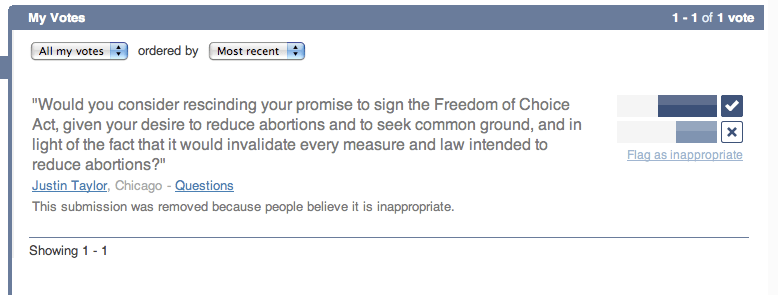
President-elect Barack Obama’s transition team is asking you, the American public, what’s on your mind and to ask Mr. Obama about it. That’s all good, except when a good question gets marked as “inappropriate” and is withdrawn. What qualifies as inappropriate? When you ask, like Justin Taylor did,
“Would you consider rescinding your promise to sign the Freedom of Choice Act, given your desire to reduce abortions and to seek common ground, and in light of the fact that it would invalidate every measure and law intended to reduce abortions?”
It is a tragic thing when someone commits suicide. A life ended prematurely leaves questions, raises doubts, shakes our beliefs. Suicide touches the lives of many, either through a family relationship or through acquaintance. It is so shocking that one cannot ignore it, yet it is something, because it is so disturbing, that is not spoken about widely.
A valuable resource to help that discussion comes from Desiring God and John Piper, who have published services that Pastor Piper has led for those who have committed suicide. For the families who have graciously shared what must have been one of the most painful moments in their lives, we can be grateful in that these powerful messages can give insight, comfort and guidance to those who have or who are struggling with similar circumstances.
[L]et me put a biblical stake in the ground and then fasten to it a banner of hope.
The stake is this: True Christians can commit suicide. Or to put it another way: There is nothing unique or peculiar about the final act of life that makes it determinative in validating or nullifying our salvation. Or let me say it another way: The final season of faith with all its battles and failures is not the only season of faith that will bear witness in the Last Day that we were born again.
Piper, in this message and others, explains with expositional precision why he believes this way. These are questions we don’t ask ourselves or perhaps don’t allow ourselves to ask. But nonetheless they are important because, like my daughter experienced this past week, there will be times when you are confronted with a tragic suicide by someone you knew and questions will come.
The messages are all available online to read or even listen to the audio.
Lindsey writes that for all that he loves about the book, “I wish The Shack had an Acts 17:11 tone: “Now the Bereans were of more noble character than
the Thessalonians, for they received the message with great eagerness and examined the
Scriptures every day to see if what Paul said was true.”
With the book’s repeated message that the Bible has been twisted by churches and pastors and
seminaries (and yes, sometimes it has), I wonder whether readers will walk away from The
Shack with a greater love for Scripture and more of a desire to study it, and more of a desire to
get involved in their churches and submit to their leaders, as Hebrews 13 commands us to. Sadly,
I’m afraid some readers will feel justified in further distancing themselves from both the
Scriptures and the church. And some may read meanings into Scripture that the biblical text itself
contradicts.”
Lindsey says in his review that the portrayal of God and the the Trinity, while entertaining, is flawed and even dangerous.
One reviewer said “Systematic theology was never this good.” This concerns me. While to some
readers God will seem bigger, in certain respects God seemed more amusing and friendly, but
also somewhat smaller, more manageable, less threatening–someone not to be feared. If the
picture of God in The Shack is radically different from the impression people get from just
reading the Bible, this raises an obvious question.
It’s just a novel, just fiction, right? Yes, but when it comes with the hearty endorsement of someone like a Eugene Peterson and comes in a more accessible form than nonfiction books that take a more careful, scholarly approach to exploring the Trinity like Communion With The Triune God by John Owen or The Pleasures of God by John Piper, than it can be dangerous. People who are not well-grounded in the Word will accept something like this as truth.
And if that were not enough of a warning, there is a strong endorsement of universalism that comes through in the novel. This is what Lindsey says in his review:
When I read it without any preconceived notions, I noticed things in The Shack that hint at universalism. E.g., in the passage where “Papa,” God the Father, says—speaking of Buddhists and Muslims—that he doesn’t desire to make them “Christian.” What the author means by Christian is obviously critical. Some could argue that “Christian” is a cultural designation, that all Americans are Christian, Saudis are Muslim, etc., and that Christian is not a helpful term.
There is some truth to that, but Acts 11 says the disciples were first called Christians at Antioch. That wasn’t cultural; it referred to true followers of Christ. So since this is in the Word of God, I don’t think it’s wise to portray God as disregarding the term Christian to the point that he would say he doesn’t want to make people Christian.
Lindsey does a thorough job of examining the book in his review. You would do well to read it and decide for yourself.
My younger brother, who posts at Jedi Blog when he’s not doing his job as a major in the U.S. Army, has written a moving piece about something we can all relate to in some sense. Imagine being in a place that is far from the ones you love, where a good many people hate your guts, where the conditions are hard and you work long hours. Now imagine that the conditions you’ve been adapting to just got worse. Would you complain? Would you feel sorry for yourself? It would be so easy, and my brother makes it clear in his writing that the was definitely the mood. That is, until something changed.
Read here to find out what and then ask yourself if you’ve maybe been feeling sorry for yourself lately.





 I know that while I’ve already linked to the comprehensive
  My younger brother, who posts at
  Rockstanding
You must be logged in to post a comment.