Overcome the fear of living

I have mentioned it earlier, but I can’t recommend high enough Kevin DeYoung’s excellent “Just Do Something: A Liberating Approach to Finding God’s Will.” This little book will have a deep impact on your view of approaching God’s will and what it means. Here is how DeYoung puts it:

The will of God isn’t a special direction here or a bit of secret knowledge there. God doesn’t put us in a maze, turn out the lights, and tell us, “Get out and good luck.” In one sense, we trust in the will of God as His sovereign plan for our future. In another sense, we obey the will of God as His good word for our lives. In no sense should we be scrambling around trying to turn to the right page of our personal choose-your-own-adventure novel.

God’s will for your life and my life is simpler, harder, and easier than that. Simpler, because there are no secrets we must discover. Harder, because denying ourselves, living for others, and obeying God is more difficult than taking a new job and moving to Fargo. Easier, because as Augustine said, God commands what He wills and grants what He commands.

Thank you to Kevin DeYoung for writing this book. Just do something. Buy this book and read it.

He tried? Let Shai Linne explain Particular Redemption to you

Hip-hopper Shai Linne lays out a solid lesson for us in his song Mission Accomplished. Class is now in session. As he says, “Lord, thank you for the cross.”


Verse 1

Here’s a controversial subject that tends to divide
For years it’s had Christians lining up on both sides
By God’s grace, I’ll address this without pride
The question concerns those for whom Christ died
Was He trying to save everybody worldwide?
Was He trying to make the entire world His Bride?
Does man’s unbelief keep the Savior’s hands tied?
Biblically, each of these must be denied
It’s true, Jesus gave up His life for His Bride
But His Bride is the elect, to whom His death is applied
If on judgment day, you see that you can’t hide
And because of your sin, God’s wrath on you abides
And hell is the place you eternally reside
That means your wrath from God hasn’t been satisfied
But we believe His mission was accomplished when He died
But how the cross relates to those in hell?
Well, they be saying:

God knows He tried (8x)

Verse 2

Father, Son and Spirit: three and yet one
Working as a unit to get things done
Our salvation began in eternity past
God certainly has to bring all His purpose to pass
A triune, eternal bond no one could ever sever
When it comes to the church, peep how they work together
The Father foreknew first, the Son came to earth
To die- the Holy Spirit gives the new birth
The Father elects them, the Son pays their debt and protects them
The Spirit is the One who resurrects them
The Father chooses them, the Son gets bruised for them
The Spirit renews them and produces fruit in them
Everybody’s not elect, the Father decides
And it’s only the elect in whom the Spirit resides
The Father and the Spirit- completely unified
But when it comes to Christ and those in hell?
Well, they be saying:

God knows He tried (8x)

Verse 3

My third and final verse- here’s the situation
Just a couple more things for your consideration
If saving everybody was why Christ came in history
With so many in hell, we’d have to say He failed miserably
So many think He only came to make it possible
Let’s follow this solution to a conclusion that’s logical
What about those who were already in the grave?
The Old Testament wicked- condemned as depraved
Did He die for them? C’mon, behave
But worst of all, you’re saying the cross by itself doesn’t save
That we must do something to give the cross its power
That means, at the end of the day, the glory’s ours
That man-centered thinking is not recommended
The cross will save all for whom it was intended
Because for the elect, God’s wrath was satisfied
But still, when it comes to those in hell
Well, they be saying:

God knows He tried (8x)


HT: Reformed Theology

Love is the essence of God

From Tim Keller in “The Reason For God: Belief in the Age of Skepticism“:

If there is no God, then everything in and about us is the product of blind impersonal forces. The experience of love may feel significant, but evolutionary naturalists tell us that it is merely a biochemical state in the brain.

But what if there is a God? Does love fare any better? It depends on who you think God is. If God is unipersonal, then until God created other beings there was no love, since love is something that one person has for another. This means that a unipersonal God was power, sovereignty, and greatness all from eternity, but not love. Love then is not the essence of God, nor is it at the heart of the universe. Power is primary.

However, if God is triune [Father, Son, Holy Spirit], then loving relationships in community are the “great fountain … at the center of reality.” When people say “God is love,” I think they mean that love is extremely important, or that God really wants us to love. But in the Christian conception, God really has love as his essence. If he was just one person he couldn’t have been loving for all eternity.

Graduation special from Desiring God

The fine folks at Desiring God are offering significant discounts on some great material.


The Essential Piper Trilogy: Desiring God, Future Grace

and The Pleasures of God
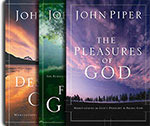
EssentialPiper

DESIRING GOD:The message of Desiring God is that God is most glorified in us when we are most satisfied in him. In this book, Piper calls this worldview “Christian Hedonism” and explains why pursuing maximum joy is essential to glorifying God. He discusses the implications of this for conversion, worship, love, Scripture, prayer, money, marriage, missions, and suffering.

FUTURE GRACE: What is future grace? It is all that God promises to be for us from this second on. Saving faith means being confident and satisfied in this ever- arriving future grace. This is why saving faith is also sanctifying faith. The power of sin’s promise is broken by the power of a superior satisfaction; namely, faith in future grace. Gratitude for past grace was never meant to empower future obedience. Tomorrow’s crisis demands tomorrow’s grace. And faith that future grace will be there is the victory that overcomes the world. Future Grace contains 31 chapters – one for each day of the month – including practical chapters on how faith in future grace defeats anxiety, pride, shame, lust, despondency and more.

THE PLEASURES OF GOD: One way to see the glory of God is to meditate upon the object of his delight. In this reissued version with a new cover design, John Piper unfolds for us a vision of God through the lens of his happiness. What most delights the happiest Being in the universe? God’s gladness in being God. If God’s excellencies can be admired in his pleasures, and if we tend to become like what we admire and enjoy, then focusing on these pleasures can help us to be gradually conformed to his likeness. In other words, we will be most satisfied in God when we know why God is most satisfied in God.

Don’t Waste Your Life Book and DVD Set

DWasteYLife

DON’T WASTE YOUR LIFE STUDY EDITION: In this book John Piper describes his journey toward one great, single passion—endless joy in the crucified Christ—and challenges the reader to the same pursuit. The cost is great. But the joy is worth any cost.

DON’T WASTE YOUR LIFE 3-DVD SET: In this 3-DVD set, John Piper challenges viewers to wake up from the American dream to the soul-saving reality that “to live is Christ and to die is gain.”

* Disc 1: Book Study Edition DVD with ten 15-minute teaching sessions. These lessons are designed for smaller groups and work in tandem with the Don’t Waste Your Life group study materials (book, study guide).

* Discs 2-3: Conference Edition DVDs with four new, hour-long messages. These messages enable you to conduct your own Don’t Waste Your Life event or class.

The Complete Romans Series

Romansseries

After 18 years of preaching at Bethlehem Baptist Church, John Piper felt the time had come to preach through Paul’s letter to the Romans. “The glory of Christ, who is the image of God (2 Corinthians 4:4), seems more glorious to me now than it ever has. And there is no greater exposition of the Gospel of God than the book of Romans… I have a deep confidence that the best way to be lastingly relevant is to stand on rock-solid, durable old truths, than jumping from one pragmatic bandwagon to another. Romans is as solid and durable and reliable and unshakable as truth can get.” Come and worship through the Book of Romans with us!

Note on the format: MP3 DVDs can be played in computers with DVD drives and some DVD players. For best results put this DVD in the computer’s DVD drive and copy the MP3 files to your computer’s media player. They will not play in standard CD players.

As it says at the Desiring God site, there is always more to learn, always more to be excited about and more to love God for. As young men and women go off to school next fall, these resources can help them grow even more. Go here to see more information.


In this book John Piper describes his journey toward one great, single passion—endless joy in the crucified Christ—and challenges the reader to the same pursuit. The cost is great. But the joy is worth any cost.

What makes a Calvinist a Calvinist?

Kevin DeYoung wrote this for Christian Research Journal, which you can subscribe to or find at your local Christian bookstore. It’s about the rise of the New Calvinism:

The influence of Calvinism is growing because its God is transcendent and its theology is true. In a day when “be better” moralism passes for preaching, self-help banality passes for counseling, and “Jesus is my boyfriend” music passes for worship in some churches, more and more people are finding comfort in a God who is anything but comfortable. The paradox of Calvinism is that we feel better by feeling worse about ourselves, we do more for God by seeing how He’s done everything for us, and we give love away more freely when we discover that we have been saved by free grace.

I’d like to think that we are Calvinists because of what we see in the Bible. We see a God who is holy, independent, and unlike us. We glory in God’s goodness, that He should save miserable offenders, bent toward evil in all our faculties, objects of His just wrath. We rejoice in God’s electing love, which He purposed for us before the ages began. We are grateful for God’s power by which He caused us, without our cooperation, to be born again and enabled us to believe His promises. We take comfort in God’s all-encompassing providence, whereby nothing happens according to chance, but all things—prosperity or poverty, health or sickness, giving or taking away—are sent to us by our loving heavenly Father.

As Calvinists and Christians, we praise God for His mercy, shown to us chiefly on the cross where His Son died, not just to make a way for us to come to Him, but effectually for us such that our sins, our guilt, and our punishment all died in the death of Christ. We find assurance in God’s preserving grace, believing with all our might that nothing—not even ourselves—can separate us from the love of God in Christ Jesus our Lord. We delight in the glory of God and in God’s delight for His own glory, which brings us, on our best days, unspeakable joy, and on all other days, still gives purpose and order to an otherwise confusing and seemingly random world.

What draws people to Reformed theology is the belief that God is the center of the universe and we are not, that we are worse sinners than we imagine and God is a greater Savior than we ever thought possible, that the Lord is our righteousness and the Lord alone is our boast.

Don’t look to your past. Look to Jesus.

“Would you like to be rid of this spiritual depression? The first thing you have to do is to say farewell now once and forever to your past. . . . Never look back at your sins again. Say, ‘It is finished, it is covered by the Blood of Christ.’ That is your first step. Take that and finish with yourself and all this talk about goodness, and look to the Lord Jesus Christ. It is only then that true happiness and joy are possible for you. What you need is not to make resolutions and to live a better life, to start fasting and sweating and praying. No! You just begin to say, ‘I rest my faith on Him alone, who died for my transgressions to atone.'”

D. Martyn Lloyd-Jones, Spiritual Depression, p. 35.


HT: Zach Nielsen

When everyone will give account

So then each of us will give an account of himself to God. — Romans 14:12

If you notice, that verse says “each of us.” That means believers and unbelievers alike. So, the question is, what if, as a believer, I have a poor account to give on that day? What we need to remember is that when we were saved by God, Christ covered our sins on the cross — past and future. But we also know that we still struggle daily against sins and thus need to continually look to the sacrifice Christ made for us (I John 1:9). 

The thing to remember is that we are NOT saved by our works but by the blood of Christ. If we are pointing to a lifetime of good works as our salvation then we are relying on our own efforts and not Christ’s. And we will not enter into the Kingdom of God. Instead, our acceptance on that day will be on the basis of Christ’s atoning death.

What then, is the purpose of our deeds once we have been saved? The recounting of our deeds will be evidence that Christ died for us. For some there will be ample fruit, and for others there will be little to point to. Both, however, will enter based on the blood of Christ. Depending on what fruit was shown in our deeds, we will be rewarded accordingly in the kingdom to come.

For more on this, see John Piper’s recent Q&A at Desiring God.

People of the Book

The brothers immediately sent Paul and Silas away by night to Berea, and when they arrived they went into the Jewish synagogue. Now these Jews were more noble than those in Thessalonica; they received the word with all eagerness, examining the Scriptures daily to see if these things were so. Many of them therefore believed, with not a few Greek women of high standing as well as men. — Acts 17:10-12

This was the passage we looked at today at church. In the passage, it says the people in Berea “were more noble” than those in Thessalonica, who expelled Paul and Silas from their midst. In the ESV Study Bible, it says: Noble translates the Greek eugenēs, which originally meant “of noble birth” or “well born.” The word was also applied to people who exhibited noble behavior, in that they were open-minded, fair, and thoughtful.

In other words, Luke is commending those who are open-minded when it comes to examining the scripture, those who look to it daily, examining what it says and not trying to shape it with their own biases and preconceived ideas. It is my prayer that I will seek God’s word so that it may teach me, rebuke me, encourage me, shock me and ultimately make me into someone who knows God intimately. The world likes to tell you what the Bible says and how it is either right or wrong about what we see every day. Instead, we need to go to the Bible first and let it be the prism through which we see everything else.

God stands alone

Just to be clear, here is what God says in the Bible about whether there is anyone — or anything – like him in all the universe. So, then the next thing is, do you know him?


HT: Abraham Piper at Desiring God

Lectures on ‘The Pastor as Scholar, and the Scholar as Pastor’

On Thursday, April 23, 2009, at Park Community Church in Chicago, IL, the Carl F. H. Henry Center for Theological Understanding of Trinity Evangelical Divinity School hosted Dr. John Piper ofBethlehem Baptist Church and Dr. D. A. Carson of Trinity Evangelical Divinity School. Titled “The Pastor as Scholar, and the Scholar as Pastor: Reflections on Life and Ministry with John Piper and D.A. Carson”, the evening featured hour-long lectures by Drs. Piper and Carson offering reflections of a theological and personal nature on the work of the pastor and the scholar, respectively. Below are video links to their talks.

Carson talk

Pastor as Scholar