New ground being broken in Georgia on embryo adoptions

From the Christian Examiner:

ATLANTA — The nation’s first law governing the adoption of embryos is set to take effect in Georgia after being passed by the legislature and signed by the governor.

The “Option of Adoption Act,” which will go into effect July 1, will provide safeguards for both parties involved in an embryo adoption, which is a unique form of adoption in which a couple — often an infertile one — adopts one or more surplus embryos from a couple who has undergone in-vitro fertilization (IVF).

Embryo adoption allows the adopting mother to experience pregnancy and has been promoted by pro-lifers for years but, until now, has not been governed by the laws of any state. Significantly, the Georgia bill amends Georgia’s adoption laws to make clear that embryo adoption in fact is a form of adoption. The law also allows adoptive parents to file in court for a final order of adoption (for the child who is born as the result of the embryo adoption), which supporters of the new law say clarifies that the adopting parents are eligible for claiming some but not all of their expenses for the federal adoption tax credit, which this year is more than $11,000.

Although embryo adoption tends to be cheaper than traditional adoption it nevertheless can still cost several thousands of dollars.

Couples who undergo an embryo adoption in a state without such a law as Georgia’s must sign private legal contracts that treat the embryo as property. The new Georgia law defines an embryo as “an individualized fertilized ovum of the human species from the single-cell stage to eight-week development.”

The law has the support of the nation’s embryo adoption programs, including Nightlight Christian Adoptions, which runs the nation’s oldest embryo adoption program — the Snowflakes program.

“Science has outpaced our legislation in clarifying the rights of the parties in potential disputes involving embryo transfer between families,” Ron Stoddart, executive director of Nightlight Christian Adoptions, previously told Baptist Press. “There needs to be certainty, particularly before an embryo is thawed and implanted in the womb of an adopting mother.”

HT: Zach Nielsen
The wave that will sweep you away: Google shows how

The demonstration is a little rough in spots, but the idea of combining all of these into one app is amazing. Google Wave will really be something when it hits.


HT: Andy Wibbels

Inflicting pleasure: Perhaps Huxley was right?

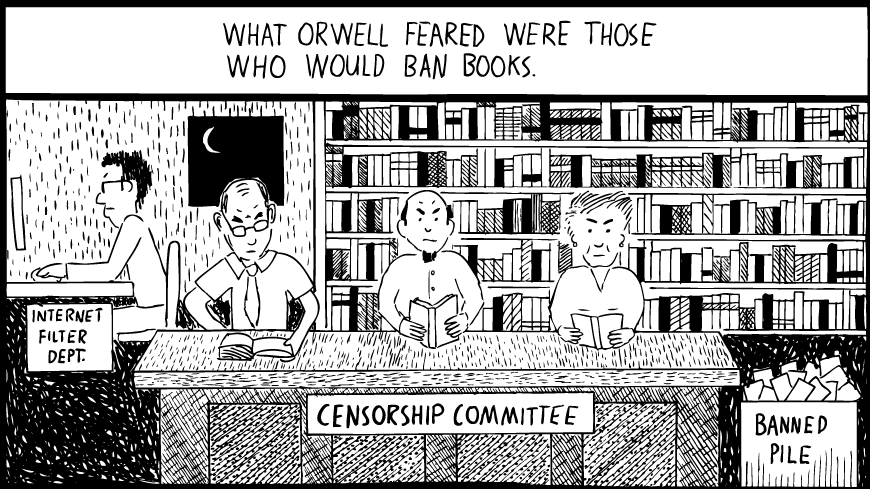
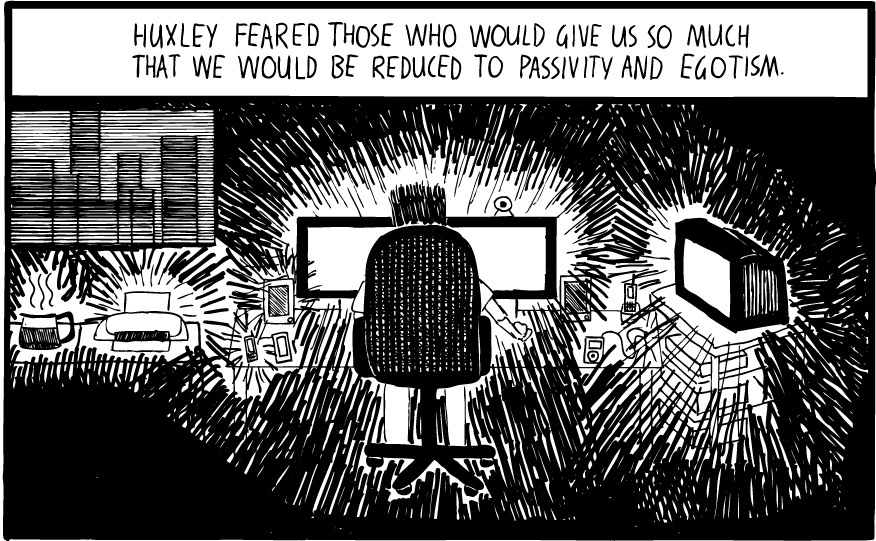
From the foreward of Neil Postman’s Amusing Ourselves to Death: Public Discourse in the Age of Show Business, where he suggests that Aldous Huxley may have had a better idea of what the future held than George Orwell did in his classic 1984:

But we had forgotten that alongside Orwell’s dark vision, there was another – slightly older, slightly less well known, equally chilling: Aldous Huxley’sBrave New World. Contrary to common belief even among the educated, Huxley and Orwell did not prophesy the same thing. Orwell warns that we will be overcome by an externally imposed oppression. But in Huxley’s vision, no Big Brother is required to deprive people of their autonomy, maturity and history. As he saw it, people will come to love their oppression, to adore the technologies that undo their capacities to think.

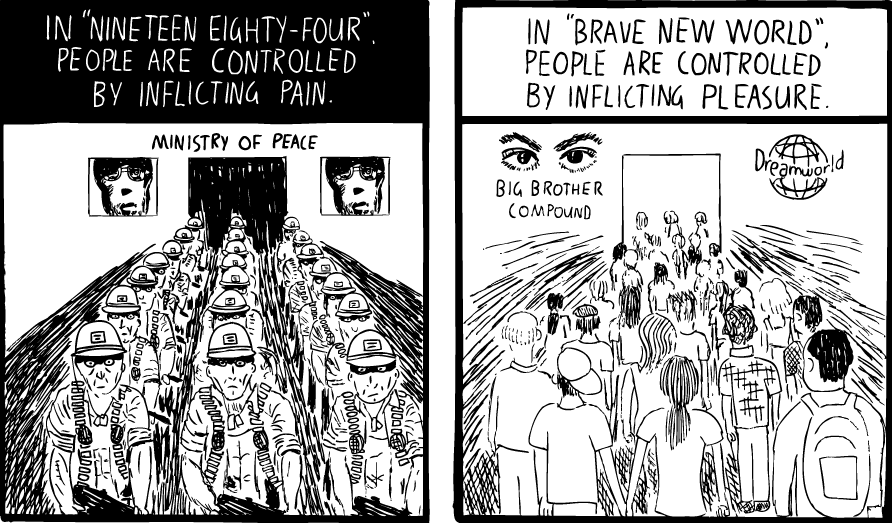
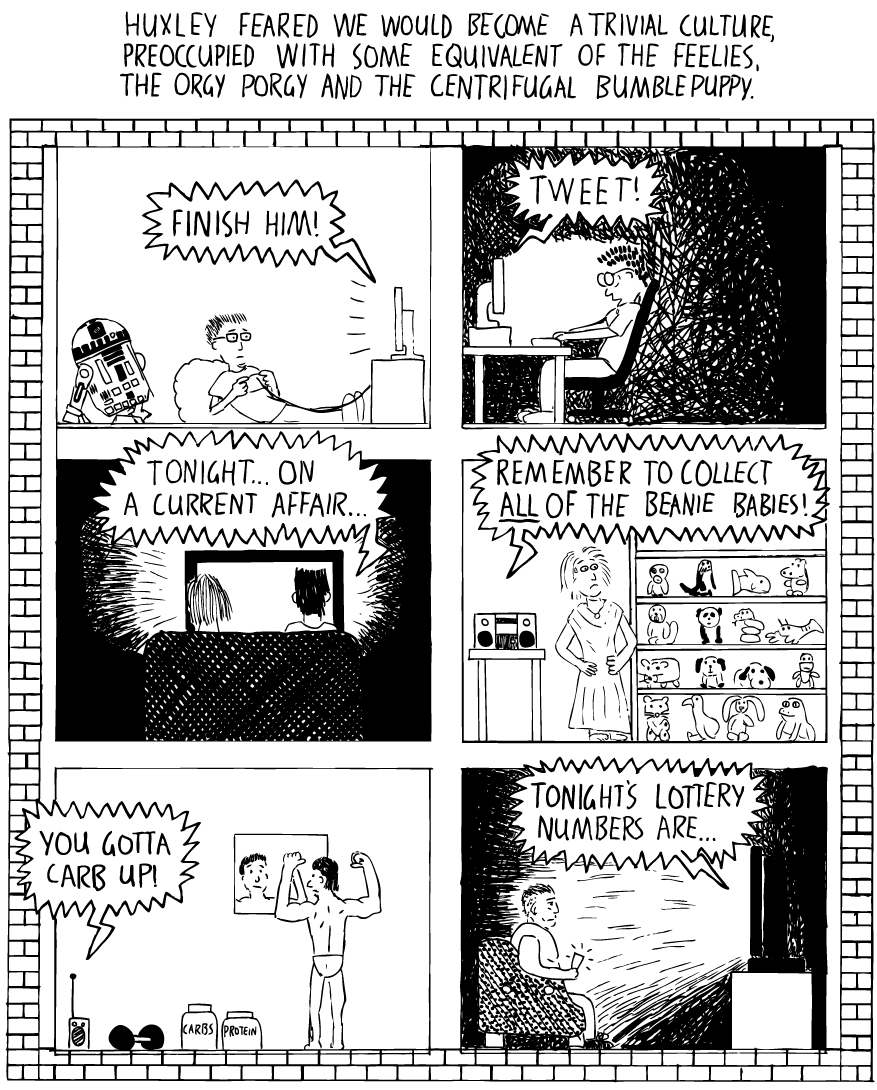
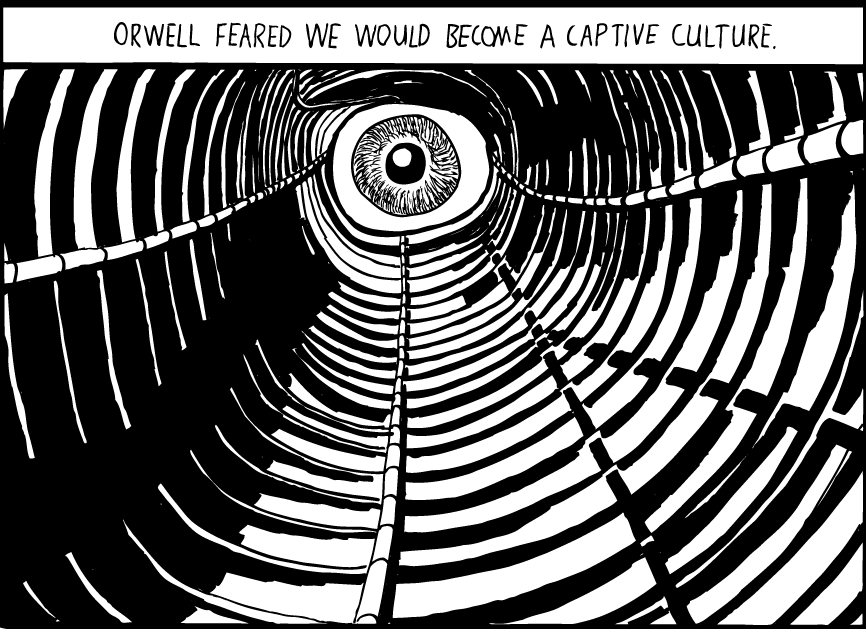
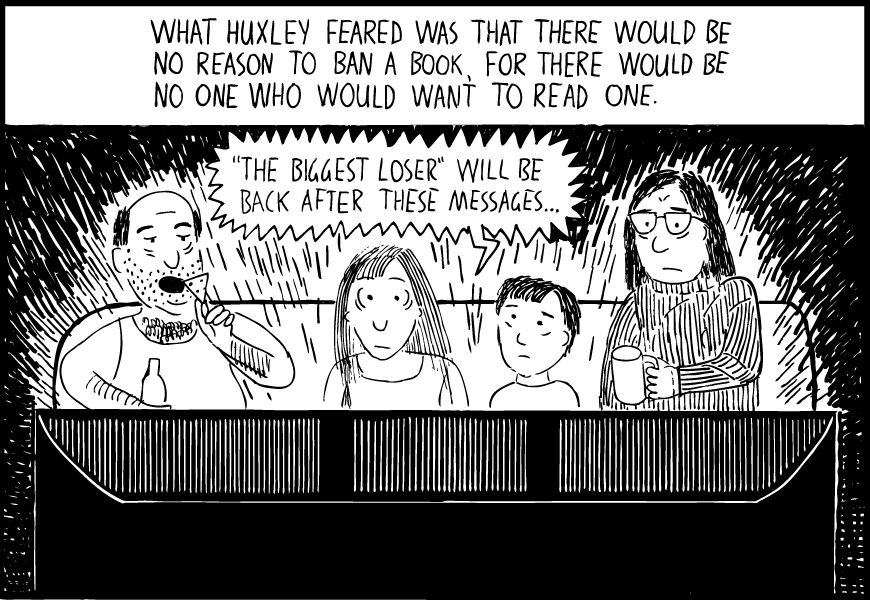
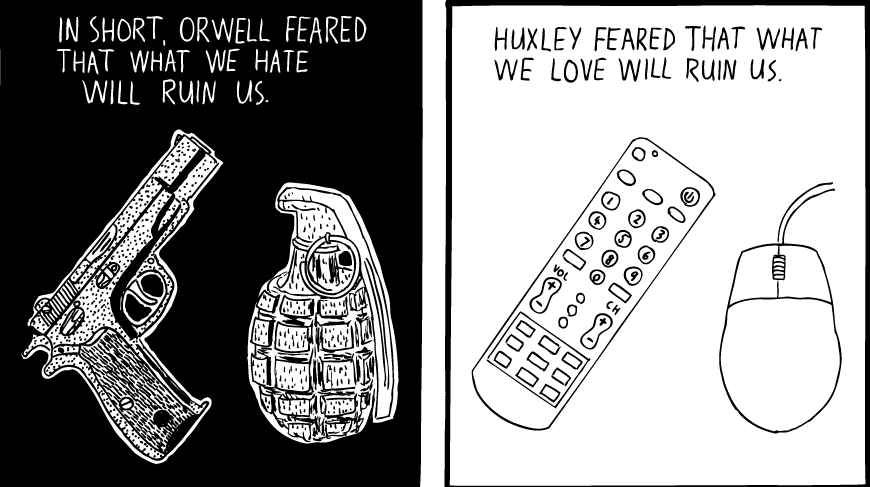
What Orwell feared were those who would ban books. What Huxley feared was that there would be no reason to ban a book, for there would be no one who wanted to read one. Orwell feared those who would deprive us of information. Huxley feared those who would give us so much that we would be reduced to passivity and egoism. Orwell feared that the truth would be concealed from us. Huxley feared the truth would be drowned in a sea of irrelevance. Orwell feared we would become a captive culture. Huxley feared we would become a trivial culture, preoccupied with some equivalent of the feelies, the orgy porgy, and the centrifugal bumblepuppy. As Huxley remarked in Brave New World Revisited, the civil libertarians and rationalists who are ever on the alert to oppose tyranny “failed to take into account man’s almost infinite appetite for distractions”. In 1984, Huxley added, people are controlled by inflicting pain. In Brave New World, they are controlled by inflicting pleasure. In short, Orwell feared that what we hate will ruin us. Huxley feared that what we love will ruin us.

This book is about the possibility that Huxley, not Orwell, was right.

Drawings by Stuart McMillen, Recombinant Records


“Do not lay up for yourselves treasures on earth, where moth and rust [1] destroy and where thieves break in and steal, but lay up for yourselves treasures in heaven, where neither moth nor rust destroys and where thieves do not break in and steal. — Matthew 6:19-20


HT: Justin Taylor

Hold your twittering, please

TwitterphoneJosh Harris posted some good thoughts about how his church recommends that worshippers not to use Twitter during services. John Piper agrees. Harris brings six points, which I think are helpful. This one is particularly good:

The most important thing I can do while I’m sitting under the preaching of God’s word is to listen to what God is saying to me. I need to actively engage my heart and mind to receive. Twitter, takes the focus off of hearing and receiving and and makes it broadcasting and sharing. So instead of my mind being engaged with thoughts of “What is the Word of God saying to me?” when I start “tweeting” my focus becomes, “What do I want to say? What do Iwant to express? What am I thinking?”

Along those lines, Piper adds these thoughts:

There is an assumption that Josh and I share, which is not understood or embraced by all. Preaching and hearing preaching are worship. Preaching is expository exultation. The preacher is explaining the Bible and applying the Bible and EXULTING over the truth in the Bible. The listener is understanding, and applying, and joining in the exultation. Hearing preaching is heart-felt engagement in the exposition and exultation of the Word of God.

This is a fragile bond. The fact that an electric cord is easily cut, does not mean that the power flowing through it is small. It produces bright and wonderful effects. So it is with preaching. Great power flows through fragile wires of spiritual focus.

The point is, we already need to battle the temptation for distraction when we are worshipping. It isn’t just twittering. Before Twitter ever came along there were myriads of things that come before us to break the focus on what God is revealing to us through worship. Don’t add another one.

And, finally, when it is over both men make clear that then yes, by all means twitter. Tell people what you have heard. Share it. Exult in it. But get the message first, that’s all.

The Kindle DX is here. Can it save newspapers?

kindledxAmazon today announced the new 9.7-inch Kindle DX, along with deals from textbook and newspaper publishers. The new e-reader is priced at $489 and will be shipped this summer.

What’s the big deal? According to MacRumors:

The Kindle DX, now available for pre-order at a price of $489 for shipment this summer, contains a 9.7″ screen and is being positioned as a device for reading documents such as newspapers, textbooks, and research journal articles whose formats have not worked ideally with the smaller 6″ screen of the current Kindle 2 model.
The Kindle DX features a built-in accelerometer that allows for auto-rotation of content between portrait and landscape orientations, and increased storage over the Kindle 2 of 3.3 GB, which provides space for up to 3,500 books periodicals, and documents. Like the Kindle 2, which will remain available at its current price of $359, the Kindle DX offers free 3G access through Sprint’s network to allow downloading of content on the go. Native PDF support is also included.
The Boston Globe, The New York Times and The Washington Post are all planning to offer long-term subscriptions for Kindle newspaper editions at discounted prices.

The Kindle DX is being positioned as a device for reading documents such as newspapers, textbooks, and research journal articles whose formats have not worked ideally with the smaller 6″ screen of the current Kindle 2 model.

The Kindle DX features a built-in accelerometer that allows for auto-rotation of content between portrait and landscape orientations, and increased storage over the Kindle 2 of 3.3 GB, which provides space for up to 3,500 books periodicals, and documents. Like the Kindle 2, which will remain available at its current price of $359, the Kindle DX offers free 3G access through Sprint’s network to allow downloading of content on the go. Native PDF support is also included.

The Boston Globe, The New York Times and The Washington Post are all planning to offer long-term subscriptions for Kindle newspaper editions at discounted prices.

How the ESV Online Study Bible helps daily devotions

ESV Study BibleI use the ESV daily reading plan as I do my devotions. In many of the versions you get from Crossway these days, those plans are often printed right in the Bible, so it’s a great way to keep track of where you should should be for that day. Lately, as I’ve done more Bible study online, I’ve come to appreciate the tools the ESV and other groups have to aid in devotions.

As you well may know, this month the ESV is offering a free tryout of its ESV Online Study Bible. I can’t tell you how much this is a great way to study the Bible. One advantage of using the study Bible online over the print version is having the audio Bible available. I love this feature. It is good to have the capable voice of David Cochran Heath when you are going through Old Testament passages where unfamiliar names can often cause you to stumble.

Another great way the online study Bible aids devotions — and especially daily reading as you go through the Bible — is its ability to group diverse passages on one Web page. So, for instance, today I was able to take the four passages I was reading in my daily reading plan — Psalm 83; Exodus 27:20-28:43; Nehemiah 9; 1 Corinthians 1:18-31 — and have them (and all the accompanying notes!) on the same page. The key to doing this is to make sure you put the semicolon between passages to separate them. This is a great way to go through them without having to flip from section to section. Plus you can also listen to each of them this way to.

God’s word is a treasure, and I am so thankful that I can have it and read it and listen to it and memorize it and share it with others. There are so many ways you can have it, especially in our culture, that there should be no excuse to not read it.