Turning to the Psalms in despair and in hope: Good counsel from Dr. Martyn Lloyd-Jones

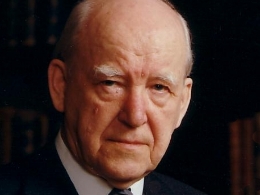
Dr. Martyn Lloyd-Jones, the great preacher of the 20th Century, wrote “Spiritual Depression: Its Causes and Its Cure,” a collection of 21 sermons he originally delivered at Westminster Chapel in London. “Christian people.” writes Lloyd-Jones, “too often seem to be perpetually in the doldrums and too often give this appearance of unhappiness and of lack of freedom and absence of joy. There is no question at all but that this is the main reason why large numbers of people have ceased to be interested in Christianity.”

Believing that Christian joy was one of the most potent factors in the spread of Christianity in the early centuries. Lloyd-Jones not only lays bare the causes that have robbed many Christians of spiritual vitality but also points the way to the cure that is found through the mind and spirit of Christ.

This summer, John Piper is going through the Psalms in a sermon series at Bethlethem Baptist Church in Minneapolis. Last week’s sermon, “Spiritual Depression in the Psalms,” leans on Lloyd-Jones’ work and looks at how Psalm 42 is an antidote for depression. Below is an excerpt, go here for the whole sermon.

How pain points us to God

Every day, each one of faces pain in our life. There is emotional and spiritual pain, for sure, but there is also physical pain. In my case, the pain is a sore back and joints that bark at me more or less each day, reminding me that my body is aging more each day and that my hope lies in more than this earthly body.

Among the people I know, I see people who I know love and trust God deal with varying degrees of pain. My struggles with my back pale in comparison and I am almost embarrassed to mention my own complaints. It is one thing to live a joyful life in God when you are feeling terrific, but what does it say about God when we are hurting?

Do we hurt because of the Fall? Does God use pain for a reason in our lives? In his review of Pain and Its Transformations, Phillip Yancey explores the wonder of pain in our bodies:

Every square millimeter of the body has a different sensitivity to pain, so that a speck of dirt may cause excruciating pain in the vulnerable eye whereas it would go unreported on the tough extremities. Internal organs such as the bowels and kidneys have no receptors that warn against cutting or burning—dangers they normally do not face—but show exquisite sensitivity to distention.

When organs such as the heart detect danger but lack receptors, they borrow other pain cells (“referred pain”), which is why heart attack victims often report pain in the shoulder or arm. The pain system automatically ramps up hypersensitivity to protect an injured part (explaining why a sore thumb always seems in the way) and turns down the volume in the face of emergencies (soldiers often report no pain from a wound in the course of battle, only afterwards).

Pain serves us subliminally as well: sensors make us blink several times a minute to lubricate our eyes and shift our legs and buttocks to prevent pressure sores. Pain is the most effective language the body can use to draw attention to something important.

Read More »

Fight to go forward or you will regress

Fight the good fight of the faith. Take hold of the eternal life to which you were called and about which you made the good confession in the presence of many witnesses. — I Timothy 6:12

John Piper spoke at New Attitude over the weekend in Louisville, Ky. His two messages were Fighting for Faith with God’s Word and William Tyndale: A Life Transformed by God’s Word. New Attitude is a conference that has been going on for a few years, promoting something called humble orthodoxy. Of particular interest — and benefit — is his how-to for studying your Bible regularly.

More free resources for you: Dr. Martyn Lloyd-Jones

Dr. Martyn Lloyd-JonesFrom OnePlace.com:

Dr Martyn Lloyd-Jones (1899 – 1981) has been described as ‘a great pillar of the 20th century Evangelical Church’. Born in Wales, and educated in London, he was a brilliant student who embarked upon a short, but successful, career as a medical doctor at the famous St Bartholemew’s Hospital. However, the call of Gospel ministry was so strong that he left medicine in order to become minister of a mission hall in Port Talbot, South Wales. Eventually he was called to Westminster Chapel in London, where thousands flocked to hear his ‘full-blooded’ Gospel preaching, described by one hearer as ‘logic on fire’. With some 1600 of his sermons recorded and digitally restored, this has left a legacy which is now available for the blessing of another generation of Christians around the world – ‘Though being dead he still speaks’.

You can hear sermons from this great preacher for free! at OnePlace.com (with registration). If you own an iPod or an MP3 player, this is a great way to fill it with awesome encouragement, teaching and counsel. If you don’t you can still listen online for free.

Free audio for you to take advantage of

Here are some free things for you to investigate and one that’s worth the price for your own nourishment.

John Lennox (M.A., Ph.D., D.Phil.,), Research Fellow in Mathematics and the Philosophy of Science and Pastoral Advisor at Green College, University of Oxford recently gave a seminar on God and Richard Dawkins, which is now being offered online at BeThinking.org

For a little background, Lennox debated Dawkins last October in Birmingham, Ala. The debate was sponsored by Fixed-Point Foundation, which now offers videos of the event. Both men debated points from Dawkins’ book, “The God Delusion” before an audience of Christians and atheists. Even though this is not a free resource, I would strongly encourage you to see the debate because Lennox pokes all kinds of holes in the arguments Dawkins makes in his book while giving a vigorous defense of Christianity.

My personal connection with this is that Larry Taunton, the founder and executive director of Fixed-Point Foundation, and his wife Lauri are good friends of my wife and mine who we’ve known since high school. Larry and his family were gracious hosts of my in-laws last fall during the debate. But even without that connection, I would still strongly endorse the video. As a followup, Fixed-Point will be sponsoring a debate between Dinesh D’Souza and Christopher Hitchens in September. Hitchens, you may remember, is the author of “God is not Great: How Religion Poisons Everything.”

In His Own Words
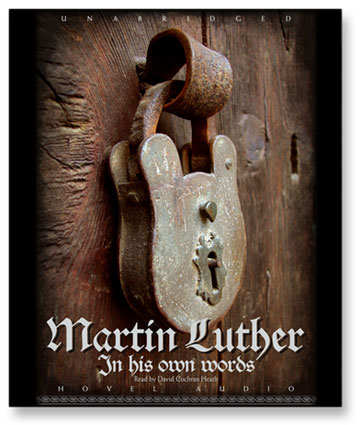
And, if you are itching for some more great audio, then you should head over online to ChristianAudio.com and download Martin Luther: In His Own Words (unabridged). From the site:

Each month christianaudio.com gives away a premium audiobook download for free. The way our Free Audiobook of the Month program works is like this: we give away one audiobook download each month totally free. The audiobook we give away is available for free only once – ever.

Use the coupon code MAY2008 to redeem this month’s free audiobook download from christianaudio.com

There are other great free sources out there, but this should be enough to get you started. More later.

HT: Justin Taylor and Tony Kummer

Stand firm in Christ

Dietrich Bonhoeffer
For freedom Christ has set us free; stand firm therefore, and do not submit again to a yoke of slavery.
Galatians 5:1

It is a hard thing to imagine standing against all that you live for, unless you know Someone greater than that. This Bible for Life spot from the ESV is a powerful reminder that God is greater than all.

Dietrich Bonhoeffer

John Piper says “Don’t Waste Your Pulpit”

First of all, I am not a pastor. I will say this: I am glad that my pastor values the word of God and does take time every Sunday to explain it to us. In the clip below, John Piper exhorts pastors to preach God’s word and not their own thoughts. It is a tragic thing when churches become places of topical discussion when we know that “faith comes by hearing, and hearing though the word of Christ.

HT: Provocations and Pantings

O Help My Unbelief

And when they came to the disciples, they saw a great crowd around them, and scribes arguing with them. And immediately all the crowd, when they saw him, were greatly amazed and ran up to him and greeted him. And he asked them, “What are you arguing about with them?” And someone from the crowd answered him, “Teacher, I brought my son to you, for he has a spirit that makes him mute. And whenever it seizes him, it throws him down, and he foams and grinds his teeth and becomes rigid. So I asked your disciples to cast it out, and they were not able.” And he answered them, “O faithless generation, how long am I to be with you? How long am I to bear with you? Bring him to me.” And they brought the boy to him. And when the spirit saw him, immediately it convulsed the boy, and he fell on the ground and rolled about, foaming at the mouth. And Jesus asked his father, “How long has this been happening to him?” And he said, “From childhood. And it has often cast him into fire and into water, to destroy him. But if you can do anything, have compassion on us and help us.” And Jesus said to him, “‘If you can’! All things are possible for one who believes.” Immediately the father of the child cried out and said, “I believe; help my unbelief!” And when Jesus saw that a crowd came running together, he rebuked the unclean spirit, saying to it, “You mute and deaf spirit, I command you, come out of him and never enter him again.” And after crying out and convulsing him terribly, it came out, and the boy was like a corpse, so that most of them said, “He is dead.” But Jesus took him by the hand and lifted him up, and he arose. And when he had entered the house, his disciples asked him privately, “Why could we not cast it out?” And he said to them, “This kind cannot be driven out by anything but prayer.”

Mark 9:14-29

When you are being taught composition, one of the things the teacher will tell you is that you should never begin a sentence with a conjunction — “and,” “but” or “or.” You don’t do it. It is not proper. While there are many things to learn from the passage above, one of the things you could learn is that God did not respect the rules of English grammar when he inspired the Bible. After reading this particular story, you are struck by the avalanche of “Ands” that begin each sentence.

They’re like blows coming down. And this happened. And then this. And this. And then this. It’s like there are numerous issues piling up that Jesus must deal with, and they are not easy. But he does. Miraculously. It’s like he just takes the worst of the situation and shows he is totally in control. As I read it I am struck with how I often get buried under the “ands” and lose sight of who Jesus really is. I am ashamed and, like the boy’s father, I want to cry out, too, “I believe. Help my unbelief.”

Every day there are things that I struggle with, but the biggest thing is my unbelief. Do I really believe God is who he says he is and will I trust him. That is my primary battle each day. And so, until the day I die, I fight on. But I know that God will not leave me alone in my battle but will supply me the faith because I am one of his. Thank God.


AWANA awards night

Last night was Awards Night at our church’s AWANA program. AWANA? What is it, you say? AWANA is a program for children that, according to its Web site, “helps parents and churches worldwide raise children and youth to know, love and serve Christ.” Go follow the link to find out more about it, it’s quite the program.

Because I work evenings, I don’t help out there. My son is involved as a clubber (like in a member of the club) and my daughter volunteers. Every Wednesday, dozens of kids show up at church to play games, listen to an adult tell them how to live as a Christian and learn verses from the Bible. If they learn enough verses or complete enough assignments from their workbook, they earn things. Not that learning the precious word of God is a bad thing, but AWANA is there to make Bible memory a fun thing. And these kids have fun.

Maybe I worry too much, but I pray the verses these children are learning are sinking into their hearts and making them tender for God. I think it does happen because every year there are children who will come to Christ. It is a beautiful thing. But, like anything, there are those whose hearts remain hard. The fun and games keep their minds from the hard truth that they are sinners in desperate need of a savior. After all, how much fun is it to know that you are doomed to hell unless you come to Christ?

It is a delicate job trying to keep 20-30 children happy while also getting them to learn what God says about who He is and what that means for them. I am thankful for the adults who volunteer their time to listen to children recite verses or give them counsel. It’s important because there are many kids whose only relationships with Christians occurs on Wednesday nights.

So I sat and watched all these children receive awards for their work (or lack of work, in some cases) during the year. My prayer for these children, my own included, would be that these years in AWANA aren’t pushed aside when they are too old to be clubbers but that they are treasured as a time when their thirst for God and his word increased and they turned to the Bible.

Blessed are those whose way is blameless, who walk in the law of the Lord! — Psalm 119:1

Pray without ceasing

Rejoice always, pray without ceasing, give thanks in all circumstances; for this is the will of God in Christ Jesus for you. — I Thessalonians 5:16-18.

Prayer

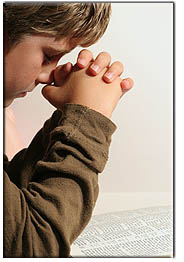
We are told to “pray without ceasing” in the Bible. John MacArthur, in Pulpit Magazine, explores this question:

Unceasing, incessant prayer is essential to the vitality of your relationship to the Lord and your ability to function in the world. But exactly what does it mean to pray without ceasing?

The first time someone hears about the concept of praying without ceasing it may conjure up the image of Christians walking around with their hands folded, heads bowed, and eyes closed, bumping into things. While certain postures and specific times set aside for prayer have an important bearing on our communication with God, to “pray at all times” obviously does not mean we are to pray in formal or noticeable ways every waking moment. And it does not mean you’re supposed to devote yourself to reciting ritualistic patterns and forms of prayer.

To “pray without ceasing” refers to recurring prayer, not nonstop talking. Prayer is to be a way of life — you’re to be continually in an attitude of prayer. It is living in continual God-consciousness, where everything you see and experience becomes a kind of prayer, lived in deep awareness of and surrender to Him. It should be instant and intimate communication — not unlike that which we enjoy with our best friend.

read more here