You’re not OK: God’s love is conditional yet unconditional

David Powlinson, in his booklet “God’s Love: Better Than Unconditional,” examines what people are intending when they talk about God’s “unconditional love” for them and how they may be not getting it right:

We can do better. Saying “God’s love is unconditional love” is a bit like saying “The sun’s light at high noon is a flashlight in a blackout.” Come again? A dim bulb sustains certain analogies to the sun. Unconditional love does sustain certain analogies to God’s love. But why not start with the blazing sun rather than the flashlight? When you look closely, God’s love is very different from “unconditional positive regard,” the seedbed of contemporary notions of unconditional love. God does not accept me just as I am; He loves me despite how I am; He loves me just as Jesus is; He loves me enough to devote my life to renewing me in the image of Jesus. This love is much, much, much better than unconditional! Perhaps we could call it “contraconditional” love. Contrary to the conditions for knowing God’s blessing, He has blessed me because His Son fulfilled the conditions. Contrary to my due, He loves me. And now I can begin to change, not to earn love but because of love.

. . . You need something better than unconditional love. You need the crown of thorns. You need the touch of life to the dead son of the widow of Nain. You need the promise to the repentant thief. You need to know, “I will never leave you or forsake you.” You need forgiveness. You need a Vinedresser, a Shepherd, a Father, a Savior. You need to become like the one who loves you. You need the better love of Jesus.

If you’re still not convinced, consider a recent post where John Piper examines specific scriptures that point to how there are conditions God has set before us. Consider:

Matthew 25:46 — And these will go away into eternal punishment, but the righteous into eternal life.

Romans 5:1 — Therefore, since we have been justified by faith, we have peace with God through our Lord Jesus Christ

Romans 8:28 — And we know that for those who love God all things work together for good, for those who are called according to his purpose.

John 14:21 — Whoever has my commandments and keeps them, he it is who loves me. And he who loves me will be loved by my Father, and I will love him and manifest myself to him.

James 4:8 — Draw near to God, and he will draw near to you. Cleanse your hands, you sinners, and purify your hearts, you double-minded.

But also consider what aspects of God are really unconditional. That is, his electing love:

Ephesians 1:4-5 — even as he chose us in him before the foundation of the world, that we should be holy and blameless before him. In love he predestined us for adoption as sons through Jesus Christ, according to the purpose of his will

Acts 13:48 — And when the Gentiles heard this, they began rejoicing and glorifying the word of the Lord, and as many as were appointed to eternal life believed.

The danger we need to guard against is having too high a regard of ourselves and too low a regard for God. If we are “OK” we don’t need a savior, and that’s just not the case.

HT: Justin Taylor
The Pursuit of God in Corporate Worship: questions and answers

As a deer pants for flowing streams, so pants my soul for you, O God. My soul thirsts for God, for the living God. When shall I come and appear before God? My tears have been my food day and night, while they say to me all the day long, “Where is your God?” These things I remember, as I pour out my soul: how I would go with the throng and lead them in procession to the house of God with glad shouts and songs of praise, a multitude keeping festival.” Psalms 42:1-4

What does worship as the Body of Christ mean to you? What does it mean to God? Is He indifferent? Pastor John Piper, in a seminar from September 2008 at The Bethlehem Institute, explores some of these questions and more.

Click on the image to view the video

Memorize scripture with your iPod

Don’t let your iPod come between you and time in the Word of God. Rather put the Word of God in your iPod and in your heart. Psalm 119:11 says: “I have stored up your word in my heart, that I might not sin against you.” And it doesn’t just get there unless you hear it, know it and live it.

As I’ve previously mentioned, you can download the audio version of the ESV either as a podcast or entirely to put on your iPod or MP3 player. But, also very helpful, B.C. McWhite shares at the weight of glory how you can put individual passages on your iPod to assist in scripture memory. I know I am always looking for ways to help me and my family “hide the word in our hearts,” so I am very glad to hear this tip.

Who saved you? And how?

PreacherIf all of us are so depraved that we cannot come to God without being born again by the irresistible grace of God, then it is clear that the salvation of any of us is owing to God’s election. Election refers to God’s choosing whom to save. It is unconditional in that there is no condition man must meet before God chooses to save him. Man is dead in trespasses and sins. So there is no condition he can meet before God chooses to save him from his deadness. We are not saying that final salvation is unconditional. It is not. We must meet the condition of faith in Christ in order to inherit eternal life. But faith is not a condition for election. Just the reverse. Election is a condition for faith. It is because God chose us before the foundation of the world that he purchases our redemption at the cross and quickens us with irresistible grace and brings us to faith. – Dr. John Piper, in “What We Believe About the Five Points of Calvinism

Who is the blessed man of Psalm 1?

Tree planted by waterThis is from John Samson at Reformation Theology and it is great to think about:

Harry Ironside, the Bible teacher, told a story of a visit to Palestine years ago by a man named Joseph Flacks. He had an opportunity to address a gathering of Jews and Arabs and took for the subject of his address the first psalm. He read it and then asked the question: “who is this blessed man of whom the psalmist speaks? This man never walked in the counsel of the wicked or stood in the way of sinners or sat in the seat of mockers. He was an absolutely sinless man.”

Nobody spoke. So Flacks said, “Was he our great father Abraham?”

One old man said, “No, it cannot be Abraham. He denied his wife and told a lie about her.”

“Well, how about the lawgiver Moses?”

“No,” someone said. “It cannot be Moses. He killed a man, and he lost his temper by the waters of Meribah.”

Flacks suggested David. It was not David.

There was silence for a while. Then an elderly Jew arose and said, “My brothers, I have a little book here; it is called the New Testament. I have been reading it; and if I could believe this book, if I could be sure that it is true, I would say that the man of the first Psalm was Jesus of Nazareth.”

Eric Costa writes, “Literally speaking, there is only one person who thoroughly fulfills Psalm 1, whose delight is fully in the law of the LORD, who never walked in the counsel of the wicked, whose works always prosper, who is in himself “the way, the truth and the life” of the righteous. This is encouraging, because if I look at Psalm 1, then look just at myself, then look back and forth a few more times, I begin to wonder whether I can truly consider myself among the congregation of the righteous. But if I look to Jesus Christ with faith as the one who fulfilled Psalm 1 for me, then in him I have the full assurance of the benefits mentioned in the Psalm.”

I look at my life and consider the guilty charge rightly pronounced upon me for my sin. I have no claim to be the blessed man of Psalm 1. Then I see One who fulfilled Psalm 1, the blessed Man, Jesus Christ, who loved His God with all His heart, soul, mind and strength. At the cross, the guilt due to me for violating God’s law and not delighting in it… it all fell upon Him, He was punished in my place, and He was made to be the curse so that I might receive the blessing (Gal 3: 13, 14).

Note the blessed man of Romans 4:4-9 :

4 Now to the one who works, his wage is not credited as a favor, but as what is due. 5 But to the one who does not work, but believes in Him who justifies the ungodly, his faith is credited as righteousness, 6 just as David also speaks of the blessing on the man to whom God credits righteousness apart from works: 7 “BLESSED ARE THOSE WHOSE LAWLESS DEEDS HAVE BEEN FORGIVEN, AND WHOSE SINS HAVE BEEN COVERED. 8 “BLESSED IS THE MAN WHOSE SIN THE LORD WILL NOT TAKE INTO ACCOUNT.” 9 Is this blessing then on the circumcised, or on the uncircumcised also? For we say, “FAITH WAS CREDITED TO ABRAHAM AS RIGHTEOUSNESS.”

God the Father picked us out and planted us as His trees; Jesus the Savior bore our sin in His body on the tree (1 Peter 2: 24), our guilt was transferred to Him, and His righteousness – the righteousness of One who has fulfilled this Psalm and every other thing God has ever demanded – was imputed or transferred to us (2 Cor 5:21). This alone is our rejoicing before God. It is all by His doing that we are now in Christ Jesus.

The blessed man (Christ), has made me a blessed man.. and I will dwell in the house of the Lord forever.

This is just a part of a great essay on Psalm 1, which is well worth your time to read.

BibleMap.org: A really cool study tool

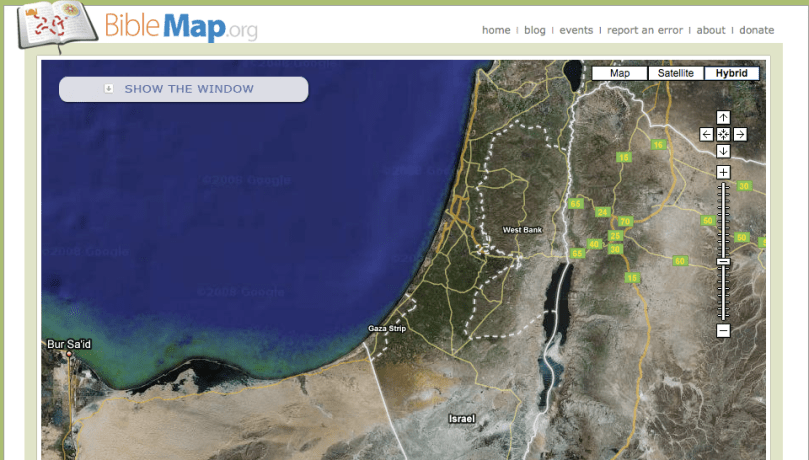
BibleMap.org is an online resource  “developed by the duo at He Lives Ministries (HeLives.com). The motivation for developing the site was simple, create a free Bible atlas which harnesses Google maps.”

BibleMap.org is a free online resource

Free resources online from D.A. Carson

D.A. Carson
D.A. Carson

A tremendous resource is now available online and free. The Gospel Coalition recently  has made available messages from D.A. Carson. You can listen to many of his sermons there in MP3 form for free. The messages are categorized by date or topic to help locate them.

Thanks to Andy Naselli, Ben Peays and Ryan James for gathering all these into one place and for making them available for free!

HT: Justin Taylor

Don’t be a Grinch: Fight for joy

This is the day the Lord has made; let us rejoice and be glad in it. — Psalm 118:24

Do you know people like this? Is this you?

I love that verse. There is a lot of suffering and doubt in Psalms, but there is a lot of hope, too. People who know me here that verse a lot from me. For one thing, I love it because it tells me that a) God made this day and everything I’ll experience in it and b) he wants me to be happy about it and trust Him. Also, I take it as a command: Be happy.

Now, there are some of you, like the Grinch over there, who say: “Why should I rejoice? What do my feelings have to do with anything?” Or maybe you think that your emotions are something that comes and goes, but it’s your duty and sense of responsibility that really matter. Oh really? Does the Bible back you up? Does God really command how we should feel?

John Piper addresses just such a thing in a sermon on Romans 12:9-13:

(There) is a deeply defective way of seeing God and of understanding your own emotions. The truth is that God does have a right to command that we feel anything we ought to feel. If we ought to feel joy in the Lord, he commands, “Rejoice in the Lord” (Philippians 4:4). If we ought to feel the sorrow of sympathy, he commands, “Weep with those who weep” (Romans 12:15). If we ought to feel gratitude for a great gift, he commands, “Be thankful” (Colossians 3:15). If we should feel remorse for our sin, he commands, “Be miserable and mourn and weep” (James 4:9). If we should feel fear of sin, he commands, “Fear the one who after he has killed has the power to cast into hell” (Luke 12:5). And so on.

The fact that our hearts are so distorted by sin that we don’t feel what we ought to feel does not mean that God cannot command what is right and good and fitting for us to feel. We are responsible to feel what God commands us to feel. So I plead with you, be more serious when you read these commands than you might be if you thought God has no right to tell you what you should feel toward others, and that you have no accountability for your emotions.

So, back to the beginning: How do we do something we don’t feel? Again, Piper helps us here by giving us 15 things we can do to “Fight for joy” and not be a Grinch:

1. Realize that authentic joy in God is a gift.

2. Realize that joy must be fought for relentlessly.

3. Resolve to attack all known sin in your life.

4. Learn the secret of gutsy guilt – how to fight like a justified sinner.

5. Realize that the battle is primarily a fight to see God for who he is.

6. Meditate on the Word of God day and night.

7. Pray earnestly and continually for open heart-eyes and an inclination for God.

8. Learn to preach to yourself rather than listen to yourself.

9. Spend time with God-saturated people who help you see God and fight the fight.

10. Be patient in the night of God’s seeming absence.

11. Get the rest and exercise proper diet that your body was designed by God to have.

12. Make a proper use of God’s revelation in nature.

13. Read great books about God and biographies of great saints.

14. Do the hard and loving thing for the sake of others (witness and mercy).

15. Get a global vision for the cause of Christ and pour yourself out for the unreached.

It is not good that there are unhappy people anywhere. For some, it may be a medical issue that they have no control over and for them we must extend grace and help them. But there is hope. God does not command what he won’t help us to do. Seek God. Go with God.

Related:

How to Fight for Joy conference message (audio)

Logos.ReferenceTagging.lbsBibleVersion = “ESV”;
Logos.ReferenceTagging.lbsLinksOpenNewWindow = true;
Logos.ReferenceTagging.lbsLibronixLinkIcon = “dark”;
Logos.ReferenceTagging.lbsNoSearchTagNames = [ “h1”, “h2”, “h3” ];
Logos.ReferenceTagging.lbsCssOverride = true;
Logos.ReferenceTagging.tag();

Spiritual Gifts in the Body of Christ

The Holy Spirit is like a bodybuilder for the Body of Christ.

The Rev. Mark D. Roberts has been blogging a series about spiritual gifts in the Body of Christ. For those of you unfamiliar with who he is, Roberts is a pastor, author, retreat leader, speaker, and blogger. Since October 2007 he has been the Senior Director and Scholar-in-Residence for Laity Lodge, a multifacted ministry in the Hill Country of Texas.

About the series, Roberts writes: Little is more important for the health and growth of the body of Christ than the power of the Holy Spirit manifested in what we call spiritual gifts. Through such bits of grace, the Spirit builds the body of Christ. In fact, it wouldn’t be too far off the mark to say that the Holy Spirit is a bodybuilder. … Like a committed bodybuilder, the Spirit invests years–indeed, millennia–of effort to help the church grow to perfection. Of course ultimate perfection won’t come this side of the eschaton. But, in the meanwhile, the Spirit molds the church, using members of the church–people like you and me–in the process.

HT: Andrew Jackson

Free John MacArthur sermons

You can now download the sermons of John MacArthur for free. For those who are unsure of who John MacArthur is, this is his bio from the Grace to You Web site:

Widely known for his thorough, candid approach to teaching God’s Word, John MacArthur is a fifth-generation pastor, a popular author and conference speaker, and has served as pastor-teacher of Grace Community Church in Sun Valley, California since 1969. John and his wife, Patricia, have four grown children and fourteen grandchildren.

John’s pulpit ministry has been extended around the globe through his media ministry, Grace to You, and its satellite offices in Australia, Canada, Europe, India, New Zealand, Singapore, and South Africa. In addition to producing daily radio programs for nearly 2,000 English and Spanish radio outlets worldwide, Grace to You distributes books, software, audiotapes, and CDs by John MacArthur. In thirty-six years of ministry, Grace to You has distributed more than thirteen million CDs and audiotapes.

John is the president of The Master’s College and The Master’s Seminary, and he has written hundreds of books and study guides, each one thoroughly biblical and practical. Best-selling titles include The Gospel According to Jesus, The Second Coming, Ashamed of the Gospel, Twelve Ordinary Men, and The MacArthur Study Bible, a 1998 ECPA Gold Medallion recipient.

HT: Between Two Worlds