America, land of opportunity

From Jeremy Taylor, who is back blogging after a long hiatus, points out something I’d heard before but is good to remember now that we have a new group leading our country:

American conservatism is often derided by the Left for exceptionalism, or the belief that as a country, we’re different and exceptional (which sometimes leads to unilateralism on the order of Mark Steyn’s America Alone.) And there are always the two dangerous ditches– one of vanity and hubris which blinds one to the faults of his country and the other, self-deprecation which blinds one to the virtues of it. The ditch which the Left all too often falls into is knee-jerk apologizing for America.

Now with the proper sophrosyne and balance, let me quickly dispense with the customary precursor and invocation which must precede, “I’m proud of America,” and that’s, “Of course, America isn’t perfect. We have our faults.”

He continues:

Collectively in the primaries, we saw a guitar-playing former Baptist minister, a Mormon business executive, a Kansas farmer, an Italian-American twice remarried district attorney, a decorated Vietnam Vet, a female lawyer, a black community organizer, a Hispanic gun owner. Now, the descriptors obviously are simplistic tags, but they aren’t meant to be reductionist or divisive.

The labels are meant to show that we have diversity and social mobility and one cannot compare Europe (much less Asia or daresay Africa) to America. Where is there such a diversity of candidates for executive office?

So, let’s be humble in the coming year but also let’s be grateful. There are opportunities afforded to us in this country that are not found elsewhere.
Mohler, Miller discuss gay marriage and the Bible on NPR

Albert Mohler, president of the Southern Baptist Theological Seminary, and Lisa Miller, religion editor at Newsweek, were recently guests on NPR’s Talk of the Nation Program. The program’s topic, “What’s The Word? The Bible on Gay Marriage” was discussed in the context of Miller’s recent cover story for Newsweek, “The Biblical Case for Gay Marriage.” You can listen to the program here.

Three questions on Newsweek’s “The Religious Case for Gay Marriage”

Greg Koukl, who does the Stand to Reason radio broadcast — also available as a podcast — gives three questions we should ask when reading Newsweek’s “The Religious Case for Gay Marriage”:

1.    What do they want you to believe?
2.    What are the reasons they offer in support of this idea they want you to believe?
3.    Are the reasons good ones?

Koukl reviews the article and goes through these questions on the podcast.

The president-elect: Open for (his kind) of questions

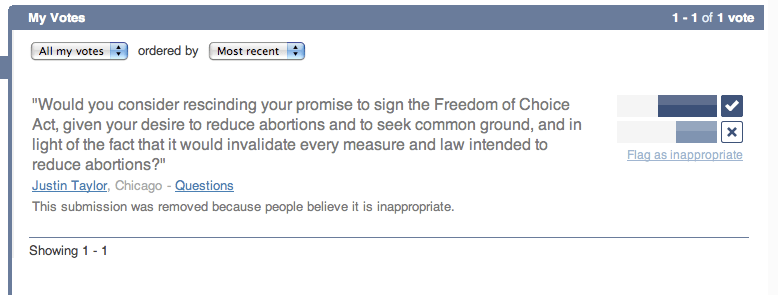
President-elect Barack Obama’s transition team is asking you, the American public, what’s on your mind and to ask Mr. Obama about it. That’s all good, except when a good question gets marked as “inappropriate” and is withdrawn. What qualifies as inappropriate? When you ask, like Justin Taylor did,

“Would you consider rescinding your promise to sign the Freedom of Choice Act, given your desire to reduce abortions and to seek common ground, and in light of the fact that it would invalidate every measure and law intended to reduce abortions?”

Not all questions are created equal

The Palin style of leadership

In a recent article, Byron York at NRO looked at how Sarah Palin governed in Alaska. What the article demonstrates is that she has learned quickly and governed more than ably and that the talk on the campaign trail is not empty rhetoric.

Of note, York describes her style of governing:

[I]t’s fair to say that overall, Palin’s time in office, from her swearing-in until the moment John McCain picked her to be his running mate, has been a success. And from her handling of the issues she has tackled, it’s possible to see a pattern in the way she approaches governing.

First, she hires well. “There was a pretty good team of people assembled right away to come in and start with her big-picture principles and develop a process and legislation to carry that out,” says Joe Balash. “I would say that her management style is to give her staff, her cabinet, a pretty long leash, but with very high expectations — and she’s not afraid to tell you that you didn’t get it right.”

Second, she is involved with details on some big things, but not on everything. “When it comes to issues that she cares about, that she knows the public cares about, she’s got all kinds of time and prioritizes things in a big way,” says one insider who has worked with her and asked not to be named. “For the mundane tasks of government . . . say, regulations for the Kenai River, she instead looks for recommendations from her cabinet and the regulatory agencies, but she’s not going to get in and argue specific details.”

Third, she is dead set on fulfilling campaign promises. “There was this absolute expectation that if it was an issue that had been talked about during the campaign and there was a particular commitment that she had made, then we had to live up to it, no matter how difficult,” says Balash, “because her big thing was restoring the confidence of the public in state government.”

From that same article, Republican state senator Gene Therriault sums it up best when he says: “She’s been in office for two years now and has been fairly successful, which either belies the argument that she was not prepared or is an argument for the fact that she is a quick study.”

Read the whole article here.

The Nebraska Civil Rights Initiative

While many go into the polling booth ready to vote for the people at the top of the tickets i.e. president, senator, governor, etc. there are often other measures that deserve attention as well.

Here in Nebraska, we will be voting on the Nebraska Civil Rights Initiative, which would amend the state constitution to prohibit the state from discriminating on the basis of race. Opponents call it anti-affirmative action while proponents say it would ban racial preferences. Already, similar measures have passed in California and Michigan and measures like this are on the ballot in several states. Republican presidential candidate John McCain has gone on the record as a supporter of a similar measure in his home state of Arizona.

Helpful to those who may not have considered this measure, Ward Connerly (who is considered the man behind California’s Proposition 209, that state’s anti-affirmative measure) discusses the impact that California’s passage of that measure in 1998. Click on the image to see the interview.

Former California regent Ward Connerly discusses the impact of that state's Proposition 209, which banned quotas.
Former California regent Ward Connerly discusses the impact of that state.

The smoke and mirrors of Obama

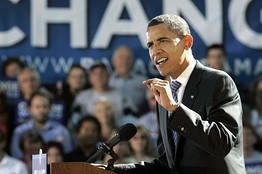
Barack Obama's "tax cuts" would actually penalize low-income workers who earned more money.
Barack Obama

From the Wall Street Journal:

One of Barack Obama’s most potent campaign claims is that he’ll cut taxes for no less than 95% of “working families.” He’s even promising to cut taxes enough that the government’s tax share of GDP will be no more than 18.2% — which is lower than it is today.

It’s a clever pitch, because it lets him pose as a middle-class tax cutter while disguising that he’s also proposing one of the largest tax increases ever on the other 5%. But how does he conjure this miracle, especially since more than a third of all Americans already pay no income taxes at all? There are several sleights of hand, but the most creative is to redefine the meaning of “tax cut.”

For the Obama Democrats, a tax cut is no longer letting you keep more of what you earn. In their lexicon, a tax cut includes tens of billions of dollars in government handouts that are disguised by the phrase “tax credit.”

Read the whole thing

Joe Biden: Confused, dazed and dead wrong

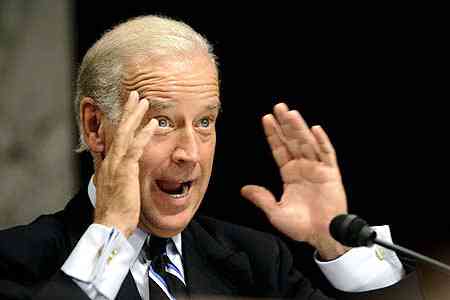
Joe Biden betrays himself with his words.

Joe Biden, the man chosen by Barack Obama to serve as his vice presidential running mate, is a man who is not afraid to let his mouth run and say what’s on his mind. And, to be honest, when you hear what’s on his mind it’s not just amusing but more often disturbing.

Of course there is plenty of talk about his gaffes (like referring to FDR going on TV after the 1929 stock market crash), but his thinking about an issue like abortion reveals not just muddled thinking but a man who wants to have it both ways.

John F. Cullinan, in an article on National Review Online, says Biden has often referred to himself as an “Irish Catholic kid from Scranton” as a way of ingratiating himself with voters who hold moral issues highly. But, because of his lack of discipline concerning his tongue, he often betrays himself as a person who holds views that are in fact in opposition. Cullinan gives an example:

One moment he’s wearing his Catholic faith on his sleeve, the next he’s thumbing his nose at basic Catholic teaching. For Biden, faith has long served as sword and shield: “The next Republican that tells me I’m not religious,” he once vowed, “I’m going to shove my rosary down their throat.”

Such calculated bravado has long helped Biden to obscure the radical inconsistency between what he says and what he does, especially regarding the basic human right to life. “My position is that I am personally opposed to abortion,” Biden wrote in his 2007 autobiography, “but I don’t think that I have the right to impose my views on the rest of society.”

Never mind that Biden has otherwise shown no such reluctance to impose his views; that his personally opposed, publicly supportive dodge applies solely to life issues; or that this intellectual and moral muddle is wholly inexplicable other than by political expediency and political partisanship.

While there is talk about Obama somehow replacing Biden on the Democratic ticket, the truth is that Biden’s faux religion serves the purpose of somehow softening Obama’s extreme liberal views. The problem is, however, that Biden continues to put his foot in his mouth and thus makes his religious ruse all too obvious. More people, hopefully, are paying attention.

Sarah Palin on the economy

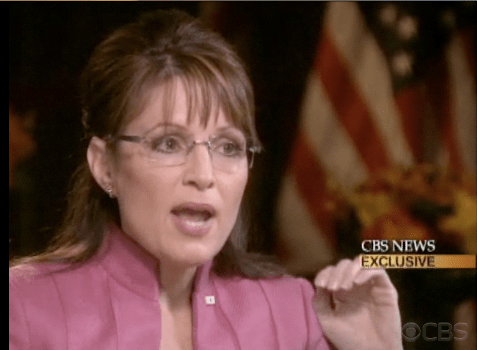
Sarah Palin, in an interview to be broadcast Wednesday night on CBS with Katie Couric, says what could happen if the bailout fails. Click on the image to view the video.