What do CC and BCC mean in e-mail and why it should matter to you

There are no written rules on how to do e-mail. At least there are no set of requirements you must fulfill before you can send mail electronically. But, that said, there are ways you can send e-mail that would be more gracious than others.

When it comes to e-mail etiquette, there may be many who aren’t aware that not everyone wishes to have their addresses forwarded along with the latest funny joke or picture that’s being passed along. Perhaps it may be due to the fact that the senders (or forwarders) are unaware of what the “CC,” “BCC” and “Reply” buttons or commands do.

The “CC” field stands for “Carbon Copy,” which in this day and age may have next to no meaning for most e-mail users. Carbon copy refers to the old days of typing when an actual carbon page was placed between two pages when typing to insure that one page would be carboned (or copied) to the other. Thus, the idea is that putting an address — or addresses —  in the CC field copies that message to that (or those) addresses. The recipient(s) will see those addresses when they receive the e-mail.

The “BCC” field stands for “Blind Carbon Copy.” Understanding what CC does, you can see how BCC works. Basically it allows the sender to copy a message to another address or addresses without the recipient seeing those addresses. You can send an e-mail with the “To” field empty and addresses in either the “CC” or “BCC” fields and the message will still be sent.

So, why is this important? Well, consider the fact that sending a forwarded e-mail that is filled with addresses is a) rude to the recipient and b) possibly opening those recipients up to spammers. After all, did the people in your address book actually ask you to send their address all over the Internet? Even on a basic level, how much will your recipient enjoy your message when they have to scroll through a long list of addresses before they get to it?

That being said, it would probably be better to learn how to use the CC and BCC fields if you absolutely must forward that joke or picture. This is how it would work: Uncle Larry sends you a hilarious joke and you want to share it with your entire address book. When you hit forward and the message field opens up, you can leave the “To” and “CC” fields blank and then put your addresses in the “BCC” field and then hit send.

On a somewhat related note, suppose you’re replying to a message. Again, the same principles hold. Don’t clutter the message by filling up the “To” and “CC” fields unless you want to document to the group who saw the message and reply. Also, if you want to reply to just the sender and not the entire group, don’t hit reply all but rather just reply.

This might seem like a lot of work for something that works pretty easy already. But, like saying “please” and “thank you,” a little politeness can go a long way.
Barack Obama: Not looking out for the little guy

UPDATE: So now Barack Obama is attacking Gianna Jessen for what his campaign is calling “sleazy ads” that are “anti-choice.” Jessen responds:

“Mr. Obama is clearly blinded by political ambition given his attack on me this week. All I asked of him was to do the right thing: support medical care and protection for babies who survive abortion – as I did 31 years ago. He voted against such protection and care four times even though the U.S. Senate voted 98-0 in favor of a bill identical to the one Obama opposed. In the words of his own false and misleading ad, his position is downright vile. Mr. Obama said at the recent Saddleback Forum that the question of when babies should get human rights was above his pay grade. Such vacillation and cowardice would have left me to die if his policies were in place when I was born. Thank God they were not.”

Jill Stanek also weighs in:

“It is despicable, repulsive and beneath contempt that Barack Obama would attack Gianna Jessen. She is a courageous abortion survivor and living miracle who would not be with us today if Obama’s policies had been in place when she was born. Mr. Obama continues to mislead the American peopleon this issue, he voted four times against medical care and protection for babies who survive abortions in the Illinois State Senate, while the U.S. Senate was voting 98-0 to pass an identical bill. Mr. Obama needs to come forward and tell the American people that he understands people like Gianna Jessen, and that he will support and enforce Born Alive Infant protections — that these are living, breathing human beings who have come into our world and deserve protection in the law and should receive medical care at health care facilities. These babies have the same rights as the rest of us.”

Here is Obama’s ad:

HT: Michelle Malkin

Gianna Jessen, who I highlighted on this blog in June, is doing an ad for BornAliveTruth.org, a 527 organization that will be highlighting Barack Obama’s extreme views when it comes to abortion. The National Review Online interviewed Jill Stanek recently about the ad and why the group put it together. Stanek, a former nurse at Christ Hospital in Illinois, watched children left to die after surviving botched abortions. Her testimony led to the legislation in the Illinois statehouse that Obama passionately argued against.

Read the interview with Stanek and then watch the ad with Jessen below.

Obama calls out McCain on abortion

Woe to those who call evil good and good evil, who put darkness for light and light for darkness, who put bitter for sweet and sweet for bitter! — Isaiah 5:20

The Associated Press is reporting that Barack Obama is attacking John McCain for being too adamantly pro-life:

Obama is calling out McCain in ads that say the GOP nominee takes an “extreme position on choice” and “will make abortion illegal.” He is spreading his message through low-profile radio ads and campaign mailings, though, hoping to avoid being tagged as too liberal on a woman’s right to choose to end a pregnancy.

The article, written by the AP’s Liz Sodoti, says that each of the candidates are dancing around perceived “extreme” views in order to woo voters. But, if you listen to the candidates, I would disagree. In fact, the only “dancing” I’ve heard this election season is Obama’s “it’s above my pay grade” and Sen. Joe Biden’s “good people disagree” statements. McCain has been clear about what he believes, and we know where Gov. Sarah Palin stands. Let’s be clear here: McCain is pro-life and has voted that way. Obama is not and has voted that way. I’m not sure what a “moderate” position on abortion is just like I’m not sure what a “moderate” position on murder is. Honestly, I will give both candidates credit for not trying to occupy that ridiculous ground.

The hard life of living with a Down syndrome child

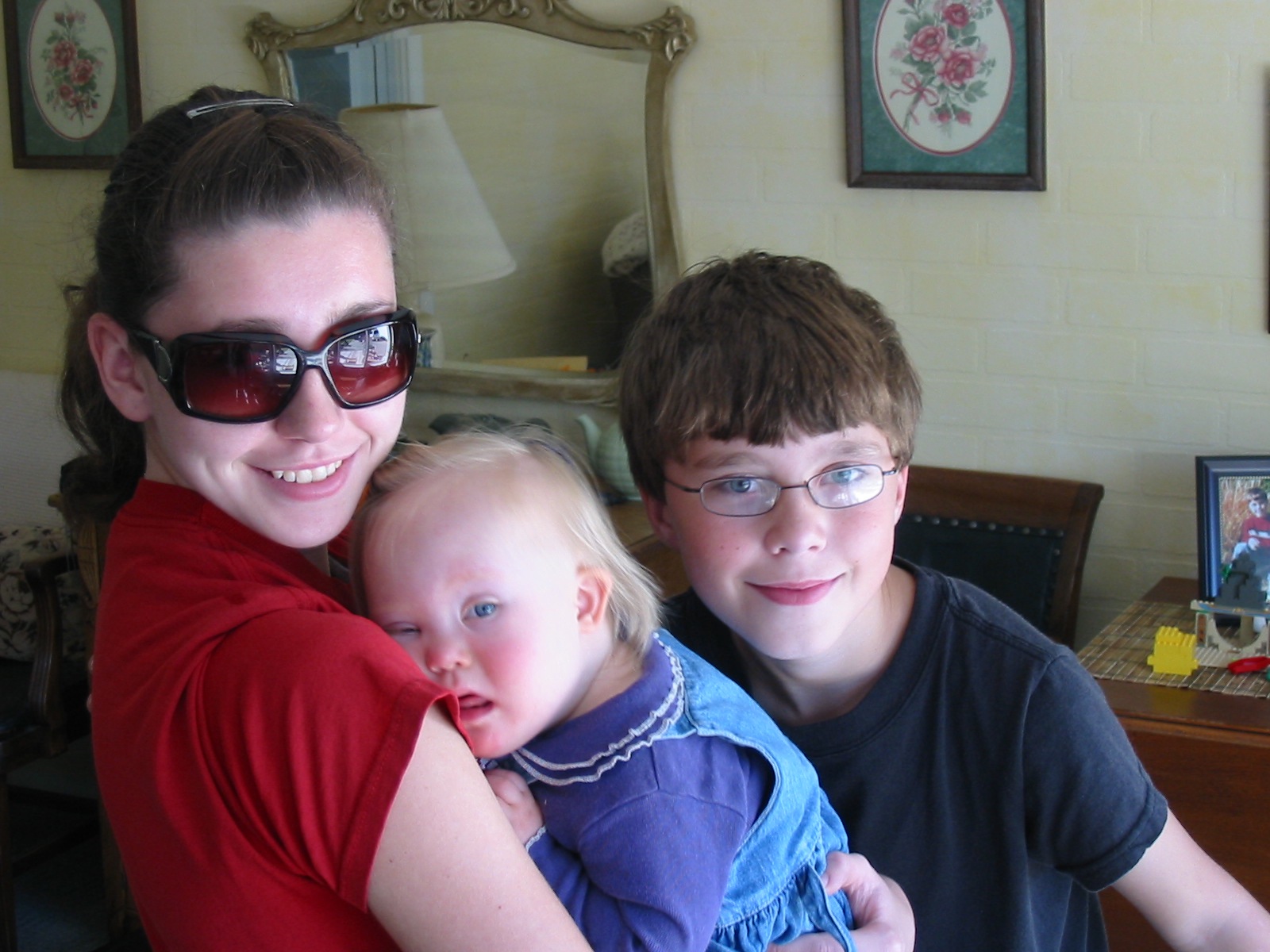
My precious niece Amelia is popular with my two children.
My precious niece Amelia is popular with my two children and all of our family.

The Washington Post did a front-page story this past Sunday on what it’s like to live with and raise a child with Down syndrome. For those who haven’t been through it, it is an eye-opening look into what is a very difficult life.

Articles like this, of course, are being written because of the attention that Alaska Gov. Sarah Palin has brought to families who have Down syndrome children. These children are all around us, but, as one of the parents in the story says: “Before, kids would stare, but not adults. Everybody’s curious: ‘What’s it like to have a kid with Down syndrome?’ ”

What’s it like for these families is put this way in the article:

Amelia is a blessing to all of our family and to those who meet her.

They spend more time in doctors’ offices than most parents. They endure stares from strangers but feel as if they and their children are invisible. They often find themselves fighting for their kids, not just raising them. Earlier, and perhaps more dramatically, they wrestle with the complex emotions that come from knowing that a child might never fulfill the lofty dreams that a parent often envisions before the child’s birth.

But the parents of children who have Down syndrome say that raising a child with a disability can also unlock profound and uplifting truths about themselves, their children and the value of life in ways that others could never see.

In our family, we have a beautiful gift from God named Amelia. She was born with Down syndrome to my wife’s brother and his wife to join their other three children. At age 2 she is still learning to stand on her own and maybe utters a handful of words, but she is world class in drawing tenderness from anyone who encounters her. It is a hard life for her parents as she has needs that press daily on them and her family, but I don’t doubt for a second that they love her every bit as much as her older brothers and sister.

One of the parents in the Washington Post article recounts an encounter with her sister that is a cruel reminder of how many in our society think the cruelest thoughts when it comes to Down syndrome children:

“My sister looked at me and said, ‘Why didn’t you abort her?’ ” Marsili recalled. “I said, ‘What? Because we love her, and she’s my baby, and we love her!’ ‘But you knew,’ my sister said. . . . It was pretty shocking. Even people that close to me.”

It is a dangerous place we’re at when we consider killing to be a solution for children who’s abilities are diminished. If it takes someone like Sarah Palin entering the spotlight for us to expose this kind of thinking — and rebuke it — then I think it is a good thing.

FOR FURTHER INFORMATION:

National Association for Down Syndrome

National Down Syndrome Society

HT: Wesley J. Smith

Religion and politics: Is God on our side?

This fall, in our Sunday school class at church, we are studying a book called “Is God on America’s Side?” The book looks at the thinking that God somehow reserves his blessing for American because it is a “Christian nation.” We’ve just started it, but I think it will be a good thing to clear up some attitudes about how God’s will is not always what we think it is.

In light of that, I want to add an essay by Joe Carter, who is the managing editor for Culture11. Carter, in what he calls “an open letter to the religious right,” lays out 11 thoughts he wants to share with them about religion and politics. You may agree or disagree with his points, but his conclusion is well worth noting:

(F)inally, we must recognize that America is not a “Christian nation”, though we should aspire to be a nation where those of us who are Christians are admired as good and noble citizens. America is not a “shining city on a hill”, though we should let our light of freedom be a shining example for the entire world. America is not the “greatest blessing God gave mankind”, though it is a great nation worthy of our conditional adoration. Patriotic sentiment has its place but we mustn’t let it expand beyond its acceptable borders. We are citizens of both the City of God and the City of Man and must always be careful not to confuse the one for the other.

102 Minutes That Changed America

The History Channel’s “102 Minutes That Changed America” was hard to watch, but fascinating. I wasn’t anywhere near New York City that day, but looking at the event through the eyes of several witnesses brought to mind the confusion and utter helplessness we all felt. I think it was a powerful way for us to shaken from the fog of our American dream and the idea that we are somehow beyond the reach of pain, suffering and evil.

Below is a preview of the special as producer Nicole Rittenmeyer talks about the collection of videos and people gathered for the program.

College survival tips

From Justin Taylor at Between Two Worlds:

John Mark Reynolds has a helpful column here offering 10 tips for college students getting ready for Fall.

What follows is the barebones outline, but if the topic is of interest, you’ll want to read the whole thing.

1. Ignore advice to “remake” yourself the first day you get to college.

2. Do something each week that puts you in contact with people older and younger than your peer group.

3. If you have a decent relationship with your parents keep it up.

4. If you are going to college, then go. You are in college to learn. In America, education often includes getting a job skill, but should also be about becoming a good, civilized citizen.

5. Find a faculty mentor during your first year.

6. Take classes that are hard from full-time professors that love to teach.

7. Secretaries and support staff are overworked, underpaid, and very powerful. You should be good to them out of virtue, but you must do it to thrive. The friendship you make with the department secretary now will pay dividends over the years. (One way I judge the character of a student is by how they treat the support staff.)

8. Books are not yet antiques. Go to the library. Talk to librarians. They are faculty members that are often under-utilized.

9. Don’t be too quick to pick a major, but try to do so by the end of the first year.

10. Live like an adult in college which includes moderating your passions.

Today’s new eugenicists

Of the blogs I look at regularly, one that I have often visited and am often enlightened by is Wesley J. Smith’s Secondhand Smoke. Smith says his blog “considers issues involving assisted suicide/euthanasia, bioethics, human cloning, biotechnology, and the dangers of animal rights/liberation.” There are a lot of issues he deals with that are not isolated to the world of science but rather intersect with our lives every day.

For example, the whole furor around the nomination of Alaska Gov. Sarah Palin to be vice president by John McCain has brought to the forefront the issue of Down syndrome children and the divergent views about whether people should knowingly give birth to children with this condition. I have already given my views on the subject on this blog, but there are certainly those who disagree as seen just by comments posted here.

Physician and writer Rahul K. Parikh gives what by all appearances is a concerned response to Palin’s decision in an article in Salon:

By knowingly giving birth to a Down syndrome child, Palin represents a minority of women. A 2002 study found that about 90 percent of pregnancies in the United States where the fetus was diagnosed with Down syndrome were terminated.

Rabid anti-choice activists have called that trend eugenics via medicine. But try telling that to a mother who is told early on in her pregnancy that she will be raising a child who will have a host of medical and developmental problems, requiring intense medical and social attention for the rest of his or her life. It can be tragic and nearly impossible news to bear.

Kids with special needs require and deserve intense therapies and attention to their needs. That’s likely something Palin, with her political and social stature, can afford both financially and emotionally. But that may not be the case for other families, who have to struggle to balance work with home and family. They simply may not be up to the challenge of raising a child with Down syndrome. Sadly, kids with developmental problems like Down syndrome are at a higher risk for being abused by parents and other caregivers.

And if you can’t provide that, what should you do? Well Parikh doesn’t say, but by labeling Palin “anti-choice” gives the reader a pretty good idea. Yes, let the mother choose, but not the child. Of course it seems compassionate to consider the poor mother and family of a Down syndrome child and what they will have to face. Smith addresses such “compassion” in an article “Waging War on the Weak” that he wrote for the Discovery Institute:

(The “new eugenics”) perceives some lives as having greater value than others, and which in some cases sees death—including active euthanasia and assisted suicide—as an appropriate “solution” to the problems of human suffering. The original eugenics movement expressed this relativistic view of human life through hate-filled rhetoric; for example, eugenicists described disabled babies like Miracle in terms that today would be considered hate speech. Thus, as recounted in Edwin Blacks’ splendid history of eugenics, War Against the Weak , Margaret Sanger took “the extreme eugenic view that human ‘weeds’ should be ‘exterminated.’”

Today’s new eugenicists are not that crass, of course. Indeed, rather than screaming hate and pejoratives from the rooftops, they instead ooze unctuous compassion as they croon about a “quality of life” ethic and preventing the weak—against whom they are secretly at war—from “suffering.” But behind the politically correct language, and indeed, hiding within the hearts of those who perceive themselves as profoundly caring, lurks the same old disdain of the helpless who offend because they remind us of our own imperfections and mortality.

This kind of thinking is subtle but deadly. Smith does a great job of exposing this kind of thinking in his blog. Are these issues important or is this just a big fuss over little things? No, not when you consider that health care is a major issue in this election.

Democrats and Republicans agree: Preaching is not outdated

Erik Raymond, at Irish Calvinist, has a cogent post about how politicians deliver their important messages to the masses:

Does this not sound a bit old fashioned to the sophisticated evangelical pastor? After all, we are told by many ‘experts’ today that talking to people in large chunks of time is not effective. Furthermore, it is often said to be arrogant and archaic to stand up behind a podium and have people sit down while you talk.

But what do you see at the National Conventions? A speaker, a podium, a crowd seated, an appeal to action, and even propositional statements! What’s more, we have panels of talking heads dissecting everything about the speeches with the tenacity of a hyper-calvinist in a Methodist church.

Why vote for Sarah Palin?

There are many times you can end up in a place and wonder how you got there. I think that kind of experience has happened for many who have grown up as Democrats but call themselves pro-life. In an essay at First Things, Suann Therese Maier lays out her journey that has led to her decision to vote for John McCain and Sarah Palin this November. Of note:

I remember my father, a successful young Chicago attorney, telling me why the Democratic party was the party of “our people,” and why so many Catholics were Democrats, and why the party stood for the little guy, the poor and the defenseless. I remember listening as a young girl in our kitchen as Saul Alinsky organized my parents’ Catholic friends on racial and economic issues in our Chicago living room. And I remember the night in 1992 when Pennsylvania’s governor, Robert Casey, was denied a chance to talk against abortion at the Democratic national convention.

I will vote for Sarah Palin because Roe v. Wade is bad law, and it needs to fall. I don’t doubt the intelligence and character of men like Doug Kmiec, the younger Bob Casey, and others who sympathize with the Obama campaign. But I do doubt their judgment. At the end of the day, the Democratic party in 2008 has conceded nothing to pro-life Democrats. The fact that Sen. Obama listens respectfully to pro-lifers without calling them reactionary dunces does not constitute progress. Results and behavior are what matter. On both those counts, the party has again failed to show any real sensitivity to pro-life concerns. In that light, high profile Catholics who support Obama are simply rationalizing their surrender on Roe.

Finally, I will vote for Sarah Palin, not because I’ve left the Democratic party of my youth and young adulthood, but because that party has left me. In fact, it no longer exists. And no amount of elegant speaking, exciting choreography, and moral alibis will bring it back.