There is a divide in this country, and you can almost discern it based on the question, “How do we help the
How do we help the poor?
poor?” Politically, there is a divide for sure, but even within the church there is divergence on this question. To be sure, the Bible instructs us that we are to care for the poor, but even that point is debated as one group emphasizes responsibility and another justice.
In his essay, Keller explores from the position that the church is commanded to help the poor, yet this is not the primacy of the gospel:
So what does it mean to be committed to the primacy of the gospel? It means first that the gospel must be proclaimed. Many today denigrate the importance of this. Instead, they say, the only true apologetic is a loving community; people cannot be reasoned into the kingdom, they can only be loved. “Preach the gospel. Use words if necessary.” But while Christian community is indeed a crucial and powerful witness to the truth of the gospel, it cannot replace preaching and proclamation. Nevertheless, the primacy of the gospel also means that it is the basis and mainspring for Christian practice, individually and corporately, inside the church and outside. Gospel ministry is not only proclaiming it to people so that they will embrace and believe it; it is also teaching and shepherding believers with it so that it shapes the entirety of their lives, so that they can “live it out.” And one of the most prominent areas that the gospel effects is our relationship to the poor.
It is a lengthy read, but well worth your time. For conservatives, it is a good reminder that merely proclamation of the gospel while failing to help the poor and needy shows a lack of understanding of the gospel. For liberals, it is a good reminder that giving aid is not an end in itself.
Albert Mohler, president of the Southern Baptist Theological Seminary, and Lisa Miller, religion editor at Newsweek, were recently guests on NPR’s Talk of the Nation Program. The program’s topic, “What’s The Word? The Bible on Gay Marriage” was discussed in the context of Miller’s recent cover story for Newsweek, “The Biblical Case for Gay Marriage.” You can listen to the program here.
Greg Koukl, who does the Stand to Reason radio broadcast — also available as a podcast — gives three questions we should ask when reading Newsweek’s “The Religious Case for Gay Marriage”:
1. What do they want you to believe?
2. What are the reasons they offer in support of this idea they want you to believe?
3. Are the reasons good ones?
Koukl reviews the article and goes through these questions on the podcast.
When the economy is struggling, and your industry is on a steady decline, what is your next move? Well, in the case of Newsweek, you decide to become something totally different and, in the process, spit at a good deal of your subscriber base. Is it working? If is if you want to shed circulation and jobs, as reported by the Wall Street Journal:
Newsweek could subtract anywhere from 500,000 to one million copies from its current guarantee of 2.6 million, according to people familiar with the magazine’s thinking. That Newsweek is exploring a rate-base cut was first reported by the trade publication Folio.
Newsweek's highly controversial cover story comes as it is dropping subscribers and guarantees to advertisers.
The WSJ reported Newsweek “has emphasized commentary on hot-button issues, such as gay marriage, by big-name journalists like editor Jon Meacham and international editor Fareed Zakaria, as well as contributions from political operatives and academics like Michael Beschloss and Sean Wilentz.” And while looking at these issues is not in itself something to be up in arms about, it’s the way Newsweek has been going about it that has driven — or about to — subscribers and advertisers away:
Mr. Meacham said recently that Newsweek has never been an objective summarizer of the week’s events, or “AP on nicer paper,” though he acknowledged a greater emphasis lately on editorializing. “We are trying to be more provocative,” he said.
This week’s cover story, “The Religious Case for Gay Marriage,” is a case in point. The story spawned an organized campaign to get readers to cancel their subscriptions and elicited so many angry emails that Newsweek Chief Executive Tom Ascheim had to open a new email account to handle the added volume, a company spokesman said.
For those who subscribed thinking they were getting “AP on nicer paper,” the shift to provocation was jarring and, mostly, unwelcome. Without any rebuttal or guidance from a theologian, lines like this are tossed out by religion editor Lisa Miller in her piece “The Religious Case for Gay Marriage” (emphasis mine):
The Bible does condemn gay male sex in a handful of passages. Twice Leviticus refers to sex between men as “an abomination” (King James version), but these are throwaway lines in a peculiar text given over to codes for living in the ancient Jewish world, a text that devotes verse after verse to treatments for leprosy, cleanliness rituals for menstruating women and the correct way to sacrifice a goat—or a lamb or a turtle dove. Most of us no longer heed Leviticus on haircuts or blood sacrifices; our modern understanding of the world has surpassed its prescriptions. Why would we regard its condemnation of homosexuality with more seriousness than we regard its advice, which is far lengthier, on the best price to pay for a slave?
Of course, this kind of writing did not go unnoticed. MZ Hemingway at GetReligion.org gives a lengthy excoriation of Miller and her work:
When I started looking at the media coverage of this hot topic, I had to do just that. As a libertarian, I was unfamiliar with why people thought the state should define marriage, much less why it should be defined in such a way as to limit it to a certain number or sex of people. And what I found is that there is an unbelievable wealth of argument in favor of traditional marriage. And most of it is based (no, not in the fevered imaginations of what Hollywood and the media elite think religious conservatives believe) but in NaturalLaw. In this way of thinking, society defines marriage as a sexual union between a husband and wife, based around the ideas that babies are created via intercourse, that procreation is necessary for the survival of society and that babies need fathers as well as mothers. So the entire premise of this article is wrong, if you look at it that way.
But if you are going to pretend that opposition to same-sex marriage is based Sola Scriptura, could we at least get our Scripture right?
This is such hackery that it’s offensive. Abraham and Sarah, while certainly noted for their eventual trust in God were basically poster children for marital disobedience when they didn’t trust God to provide them with children. Even though he promised them they would have offspring. Sarah was a jealous and cruel slavemaster and Abraham was pliant and cowardly during their Hagar offensive. In fact, if you are reading the Old Testament as a self-improvement book based on anything other than the commandments from God, you are an idiot. God’s chosen people, some of them with great and abiding faith, are sinful disasters — the lot of them.
I hold sacred the New Testament model of marriage and find Miller’s comments to be beneath contempt. I also wonder what, if anything, she has read from the New Testament.
When my husband read the opening graph of this train wreck of a hit piece, he wondered if these words of Jesus, found in the Gospel of Matthew, indicated indifference to family:
And He answered and said to them, “Have you not read that He who made them at the beginning ‘made them male and female,’ and said, ‘For this reason a man shall leave his father and mother and be joined to his wife, and the two shall become one flesh’? So then, they are no longer two but one flesh. Therefore what God has joined together, let not man separate.”
This video, from the folks at St. Helens Bishopgate, asks questions about what Christmas means. If there was ever a time for someone to look into Jesus (like Larry Norman asks), it would be this time of year. Surprisingly, many people don’t think about Jesus at Christmas, but it’s not too late to think about someone and something that’s not tradition or myth, but real history. And this isn’t ancient history, but something that matters for your life right now and every day.
Robert P. George was honored for his service to the nation serving on the President' Council on Bioethics
Robert P. George, who has served our nation on the President’s Council on Bioethics, was honored this week with the Presidential Citizens Medal for “exemplary deeds of service for the nation. It is one of the highest honors the President can confer upon a civilian, second only to the Presidential Medal of Freedom.”
The press release at the White House’s Web site said this about George:
With wisdom and integrity, Dr. Robby George has brought forceful analytic clarity to the study of America’s ideals and institutions. He has helped strengthen our Nation’s system of ordered liberty by exploring enduring questions of American constitutional law and Western political theory. The United States honors Robby George for his many contributions to our civic life.
Why should we care? We should because it was George who was among the scholars, reseachers, scientists and theologians who advised the president when he made his landmark decision to limit embryonic stem cell research to existing lines in 2001. George, who lectures on constitutional interpretation, civil liberties and philosophy of law at Princeton University, is a solid conservative who is pro-life and pro-family. In other words, he is the polar opposite of his Princeton colleague Peter Singer.
George operates at high velocity, moving easily within the worlds of academia, politics, and religion. He serves on President George W. Bush’s Council on Bioethics, where, says council chairman Leon Kass, George brings “enormous integrity and decency. He is an absolutely lucid and careful thinker, deeply committed to the dignity of the human person from its earliest beginnings.” Like Socrates, Kass notes, George meets his interlocutors “on their own grounds but show[s] them that their arguments take them to places they don’t want to go.”
The idea that is repeatedly bandied about is that there is a disconnect between being a rational, thinking person and a person of deep faith. In answer to that, we can merely point to people like Robert George and how he lives his faith.
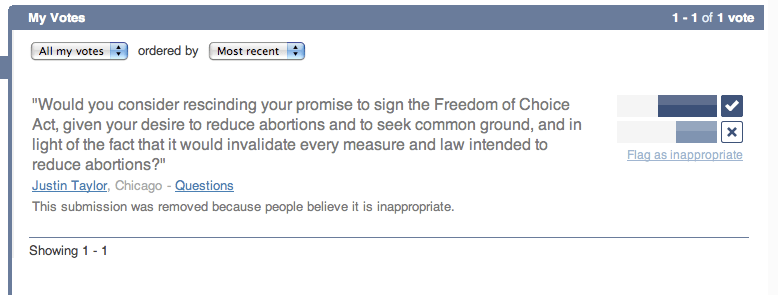
President-elect Barack Obama’s transition team is asking you, the American public, what’s on your mind and to ask Mr. Obama about it. That’s all good, except when a good question gets marked as “inappropriate” and is withdrawn. What qualifies as inappropriate? When you ask, like Justin Taylor did,
“Would you consider rescinding your promise to sign the Freedom of Choice Act, given your desire to reduce abortions and to seek common ground, and in light of the fact that it would invalidate every measure and law intended to reduce abortions?”
Collin Hansen, writing in the Web edition of Christianity Today, explores recent new medical advances that allow for non-invasive testing of pregnant women to determine whether the babies they’re carrying have cystic fibrosis, b-thalassemia, or sickle cell anemia — ailments all caused by a single mutated gene. Like new, expanded testing for Down syndrome, it ominously points to not treatment or education for the parents but an earlier opportunity to abort the child.
As we press forward for further knowledge, it becomes clear that we are less capable of handling that knowledge that we are so eager to have. Hansen puts it this way:
At the root of the quest for foreknowledge is control. Testing children for genetic abnormalities gives concerned parents a measure of control over the situation. But abortion can only negate the pregnancy; it cannot make their children healthy. We have much less control than we want or think we have. And that is the good news, because the God who knows all that was, all that is, and all that will be holds out the promise that by faith we can have peace with all that he brings to pass.
John Lennox is an Oxford professor of mathematics.
John Dickson at the Centre for Public Christianity has posted a series of video interviews with noted Oxford professor of mathematics and Christian apologist John Lennox. Among the topics addressed were:
Who is John Lennox? Introduction to the Professor
A Good God? Hope for a mucked up world
Science, Atheism and Belief Has science buried God?
Face off! Debating Richard Dawkins and Christopher Hitchens
Science, the Bible and belief in the 21st Century Do you have to put your brain to one side to read the Bible?
Atheism and morality Does atheism provide grounds for morality?
The evils of Christendom Do the evils done in the name of Christ show that Christianity has failed?
Russian adventures Professor Lennox discusses his experiences in Eastern Europe
Creator or the Multiverse? Does the fine tuning of the universe point to God or an infinite collection of universes?
Christianity and the tooth fairy Does science deal with reality and religion with everything else?





 Rockstanding
You must be logged in to post a comment.