Still in school: Learning from a book about failures

And he began to teach them that the Son of Man must suffer many things and be rejected by the elders and the chief priests and the scribes and be killed, and after three days rise again. And he said this plainly. And Peter took him aside and began to rebuke him. But turning and seeing his disciples, he rebuked Peter and said, “Get behind me, Satan! For you are not setting your mind on the things of God, but on the things of man.” — John 8:31-33

There is a tendency for me not to get it. And not only to I not get it, I do what I don’t want to do again and again. That is why I am encouraged when I take up the Bible and read it. Why? Because over and over I see people who fail miserably yet are able, with God’s help, to come back to God. I agree with Scotty Smith, who prays “As you dealt with Peter, so deal with me. Give me all the life-giving rebukes I need to keep me living in gospel-sanity.”

We have not graduated from the gospel. We need it each day. The hard lessons are a good thing for me. I am glad for the imperfect people of the Bible who are there to show me that only God can make me what I need to be, what I hope to be.

Scotty’s prayer is a great one. Read it all and let it soak it.

Jesus, Proverbs and American idols: An appeal to be humble, open-minded, generous, obedient and patient

Tim Keller, digging through Proverbs 3, has come up with five guides to godly living that are useful to pray about for ourselves, our families and our church leaders. They are good checks to see if we are putting these things in our hearts.

1. Put your heart’s deepest trust in God and his grace. Every day remind yourself of his unconditioned, covenantal love for you. Do not instead put your hopes in idols or in your own performance.

Let love and faithfulness never leave you; bind them around your neck, write them on the tablet of your heart. Then you will win favor and a good name in the sight of God and man. Trust in the LORD with all your heart (Prov 3:3-5a)

2. Submit your whole mind to the Scripture. Don’t think you know better than God’s word. Bring it to bear on every area of life. Become a person under authority.

Lean not on your own understanding; in all your ways acknowledge him, and he will make your paths straight. (Prov 3:5b-6)

3. Be humble and teachable toward others. Be forgiving and understanding when you want to be critical of them; be ready to learn from others when they come to be critical of you.

Do not be wise in your own eyes; fear the LORD and shun evil. This will bring health to your body and nourishment to your bones. (Prov 3:7-8)

4. Be generous with all your possessions, and passionate about justice. Share your time, talent, and treasure with those who have less.

Honor the LORD with your wealth, with the first fruits of all your crops; then your barns will be filled to overflowing, and your vats will brim over with new wine. (Prov 3:9-10)

5. Accept and learn from difficulties and suffering. Through the gospel, recognize them as not punishment, but a way of refining you.

My son, do not despise the LORD’s discipline and do not resent his rebuke, because the LORD disciplines those he loves, as a father the son he delights in. (Prov 3:11-12)

Keller goes on to say that this wisdom is personified in the New Testament in Jesus, who did all this by 1) trusting God, 2) being saturated in and shaped by the Scripture, 3) being meek and lowly, 4) becoming poor for us, though he was rich, and 5) patiently enduring suffering on our behalf. These are good, solid truths to think on, pray about and ask God to put in your life and others’.

HT: The Gospel Coalition and Redeemer City to City

With God on your side is better than at arm’s length

I’ve been reading through “A Praying Life” by Paul E. Miller. In it, he says that prayerlessness “is rooted in a core unbelief that can shape our lives, even as Christians. Because of prayerlessness, our lives are often marked by fear, anxiety, joylessness, and spiritual lethargy.” There is a lot about prayer that we either don’t understand or else we understand and don’t like. In a recent chapter I read, Miller talks about how there is a tendency  we have to avoid intimacy with God.

Why would we do that? Well, for one, we don’t really want God nosing around in our business. Miller says there is a reason, perhaps, that we keep God at arm’s length, even with our prayers to him:

Frankly, God makes us nervous when he gets too close. We don’t want a physical dependence on him. It feels hokey, like we are controlling God. Deep down we just don’t like grace. We don’t want to risk our prayer not being answered. We prefer the safety of isolation to engaging the living God. To embrace the Father and thus prayer is to accept what one pastor called “the sting of particularity.” (A Praying Life, p. 125)

The very human prayer of Jesus asking that “this cup pass from me.” is much different than what Miller sees as the Buddhist and Neoplatonic attitudes that have crept into the church. That is, the attitude that we need to resist our own desires and deny physical urges. Those kind of simple, intimate prayers are the ones we hear children saying because they are more humble than “wiser” adults.

I don’t have it all together. The thing I want to battle against is the attitude that I will not lay it all on the line when I pray. That is to deny a personal God, and it doesn’t honor him.

Believing is the evidence of new birth

Everyone who believes that Jesus is the Christ has been born of God, and everyone who loves the Father loves whoever has been born of him. — I John 5:1

Enjoy your Starbucks, but don’t think it makes you a better — or worse — person

For those who haunt places like Starbucks, you can sometimes get the impression that you’re doing much more than enjoying a $5 drink. What? Well, according to the Starbucks itself (from the back of a cup): Everything we do, you do. You stop by for a coffee. And just by doing that, you let Starbucks but more coffee from farmers who are good to their workers, community and planet. Starbucks bought 65% of our coffee this way last year–228 million pounds–and we’re working with farmers to make it 100%. It’s using our size for good, and you make it all possible. Way to go, you” (emphasis original).

This kind of ultra-coolness can go to your head. So much so that people say things like: “I think we have managed to, with a simple cup of coffee and a very unique experience, enhance the lives of millions of people by re-creating a sense of community, by bringing people together and recognizing the importance of place in people’s lives.” That’s actually a statement from Starbucks CEO Howard Schultz, as quoted in Bryant Simon’s new book “Learning About America from Starbucks,” which tells us in bits and snippets how Starbucks shapes our lives.

Kevin DeYoung, in a great post at his Gospel Coalition blog, cuts through a lot of the baloney with some great insights. For one, he says churches have almost nothing to learn from how to be a “community” from Starbucks. Rather, DeYoung says, you would do better reading Ephesians. As far as coffee culture, don’t get too wrapped up in being cool or uncool, hip or unhip. You’re not saving the world with you five-cent donation, but enjoying coffee and coffee house trappings is not the worst thing in the world either. Enjoy your coffee, by all means, but love your neighbor as yourself. That’s good advice from the Bible, not a coffee cup.

Lukewarmness and the call of a football coach

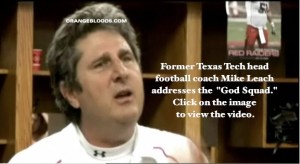
I came across this video of former Texas Tech head football coach Mike Leach today and it just struck me as amazing. For those of you who don’t know, Mike Leach was a very successful coach at Texas Tech for several years before he was fired just before the team’s bowl game in December. He is not a conventional person and has been viewed as a loose cannon. His firing came in the wake of allegations he locked one of his players in a closet after that player had suffered a concussion. He is a man who has his own methods and has been portrayed as someone who speaks freely, whether it is seen as correct or not. There are many who admire him for his candor and boldness.

Because he felt unfairly treated by the university in being fired, his story has not gone away quietly. Thus, the video is something that has come to light recently, showing how he addressed his players during this past season as a way of showing what kind of character he has. What I found interesting about the video was that in it he addresses those on the team who were Christians, the ones he referred to as “the God Squad.” On one hand, he acknowledges the way the publicly show their faith, yet he is derisive as well. I found it revealing in the way he told them they need to be focused on playing football and not let their prayers distract them from that goal. He even misapplies scripture from Revelations about Jesus “spewing out” the lukewarm believers of Laodicea as a way of saying he doesn’t want half-hearted players.

There are so many things to think about in this. Even though Mike Leach comes across as harsh, I think he fairly represents the way a lot of people view Christianity. It is something that is all right to have, as long as it doesn’t interfere with “real life.” Many people who actually consider themselves Christians may share this view. Is that what God is saying in I Corinthians 10:31 when he says “so whatever you eat or drink, or whatever you do, do all for the glory of God”? That verse is not pointing to a compartmentalized Christianity but rather a faith that seeps out of every area in your life. Certainly, it means to strive for excellence in everything you do (which someone like Mike Leach could appreciate). But it doesn’t mean that are areas where it must take a back seat. We are citizens of heaven first and foremost.

Now, I understand a football coach trying to motivate his players to strive for excellence. The point to remember is that if we call ourselves Christians, it does not mean that we set aside the tasks in life that we are faced with in order to serve God. Half-hearted, mediocre football players don’t bring glory to God as neither do half-hearted coaches, teachers, parents, students or whatever. We work hard, not because that is our goal, but because it shows that we are humbly looking to God as our all in all.

Being liberated from the hard yoke — by the easy one

I have been enthalled again rereading and listening to Dietrich Bonhoeffer’s “The Cost of Discipleship.” Bonhoeffer streches and challenges my mind when I read sections like this:

When the Bible speaks of “following Jesus”, it is proclaiming a discipleship which will liberate mankind from all man-made dogma, from every burden and oppression, from every anxiety and torture which afflicts the conscience. If they follow Jesus, men escape from the hard yoke of their own laws, and submit to the kindly yoke of Jesus Christ. But does this mean that we can ignore the seriousness of His command? Far from it! We can only achieve perfect liberty and enjoy fellowship with Jesus when His command, His call to absolute discipleship, is appreciated in its entirety. Only the man who follows the command of Jesus without reserve, and submits unresistingly to His yoke, finds his burden easy, and under its gentle pressure receives the power to persevere in the right way. The command of Jesus is hard –unutterably hard — for those who try to resist it. (Dietrich Bonhoeffer, The Cost of Discipleship, xxxiii)

There was a conversation we had the other day at my house. We were talking about reserve and how people’s personalities change. It was my contention that, while there are always instances of indecision, a person who comes to Christ (and follows him as a disciple) has a boldness that goes beyond his own personal inhibitions because Christ has already secured everything for him. The irony is that you are freed from oppression only by complete surrender.

You will not be disappointed if you read “The Cost of Discipleship.” At the very least, go download it for free and listen. If you are like me, you will be rewarded for the effort.

The breach that comes from following Christ

I was listening to the excellent audiobook of Dietrich Bonhoeffer’s “The Cost of Discipleship” today while on the road. As a reminder you can pick this up for FREE this month at christianaudio.com. It is a challenging book that I am so glad I read and now am being challenged again hearing the audiobook.

 We are called to become disciples of Christ, but what does that mean? Bonhoeffer, who wrote this book over 60 years ago before he was martyred in Germany, says that the call to Christ is a call to die — to yourself. There were many parts that I found myself challenged by today as I rode on barren stretches of Nebraska highway listening to this book. The part that struck me today came from Chapter 5: Discipleship and the Individual. Earlier in the book, Bonhoeffer described how a discple is called by Christ and does not offer his services of his own will. We see Jesus calling Matthew to follow him and also the instance where Jesus comes to the disciples on the Sea of Galilee and he calls Peter to come to him from the boat. Jesus makes his disciples. Here, in Chapter 5, Bonhoeffer goes further, telling the reader that being called to discpleship is a solitary thing:

The call of Jesus teaches us that our relation to the world has been built on an illusion. All the time we had thought we had enjoyed a direct relation with men and things. This is what had hindered us from faith and obedience. Now we learn that in the most intimate relations in life, in our kinship with father and mother, brothers and sisters, in married love, and in our duty to the community, direct relationships are impossible. Since the coming of Christ, his followers have no more immediate realities of their own, not in their family relationships, nor in the ties with their nation nor in the relationships formed in the process of living. Between father and son, husband and wife, the individual and the nation, stand Christ the Mediator, whether they are able to recognize him or not. We cannot establish direct contact outside ourselves except through him, through his word, and through our following of  him. To think otherwise is to deceive him. (The Cost of Discipleship, page 50)

Because this is the case, Bonhoeffer says that we must repudiate anything that comes between us and Christ, whatever form that group takes, for the sake of Christ. It is not that we have no relation with that group, it is that we can have no relation outside of Christ the Mediator. To try to do so would be hatred of Christ and thus be a denial of our discipleship with him. These are hard things to hear and grasp, but to follow Christ as a disciple is not something to be taken lightly. But also, as Jesus said in Matthew 11:30: “My burden is easy, and my yoke is light.” Yes, it is a yoke, but it is not something that we cannot bear.

Our record of good deeds doesn’t save us

And you, who were dead in your trespasses and the uncircumcision of your flesh, God made alive together with him, having forgiven us all our trespasses, by canceling the record of debt that stood against us with its legal demands. This he set aside, nailing it to the cross. — Col. 2:13-14

There is a way that people of many faiths blur the lines among them. It happens when they mistakenly think that their good deeds can one day outweigh their bad deeds. As Christians, we are told through the Bible that this is not possible. Indeed, rather than paying our debt (through good deeds), it says we are only saved through the cancellation of our debt by God. And that is only done through Jesus taking that debt on the cross.

We are fooling ourselves when we think our good deeds outweigh our bad deeds because, the Bible says, even our good deeds are defective when they are not done in faith. (Romans 14:23). Besides, that is not the way God saves. Rather, we are saved through Jesus Christ, who took the curse of our sin upon himself on the cross. In that act, the debt of our sin was erased before God. We will never be able to save ourselves through the law, as Romans 8:3-4 says: “For God has done what the law, weakened by the flesh, could not do. By sending his own Son in the likeness of sinful flesh and for sin, he condemned sin in the flesh, in order that the righteous requirement of the law might be fulfilled in us, who walk not according the flesh but according to the Spirit.”

Look to Jesus Christ, the only way for you to erase the debt of your sin.

A love story with a happy ending for those who believe

[He]  loved me and gave himself for me. — Galatians 2:20

I love the blessing God has given me in that I have two females in my house who love romances. More than once I have been persuaded to sit with them and watch a movie (usually something based on a Jane Austen novel, the favorite around here) about a young woman who struggles in a relationship with a man. At first, she thinks he is rude or cold or something unattractive like that. But, as the movie progresses, we see that he has been working — usually without her knowing it — on her behalf out of his deep love for her. When she comes to this realization she swoons, her heart melts and they end up marrying. The movie ends there and my women are pleased.

The idea that someone does something for us not just out of duty but out of love is something that is hard for any of us to resist. We know that God demonstrated his great love for us in sacrificing the most precious person to him for our sins. (Romans 5:7-8). But it wasn’t just God who showed an incredible love. Time and again the Bible points to the great love Jesus himself showed on our behalf. It certainly wasn’t because we deserved his love. After all, we are the ones who have rebelled against God. We are ones with a heart of stone, doomed to a just punishment for our sin. (Romans 3:23) But the Bible tells us that Jesus “loved me and gave himself for me.” (Galations 2:20), that he “loved the church and gave himself up for her.” (Ephesians 5:25) and that he “(laid) down his life for his friends.” (John 15:13).

Is that you, or me? Are we his friend, the church?

And I hear the answer, “Believe in the Lord Jesus, and you will be saved” (Acts 16:31). “Everyone who calls on the name of the Lord will be saved” (Romans 10:13). “Everyone who believes in him receives forgiveness of sins through his name” (Acts 10:43). “To all who did receive him, who believed in his name, he gave the right to become children of God” (John 1:12). “Whoever believes in him should not perish but have eternal life” (John 3:16). (from Fifty Reasons Jesus Came to Die by John Piper, p. 31)

The story is moving along. We are being wooed by the perfect suitor. If we look, we can see it unfolding before us. Will you let Jesus melt your heart with his love?  Jesus died because of his great love for you and prayed, near the end of his life: “Father, I desire that they also, whom you have given me, may be with me where I am, to see my glory that you have given me.” (John 17:24) There is a glorious future with Jesus for those who see and believe.