The second coming of Christ: good news and bad news

Since this is the season where we celebrate the first coming of Christ and his sacrificial death for sinners, we should also think about his second coming when it will be much different. You can reasonably say it will be both good news and bad news for everyone who has ever lived.

It will be good news for those who have trusted him with their life and have accepted his death as payment for their sins. We should eagerly look forward to it, for this world is not our final destination and as children of God we long to be with the one we belong to for eternity.

But, as John Piper points out, we should not be quick to believe rumors about his second coming:

Jesus is going to return to earth. I pray very soon. He said that before he comes—periodically throughout history—some people would think he has already come.

If they say to you, “Look, he is in the wilderness,” do not go out. If they say, “Look, he is in the inner rooms,” do not believe it. (Matthew 24:26)

Then he gave two reasons not to believe such rumors.

The first is that his coming will be globally unmistakable. It will be as publicly unmistakable as lightning.

For as the lightning comes from the east and shines as far as the west, so will be the coming of the Son of Man. (Matthew 24:27)

And that brings us to the bad news. For those who don’t believe, it will be a terrible time of realization that all hope is gone:

The second reason for not believing these rumors is that he will come like vultures come on a corpse.

Wherever the corpse is, there the vultures will gather. (Matthew 24:28)

When the world is as ready for judgment as road kill is for the vultures, then he will come in great wrath.

The Lord Jesus is revealed from heaven with his mighty angels in flaming fire, inflicting vengeance on those who do not know God and on those who do not obey the gospel of our Lord Jesus. (2 Thessalonians 1:7-8)

This will not be private, secret, or pleasant for unbelievers. He will come “on the clouds of heaven with power and great glory” (Matthew 24:30). And the judgment will be like vultures sweeping in on the corpse of human rebellion.

The Gospel is a big deal — and getting bigger

These are good words to remember as Easter approaches and we think about the magnitude of what Christ did for us and does for us when we trust him with our lives. This is what John Piper is exhorting his family with, and I want to remember in my life as well:

Our temptation is to think that the gospel is for beginners and then we go on to greater things. But the real challenge is to see the gospel as the greatest thing—and getting greater all the time.

The Gospel gets bigger when, in your heart,

             * grace gets bigger;

     * Christ gets greater;

    * his death gets more wonderful;

    * his resurrection gets more astonishing;

    * the work of the Spirit gets mightier;

    * the power of the gospel gets more pervasive;

    * its global extent gets wider;

    * your own sin gets uglier;

    * the devil gets more evil;

    * the gospel’s roots in eternity go deeper;

    * its connections with everything in the Bible and in the world get stronger;

    * and the magnitude of its celebration in eternity gets louder.

Who was John Calvin?

This year marks the 500th anniversary of reformer John Calvin’s birth. To mark that anniversary, Reformation Trust has published a collection of essays from some of the top reformed teachers and pastors looking at Calvin’s life, ministry and teachings. The list of authors in the 20-chapter book is impressive:  Derek W. H. Thomas, Sinclair B. Ferguson, D. G. Hart, Harry L. Reeder, Steven J. Lawson, W. Robert Godfrey, Phillip R. Johnson, Eric J. Alexander, Thabiti Anyabwile, John MacArthur, Richard D. Phillips, Thomas K. Ascol, Keith A. Mathison, Jay E. Adams, Philip Graham Ryken, Michael Horton, Jerry Bridges, and Joel R. Beeke.

About the book, D.A. Carson says: “On the five-hundredth anniversary of John Calvin’s birth, it is utterly fitting that a book of essays should appear that is designed for ordinary Christians, not scholars. The scholars will have their conferences, of course, and rightly so, but here is a collection of essays that will inform and move ordinary readers to grasp something of the profound gift God gave to the church in the person and ministry—and especially the writings—of Calvin.”

Ligonier Ministries, of which Reformation Trust is a division, is selling the book as well as offering a sample chapter online. It would do anyone well to better understand a man who had a profound effect on church history and was probably one of the greatest Christian thinkers.

Time Magazine notices: There’s something about those Calvinists

Time Magazine lists Calvinism — or rather, the “New Calvinism,” as it calls it — as one of the 10 Ideas Changing the World Now. It comes in at No. 3:

Calvinism is back, and not just musically. John Calvin’s 16th century reply to medieval Catholicism’s buy-your-way-out-of-purgatory excesses is Evangelicalism’s latest success story, complete with an utterly sovereign and micromanaging deity, sinful and puny humanity, and the combination’s logical consequence, predestination: the belief that before time’s dawn, God decided whom he would save (or not), unaffected by any subsequent human action or decision.

Read the rest here.

Free resources: Hymns for modern ears

This is a great site you check out. Page CXVI’s expressed purpose is “making hymns accessible and known again. These are some of the richest, most meaningful and moving pieces of music ever written.” To do this they are making some of their recent recording available for free to bless the wider church.

News books coming from John Piper

Currently, John Piper is on a writing leave at Bethlehem Baptist Church in Minneapolis. This update was posted today on the progress he’s making five weeks into it. Here is where he’s at:

I have completed a manuscript titled Seek It Like Silver: The Place of Thinking in the Pursuit of God. It’s the same length as Finally Alive.

To explain the title, here’s the last paragraph of the introduction:

If you…raise your voice for understanding, if you seek it like silver…then you will…find the knowledge of God” (Proverbs 2:3-6). I need all the help I can get to love the knowledge of God more than the profits of silver. I assume you do too. So I wrote this to remind myself of the place of thinking in the pursuit of God. As a little echo of Calvin and Augustine, I say with them, “I count myself one of the number of those who write as they learn and learn as they write.” If you join me, I hope you find it helpful.

I put the finishing touches on the fifth book of The Swans Are Not Silent series, Filling Up the Afflictions of Christ: The Cost of Bringing Christ to the Nations in the Lives of William Tyndale, Adoniram Judson, and John Paton.

I tweaked the endings of the four narrative poems on Ruth with a view to producing a new artistic book on Ruth like the big Job book. This will go with a new book on Ruth that will be out in about a year titled, A Sweet and Bitter Providence: Sex, Race, and Sovereignty in the Book of Ruth.

And there are more projects he’s working on that you can read about here. Continue to pray for John, his family and his church as he works for another three weeks on this leave.

Meditation: Why it’s not about clearing your mind

When you talk about meditation with someone you can often be talking about different things entirely. The other day in the paper there was an article about yoga which mentioned the benefits of a healthy mind and body.

As a Christian, I want to have a healthy mind and body. I want to bring glory to God through doing my best to be healthy because our bodies are temples of the Holy Spirit. But for Christians to practice yoga is a misunderstanding about what the Bible means by meditation and the way the world sees meditation. They are two different things entirely.

In the article, it is briefly explained that yoga was developed as a way of preparing the body for meditation. And while it goes on to say that the Western practice of yoga is a set of postures, there is more to it than that. Even the instructor, while trying to deflect concerns, hints at the real reason behind yoga:

“Some are skeptical of yoga at first — some think it’s a religion or something, but are surprised to find the movements and breathing exercises help them.”
Frazier said she hopes her students derive some of the same benefits from practicing yoga she has.
“Yoga brought me a new compassion for my self,” she said. “Yoga is embracing what is, an acceptance of reality.”

The idea of embracing yourself and “acceptance of reality” is not harmless exercise talk but in fact echoing tenets of Hinduism and Buddhism. That, and the fact that yoga brings “compassion for my self” should sound alarms for any Christian. Is that what yoga and meditation brings? Compassion for ourselves? When I am alone with my thoughts, rather, this is what confronts me: I am not good. Consider what the Bible says about how we should meditate:

  • This Book of the Law shall not depart from your mouth, but you shall meditate on it day and night, so that you may be careful to do according to all that is written in it. For then you will make your way prosperous, and then you will have good success. (Joshua 1:8)
  • but his delight is in the law of the Lord, and on his law hemeditates day and night. (Psalm 1:2)
  • I will ponder all your work, and meditate on your mighty deeds. (Psalm 77:12)
  • I will meditate on your precepts and fix my eyes on your ways. (Psalm 119:15)
  • I remember the days of old; I meditate on all that you have done; I ponder the work of your hands. (Psalm 143:5)

Notice in those verses what is lacking? Yes, any reference to self or self worth. Instead, we are to focus on God’s greatness and his majesty. Why? Because only He can save us from our terrible conditions. “Clearing” your minds won’t make it go away, it’ll just mask the problem.

While yoga may not be advertised as a religion class, by going through the routine you get the same effect. Even in the “non-religious” Western world. Christians should beware.

What discipline looks like in the life of Jerry Bridges

Today at the weekly men’s group that I attend (not as regularly as I would like, but as much as I can), we talked about praciticing the presence of God in our lives. Particularly, we talked about cultivating spiritual discipline in our lives — things like Bible study, prayer, fasting, solitude.

With that in mind, I was pleased to come across this interview that C.J. Mahaney, who leads Sovereign Grace Ministries, did with Jerry Bridges. If you are not familiar with Jerry Bridges, he has served with The Navigators for 50 years and has authored many helpful books including The Pursuit of Holiness, The Discipline of Grace and Respectable Sins: Confronting the Sins We Tolerate. Mahaney did a short Q&A with Bridges, asking him about how he did his devotions and what books he read or had influenced him.

In all, it was a good glimpse into the life of a man who has worked hard to develop discipline into his life. We often shy away from discipline, but, as it is good to be reminded of what it says in Hebrews 12:11: For the moment all discipline seems painful rather than pleasant, but later it yields o the peaceful fruit of righteousness to those who have been trained by it.

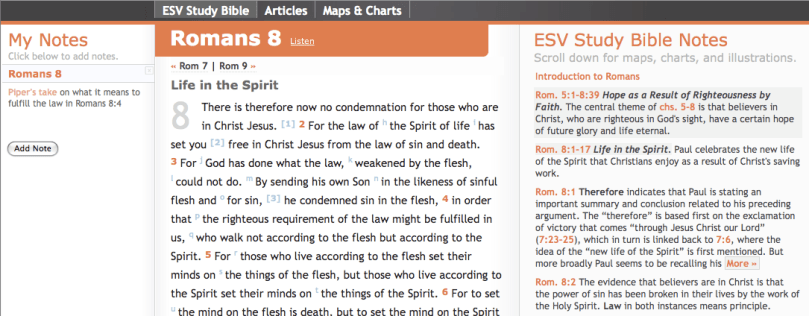
The ESV Online Study Bible — for free

Crossway Books has announced today that, for a limited time, the ESV Online Study Bible will be available to everyone for free. This means that the complete ESV Study Bible with all its notes, charts, articles and maps can be accessed for free.

I have had access to it for about a week now since my ESV Study Bible arrived and I can say that it is a tremendous research tool for indepth study of the scriptures and extremely helpful in understanding the scriptures and answering questions. An added benefit of the ESV Online Study Bible is the ability to take notes and have them available anywhere you have Internet access.

Thanks so so much to the folks at Crossway Books for making this available. I would strongly encourage all to take advantage of this offer and check out this resource.

The ESV Online Study Bible is now available for free for a limited time.

Are we ready for tough times ahead?

The coddled Western world will sooner or later give way to great affliction. And when it does, whose vision of God will hold? Where are Christians being prepared for great global sorrows? Where is the Christian mind and soul being prepared for the horrors to come? Christians in the West are weakened by wimpy worldviews. And wimpy worldviews make wimpy Christians. God is weightless in our lives. He is not terrifyingly magnificent. His sovereignty is secondary (at best) to his sensitivity.

— John Piper, Spectacular Sins and Their Global Purpose in the Glory of God (13)

We don’t have to imagine as hard these days to envision tough times in our country. But tough economic times aren’t the same as tough times to be a follower of Christ. It is good to turn to Christ for comfort, but some times we need more than just comforting words. We need words of warning. There is evil in this world and it touches every one of our lives. The fact that we live in comfort in our Western world is a providence of God, but we should not look at it as the only way.

In John Piper’s Spectacular Sins, cited above, he examines how evil in our world not only fail to nullify God’s purpose to glorify Christ they — by his providence — succeed in making his purpose come to pass. And through understanding this, we can be strengthened in our own lives in the difficult times that will surely come.

The book is one of many that you download for free as a PDF onto your computer. If you still prefer to hold a book in your hand, you can purchase it here.