What makes a Calvinist a Calvinist?

Kevin DeYoung wrote this for Christian Research Journal, which you can subscribe to or find at your local Christian bookstore. It’s about the rise of the New Calvinism:

The influence of Calvinism is growing because its God is transcendent and its theology is true. In a day when “be better” moralism passes for preaching, self-help banality passes for counseling, and “Jesus is my boyfriend” music passes for worship in some churches, more and more people are finding comfort in a God who is anything but comfortable. The paradox of Calvinism is that we feel better by feeling worse about ourselves, we do more for God by seeing how He’s done everything for us, and we give love away more freely when we discover that we have been saved by free grace.

I’d like to think that we are Calvinists because of what we see in the Bible. We see a God who is holy, independent, and unlike us. We glory in God’s goodness, that He should save miserable offenders, bent toward evil in all our faculties, objects of His just wrath. We rejoice in God’s electing love, which He purposed for us before the ages began. We are grateful for God’s power by which He caused us, without our cooperation, to be born again and enabled us to believe His promises. We take comfort in God’s all-encompassing providence, whereby nothing happens according to chance, but all things—prosperity or poverty, health or sickness, giving or taking away—are sent to us by our loving heavenly Father.

As Calvinists and Christians, we praise God for His mercy, shown to us chiefly on the cross where His Son died, not just to make a way for us to come to Him, but effectually for us such that our sins, our guilt, and our punishment all died in the death of Christ. We find assurance in God’s preserving grace, believing with all our might that nothing—not even ourselves—can separate us from the love of God in Christ Jesus our Lord. We delight in the glory of God and in God’s delight for His own glory, which brings us, on our best days, unspeakable joy, and on all other days, still gives purpose and order to an otherwise confusing and seemingly random world.

What draws people to Reformed theology is the belief that God is the center of the universe and we are not, that we are worse sinners than we imagine and God is a greater Savior than we ever thought possible, that the Lord is our righteousness and the Lord alone is our boast.


Speak the truth with your life

John Piper addresses the question whether it’s OK for a Christian couple to live together if they aren’t married. His answer, in part:

It’s not primarily, “You’re going to be tempted, and you’re going to give in, and you’re going to have more sex. That’s why.” That’s not the main reason.

The main reason is that when a man and a woman live together it says crystal clear to the world that having sex together without marriage is okay. That’s what it says.

Now, you say you’re a Christian. Do you want to say that sex before marriage is okay? And if you want to say that, then something is profoundly wrong!

And if you say, “That’s their problem,” you’re not loving people. It’s not their problem. It is your problem. You should take steps to communicate truth, and the sanctity of sex in marriage is a glorious truth, and you should want to hallow it and cherish it. 

Now, you say you’re a Christian. Do you want to say that sex before marriage is okay? And if you want to say that, then something is profoundly wrong!
And if you say, “That’s their problem,” you’re not loving people. It’s not their problem. It is your problem. You should take steps to communicate truth, and the sanctity of sex in marriage is a glorious truth, and you should want to hallow it and cherish it.

Jason McElwain, basketball and the goodness of God

Jason McElwain’s story is a great one to remember. Jason, who has autism, gained fame in 2006 when he got to play in his first high school game and hit six shots in the closing minutes and scored 20 points. His story won hearts far and wide and he went on to be celebrated by famous athletes and even spent time with President Bush.

His story doesn’t end there because he also inspired two young who, like Jason, are autistic. The videos below tell their stories and the remarkable events that unfolded for Josh Titus and Patrick Thibodeau. It is important to remember that, whatever condition we are in, we are made in God’s image and for that reason we can celebrate. This isn’t a story about how great three young men are, it’s a story about how God is great in his care of our lives.

HT: Justin Taylor

Debating Christianity: A Collision of worldviews

I don’t know when this will come out on video or theaters, but it promises to be an interesting event nonetheless. Renowned author and avowed “anti-theist” Christopher Hitchens and pastor and author Douglas Wilson are the subjects of a documentary that looks at their exchanges over the question “Is Christianity good for the world?” The documentary, called “Collision: Christopher Hitchens vs. Douglas Wilson,” follows the men as they debate one another and make public appearances during their book tour for “Is Christianity Good for The World.”

Collision — Christopher Hitchens vs. Douglas Wilson

HT: Justin Taylor

10 years later: The Hand of Hope

Fox News has an interview with 9-year-old Samuel Armas, who was “born famous” after photograher Michael Clancy took a shot of Armas while Dr. Joseph Bruner was performing prenatal surgery. The picture below is stunning and amazing all at the same time.

HandofHope


This is what Armas looks like now:

SamuelArmas

People of the Book

The brothers immediately sent Paul and Silas away by night to Berea, and when they arrived they went into the Jewish synagogue. Now these Jews were more noble than those in Thessalonica; they received the word with all eagerness, examining the Scriptures daily to see if these things were so. Many of them therefore believed, with not a few Greek women of high standing as well as men. — Acts 17:10-12

This was the passage we looked at today at church. In the passage, it says the people in Berea “were more noble” than those in Thessalonica, who expelled Paul and Silas from their midst. In the ESV Study Bible, it says: Noble translates the Greek eugenēs, which originally meant “of noble birth” or “well born.” The word was also applied to people who exhibited noble behavior, in that they were open-minded, fair, and thoughtful.

In other words, Luke is commending those who are open-minded when it comes to examining the scripture, those who look to it daily, examining what it says and not trying to shape it with their own biases and preconceived ideas. It is my prayer that I will seek God’s word so that it may teach me, rebuke me, encourage me, shock me and ultimately make me into someone who knows God intimately. The world likes to tell you what the Bible says and how it is either right or wrong about what we see every day. Instead, we need to go to the Bible first and let it be the prism through which we see everything else.

Free stuff for graduates — and anyone

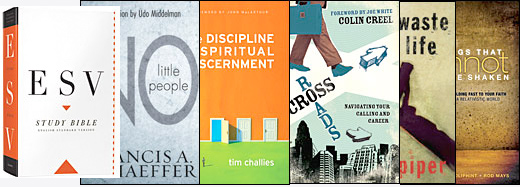
Free-Stuff FridayTim Challies, as part of his regular Free-Stuff Fridays, is offering a great collection of books that would make a fine gift to a graduate or maybe just a great collection to your personal library. From Crossway Books:

As part of the contest, all you need to do is sign up for a free drawing by midnight tonight. Thanks much to Tim for offering these great books! Go to the link above to sign up.

The euphemism of ‘choice’ and why it’s something else

Kevin DeYoung writes a great post today, “Lincoln’s Legacy and the Unborn,” in which he discusses how America’s most popular (arguably) president was not a fan of ‘popular sovereignty,’ which would have allowed each state as it entered the union the choice of whether it would be a slave state or a free state. DeYoung writes:

The connections with the pro-slavery argument and the pro-abortion argument should be obvious. Both argue for choice. Both, at least in their more civilized forms, pretend moral neutrality. And both rely for their inner logic on strikingly similar propositions: blacks are not human persons with unalienable rights; and neither are the unborn. To quote from Lincon’s 1864 speech in Baltimore with only a slight tweak, subsituting ‘choice’ for ‘liberty’: “We all declare for choice; but in using the same word we do not all mean the same thing. With some the word choice may mean for each man to do as he pleases with himself, and the product of his labor. While with others the same word may mean for some men [and women] to do as they please with others, and with other men’s labors. Here are two, not only different, but incompatible things, called by the same name–choice. And it follws that each of the things is, by the respective parties, called by two different and incompatible names–choice and tyranny.”

Freedom is more than you think

My teenage daughter recently started her first “real” job. She has also delivered newspapers — with my help — babysat and helped at camp, so I can’t say that she hasn’t worked before. Still, this is the first type of regular-working, paycheck kind of job that she’s had and I’m pleased that she’s taken some initiative and stepped out into the working world.

Because of this step and the increased responsibilities and privileges it brings, we’ve talked about how she needs to manage her school and home schedules. It’s an interesting dilemma she now faces as she’s able to earn money (which is great for a teenager!) yet also is less free to do things. The other day we talked about how you have to learn to prioritize things in your life because not everything you want to do is worth doing.

Her situation is a good example of what freedom can mean in our lives. In this culture, we hear a lot of talk about freedoms we have and ones we think are being restricted. In our society you’ll often hear people come down on Christians as “imposing their views” on people, as if telling biblical truths somehow limits your freedom to live as you choose. But there is a freedom in Christianity that limits yet liberates you more than anything else can.

In his excellent book “The Reason for God: Belief in an Age of Skepticism,” Timothy Keller addresses claims like these and others and shows that those who state them are really not seeing the issues clearly or as clearly as they think they do. Below is a brief audio excerpt of a message Keller gave in 2006 at Redeemer Church in New York as part of a series entitled “The Trouble with Christianity: Why it’s so Hard to Believe it.” Those messages were the basis of “The Reason for God.” Go here to hear the entire message.

By way of background, in the excerpt Keller is talking about freedom based on Galatians 2:4-16 where Paul confronts Peter about his treatment of Gentile believers.

Tim Keller explains how freedom is more than you think.