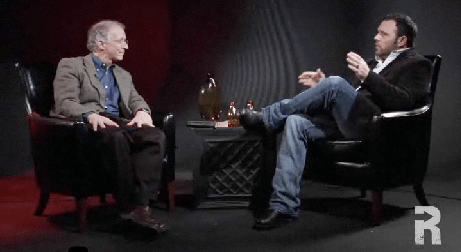
Mark Driscoll, pastor at Mars Hill Church in Seattle, sat down for an interview with John Piper. Driscoll in unabashed in his appreciation for Piper (the post is entitled “Why I Love John Piper,” so that should give you a pretty good idea!) and asks a wide range of questions in the 49-minute talk.
Mark Driscoll (right) recently interviewed John Piper on a wide array of topics.
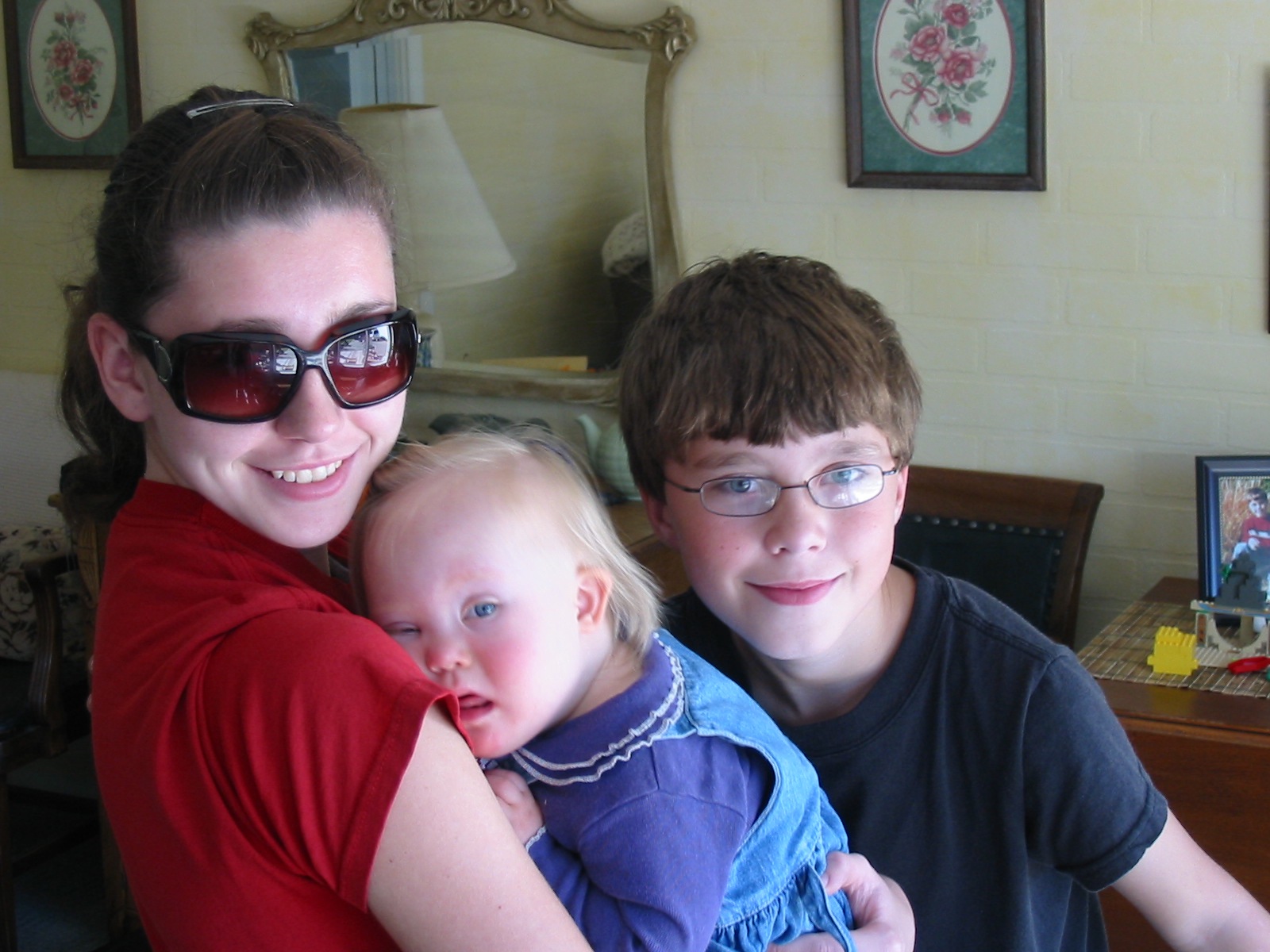
My precious niece Amelia is popular with my two children and all of our family.
The Washington Post did a front-page story this past Sunday on what it’s like to live with and raise a child with Down syndrome. For those who haven’t been through it, it is an eye-opening look into what is a very difficult life.
Articles like this, of course, are being written because of the attention that Alaska Gov. Sarah Palin has brought to families who have Down syndrome children. These children are all around us, but, as one of the parents in the story says: “Before, kids would stare, but not adults. Everybody’s curious: ‘What’s it like to have a kid with Down syndrome?’ ”
What’s it like for these families is put this way in the article:
Amelia is a blessing to all of our family and to those who meet her.
They spend more time in doctors’ offices than most parents. They endure stares from strangers but feel as if they and their children are invisible. They often find themselves fighting for their kids, not just raising them. Earlier, and perhaps more dramatically, they wrestle with the complex emotions that come from knowing that a child might never fulfill the lofty dreams that a parent often envisions before the child’s birth.
But the parents of children who have Down syndrome say that raising a child with a disability can also unlock profound and uplifting truths about themselves, their children and the value of life in ways that others could never see.
In our family, we have a beautiful gift from God named Amelia. She was born with Down syndrome to my wife’s brother and his wife to join their other three children. At age 2 she is still learning to stand on her own and maybe utters a handful of words, but she is world class in drawing tenderness from anyone who encounters her. It is a hard life for her parents as she has needs that press daily on them and her family, but I don’t doubt for a second that they love her every bit as much as her older brothers and sister.
One of the parents in the Washington Post article recounts an encounter with her sister that is a cruel reminder of how many in our society think the cruelest thoughts when it comes to Down syndrome children:
“My sister looked at me and said, ‘Why didn’t you abort her?’ ” Marsili recalled. “I said, ‘What? Because we love her, and she’s my baby, and we love her!’ ‘But you knew,’ my sister said. . . . It was pretty shocking. Even people that close to me.”
It is a dangerous place we’re at when we consider killing to be a solution for children who’s abilities are diminished. If it takes someone like Sarah Palin entering the spotlight for us to expose this kind of thinking — and rebuke it — then I think it is a good thing.
This fall, in our Sunday school class at church, we are studying a book called “Is God on America’s Side?” The book looks at the thinking that God somehow reserves his blessing for American because it is a “Christian nation.” We’ve just started it, but I think it will be a good thing to clear up some attitudes about how God’s will is not always what we think it is.
In light of that, I want to add an essay by Joe Carter, who is the managing editor for Culture11. Carter, in what he calls “an open letter to the religious right,” lays out 11 thoughts he wants to share with them about religion and politics. You may agree or disagree with his points, but his conclusion is well worth noting:
(F)inally, we must recognize that America is not a “Christian nation”, though we should aspire to be a nation where those of us who are Christians are admired as good and noble citizens. America is not a “shining city on a hill”, though we should let our light of freedom be a shining example for the entire world. America is not the “greatest blessing God gave mankind”, though it is a great nation worthy of our conditional adoration. Patriotic sentiment has its place but we mustn’t let it expand beyond its acceptable borders. We are citizens of both the City of God and the City of Man and must always be careful not to confuse the one for the other.
John Piper's latest book is "Spectacular Sins and Their Global Purpose in the Glory of Christ"
On this day, seven years ago, terrorists crashed two planes into the World Trade Center, another into the Pentagon and crashed another into a Pennsylvania field. More than 3,000 people died that day in an openly evil act. Our nation’s history was dramatically altered on that day.
With the thought of evil on my mind, I became aware that John Piper’s new book “Spectacular Sins and Their Global Purpose in the Glory of Christ” has now been released. This is what it says about the book at the Desiring God Web site:
What does the fall of Satan reveal about Christ’s glory? How does Adam’s sin magnify our Lord? How does the glory of Jesus shine through in Judas’ betrayal? How is the honor of Jesus at stake in the sin and evil, the suffering and the calamities and the wickedness, which abound in the world today? In this book John Piper seeks to provide a biblical perspective on God’s sovereign and righteous governance over even the sinful acts of men. History’s greatest sins do not thwart God’s purposes to save his people and glorify his Son; they fulfill them. And being grounded in this hope is the key to “Christ-exalting strength in calamity and Christ-exalting courage in conflict.”
We see indescribably evil things happen each day in our world. There is no escaping it. When we think of these things we may wonder how God can allow it and, if so, how does it fit into his plan. John Piper recently explained what he hopes to accomplish with the book:
The aim of this book is not to meet felt needs, but to awaken needs that will soon be felt, and then to save your faith and strengthen your courage when evil prevails.
And, even though the events of Sept. 11, 2001, are receding into history, I think none of us who lived through that day will ever feel we are free from the presence of evil. And, for that reason, it would be good to understand the purpose of God in “spectacular sins.”
ALSO SEE: How Sept. 11, 2001, proved 10 truths about God’s sovereign love
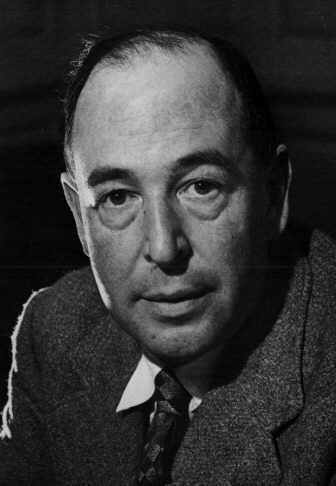
No, but there are some scholars who would argue that. How well do we know the man considered perhaps the greatest Christian of the 20th century? Lewis once said: “I believe in Christianity as I believe the sun has risen. Not only because I see it, but by it I see everything else.”
We would do well to better understand this man, who is familiar to many — Christian or not — through his many popular writings. His insight into Christianity and his way of communicating it is unique. Brad Mercer, the senior pastor at Westminster Presbyterian Church in Greenwood, Miss., is lecturing on the life and works of C.S. Lewis at the First Presbyterian Church in Kosciusko, Miss. Mercer is currently pursuing his doctorate in Lewis studies. The church has graciously made his lectures available online.
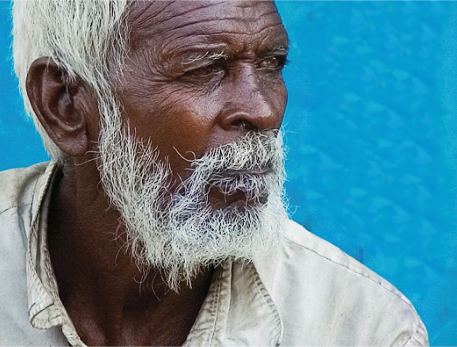
The Dalits make up 25 percent of India's population and are the poorest caste group in Hinduism. They are severely discriminated against and oppressed.
I would be remiss if I failed to mention that I’m not always thinking about elections and hurricanes. In fact, this is something I’ve been watching and praying about lately. This was from a report in The Guardian from Aug. 31:
Thousands of terrified Indian Christians are hiding in the forests of the volatile Indian state of Orissa after a wave of religious ‘cleansing’ forced them from their burnt-out homes with no immediate prospect of return.
A mob of Hindu fundamentalists rampaged through villages last week, killing those too slow to get out of their way, burning churches and an orphanage, and targeting the homes of Christians. Up to 20 people were reported dead, with at least two deliberately set alight, after the murder of a Hindu leader last Saturday provoked the violence.
In some districts, entire villages lay deserted, abandoned by Christian populations who would rather shelter in the forests than return to face the risk of death. Some villagers attempted to return to their homes yesterday despite threats of further violence.
But Christian leaders who had spoken to those who have fled said that even among the trees they were not safe. Some of their tormenters have pursued them, trying to finish the job.
While the portion of the story above indicates the killings are in response to the killing of a Hindu leader the week before, the story goes on to say that Maoist guerrillas have in fact claimed responsibility for the killing. Still, there is tension between the groups:
Underlying the violence is a long-simmering dispute between Hindus and Christians in the state over the conversion of low-caste Hindus to Catholicism. The success of the Christian churches has fuelled resentment among hardline Hindus. The Vatican has condemned the violence. Most of India’s billion-plus citizens are Hindu, while just 2.5 per cent of them are Christians.
With that in mind, I would like to point out a resource that I use called Global Prayer Digest. From its site, the Global Prayer Digest:
(I)s a unique devotional booklet. Each day it gives a glimpse of what God is doing around the world, and what still remains to be done. Daily prayer for that still-unfinished task is at the heart of the Adopt-A-People movement. Condensed missionary stories, biblical challenges, urgent reports, and exciting descriptions of unreached peoples provide a digest of rich fuel for your own times of prayer for the world.
The Global Prayer Digest is a key tool in a movement to help fulfill Christ’s commission to make disciples of all the peoples of the earth. This movement involves a daily discipline of learning, praying, and giving to help reach the world’s nearly 9,000 ureached people groups. Unreached peoples are those groups which do not yet have a strong church in their own cultural and social setting.
This month’s guide is on the Dalits of India. They are the poorest caste group in India and face severe discrimination. In the story above, many of those are from this group. Each day GPD has a prayer topic related to that month’s guide. It is a valuable resource and one that I would encourage anyone who calls himself a Christian to explore. As it says on the site, “when man works, man works, but when man prays, God works.”
Recently, on “Meet The Press,” Joe Biden said that, as a Roman Catholic, he’s “prepared to accept the teachings of the church” and that “I’m prepared as a matter of faith to say that life begins at the moment of conception.” Yet he also says he is unwilling to impose his religion on anyone.
First question: What, specifically, is Biden’s religiously based conviction on abortion? Since he said in the interview that he was “prepared to accept the teachings of his church”—and he specifically confirmed his belief that human life begins at conception—then I take it he thinks abortion ends the life of an innocent human being and is therefore an act of homicide. If not, why oppose it?
Second question: Does Joe Biden believe that his belief is true? Does he hold that his conviction is correct, that as a matter of fact human life actually does begin at conception and that abortion really does snuff out the life of a defenseless human person?
Koukl, who admits that his second question is really a trick question, but says he does that to bring up an important point about what passes for political discussion these days:
The reason for this question is tactical. I’m taking away the weasel-room that this way of talking affords to duplicitous politicians. The query sets up a logical dilemma to show that the modified pro-choice view is simply political double-talk.
If Biden denies his beliefs are true, then I have no idea what he means when he says he believes anything, whether religiously motivated or otherwise. If he doesn’t believe his beliefs are true, then what is the difference between believe and make-believe, between fantasy and reality?
But if Biden actually believes abortion truly takes the life of an innocent human being before birth in a way that is not morally distinct from killing a newborn immediately after birth, why would he not vote against such a thing? Would it make any sense to say that as a matter of religious conviction I believe that all men are endowed with inalienable rights, but I could never impose such a personal belief on slave owners?
Here is Biden during his “Meet The Press” interview:



 Rockstanding
You must be logged in to post a comment.