God, marriage and family

A recommendation from Mark Driscoll:

About the book, from Crossway Books:

We live in a time of crisis regarding marriage and the family, and only by a return to the biblical foundation can these institutions be rebuilt. To provide an integrated, biblical treatment of the full range of marriage and family issues, the authors of God, Marriage, and Family examine what Scripture says about God’s purposes for humans in their marriage and family interactions. Their examination covers the special issues stemming from marriage, childrearing, singleness, homosexuality, and divorce and remarriage. With study questions and points for further discussion, this book is a comprehensive yet concise resource for anyone seeking a Scriptural response to our culture’s complex challenges to God’s intentions for marriage and family.

To get Andreas Kostenberger’s “God, Marriage and Family: Rebuilding the Biblical Foundation,” go here.

One little problem for Obama: Dickey Amendment

The other day I posted about President Obama’s executive order on March 9 overturning restrictions on embryonic stem cell research put in place by former President Bush. In it, I said that Obama had carefully constructed his words to allow for the scientific destruction of embyos (killing of humans) for research.

A reader pointed out that, two days later, Obama signed an omnibus spending bill containing a clause which seemed in direct contradiction with his executive order. Like others, I wondered what this meant since the president’s words on March 9 were explicit about where he stood.

After his press conference last night, when he was asked about stem cell research he seemed ready to leave the issue to scientists — that is, those who are strongly in the embryonic stem cell research corner. What is clear is that, despite his words, the only thing he’s wrestled with is on this issue is with what political constituency he wants to keep his allegiances .

The complicating part is the Dickey amendment, which was part of the Omnibus bill. Found of page 280 of the bill, its says:

SEC. 509. (a) None of the funds made available in this Act may be used for—

(1) the creation of a human embryo or embryos for research purposes; or

(2) research in which a human embryo or embryos are destroyed, discarded, or knowingly subjected to risk of injury or death greater than that allowed for research on fetuses in utero under 45 CFR 46.204(b) and section 498(b) of the Public Health Service Act (42 U.S.C. 289g(b)).

(b) For purposes of this section, the term ‘‘human embryo or embryos’’ includes any organism, not protected as a human subject under 45 CFR 46 as of the date of the enactment of this Act, that is derived by fertilization, parthenogenesis, cloning, or any other means from one or more human gametes or human diploid cells.

The White House said the  amendment, which has been in appropriations bills since 1996, only means that federal funds can’t be used for the killing of embryos, it can still be used for research on embryos that are killed with private funds. Others, however, say that it’s not that simple. Douglas Johnson, legislative director for the National Right to Life Committee, told CNSNews.com the White House is too narrowly defining the amendment:

It does not merely say you can’t use federal funds to kill an embryo, it’s much broader than that. It says the federal government can’t fund research in which embryos are harmed. We should interpret that to mean the federal government can’t fund any research project if that project involves or requires harm to human embryos.

It is not consistent with the Dickey amendment for NIH to say, ‘OK, we’re going to approve this study, which involves taking 100 embryos out of the freezer in some in vitro lab and killing them and taking their stem cells, and using their stem cells in the federally funded study, and by the way, we’re going to pay for all of that, and we approve it in advance. The only part we’re not going to pay for is the part where you kill the embryo.’ That’s not what the Dickey amendment says.

And, because there is this doubt out there and actual law is at stake, Congress has already started acting on the possibility of repealing Dickey. Already this month, House Majority Leader Steny Hoyer (D-Md.) has said lawmakers may look at passing a stem cell research bill before the April 4 recess. You can bet that getting rid of Dickey will be part of that measure, as Colorado Democrat Diana Degette told the N.Y. Times that they will look at how Dickey restricts research. In other words, it would mean the government could once and for all pour money into research that kills humans for the sake of science. Again, Josef Mengele would approve.

‘Bud & Me’: The Wild West and two amazing kids


Bud&MeIn December I had the pleasure of reading “Peace Like A River,” which was the fictional tale of a Minnesota family that treks into North Dakota in search of a family member on the run from the law. Like many others, I got caught up in the story and enjoyed the way author Leif Enger told the story through the eyes of young Rube Land, whose retelling of the story caught the innocence yet had a maturity to it.

If you enjoyed that, imagine a true story of two young adventurers on amazing trips, including one by themselves! Bud & Me: The True Adventures of the Abernathy Boys is told through the eyes of Temple Abernathy (the “Me” in the title), who at age 5 rode horseback with his 9-year-old brother Bud from Frederick, Okla., to Santa Fe, N.M., and back.

The world was a different place in 1905, but to read something like this it just amazes you. At one point, Temple Abernathy says he and his brother were encouraged by reading Mark Twain’s “Roughing It,” a book that I’ve read and enjoyed. This is the kind of book that would be fun to read with children and then talk about. In the last year I’ve read through “Do Hard Things” by Alex and Brett Harris and so have my two children. The idea of that book was to defy the low expectations that are placed on kids. I would say these kind of adventures would fall in the “Do Hard Things” category!

To read some sample pages of “Bud and Me” go here.


HT: The Children’s Hour

To spank or not to spank?

You should, and it’s biblical. That it, if you believe verses like Prov. 13:24, which says: “Whoever spares the rod hates his son, but he who loves him is diligent to discipline him.” And, if Jesus believed the Bible, then I think we can to.

Still squeamish about? Then maybe you should check out this post by John Piper, pastor at Bethlehem Baptist Church.

Yes, Virginia, there is a Jesus Christ. But about Santa Claus …

Every year, my local newspaper prints an old editorial entitled, “Yes, Virginia, there is a Santa Claus.” It was written in 1897 by an editorial writer for the New York Sun in response to a letter by an 8-year-old girl named Virginia. The little girl wondered if there really was a Santa Claus since some of her friends said he didn’t exist.

Poor little Virginia. She was asking the wrong question. Maybe her friends were pointing her to a more satisfying focus of her devotion and, rather than turning to find him, some ridiculous adult went on to ramble about how Santa will live a thousand years from now even though you couldn’t see him or prove he exists. Great. So, in the spirit of journalism, this is repeated yearly as if it somehow preserves some kind of childlike innocence.

Here’s something for all you Viriginias out there. Was there a Santa Claus? Mark Driscoll at The Resurgence looks at the man known as Saint Nicholas and the myths surrounding him. What you will find is that there is a lot of storytelling involved in the Santa story. But, on the other hand, you will find that what is known about Jesus Christ is not just hearsay but was written down by eyewitnesses and then handed down faithfully. It’s not another fairy tale, but real history. And that’s the best news. If you are going to look forward expectantly for someone this Christmas, look forward to Jesus.

‘Santa Claus is a poor replacement for Jesus Christ’

There’s this growing idea that religion is the thing that makes the world an awful place, that somehow if people lived without religion, we would all get along better and be happier. It has been tried throughout history, but it doesn’t help. At this time of year, we even put that effort in the form of a person called Santa Claus. This is what John Piper says about that and how the effort fails to help us:

If there is going to be any salvation at all, there must be a divine revelation. God must reveal these things to us or we perish. We can’t find them out from television or radio or medicine or psychology or art. We learn the truth about ourselves from the Word of God. And once our eyes are opened to the truth that God reveals, then we can see confirmations of it in virtually all the sciences and arts.

Santa Claus and Religion

But if we don’t start with God’s interpretation of who we are, we will be like blind people who go on developing elaborate theories to prove that there really is no such thing as vision, and that color and light and perspective are the inventions pious imaginations projecting onto reality their own dissatisfaction with the dark. “Religion is the opiate of the people.”

That statement is not simply classic Marxism. It is classic American materialism. The difference is that American materialism doesn’t outlaw religion; it imitates it and then uses it. That is the real meaning of Santa Claus.

The true meaning of Christmas—that God sent his Son into the world to save us from our evil hearts of sin (Matthew 1:21), and to destroy the works of the devil in our habits and homes and schools and workplaces (1 John 3:8), and to rescue us from the wrath to come (1 Thessalonians 1:10)—that meaning of Christmas is unacceptable to the spirit of this world. But the impact of the truth of the incarnation is so undeniable after 2,000 years of influence, that the god of this world behind American materialism cannot oppose it outright, but simply imitates it with Santa Claus and a hundred other trappings in order to direct the religious impulses of the masses into economically profitable channels.

Does that mean you sit Christmas out completely? Listen to Piper explain how Christmas Day looked at their house when their kids were growing up:

Click on the image to view the video

We’re supposed to live and learn …

Moshe Holtzberg, the 2-year-old orphan of the rabbi and his wife slain in the Mumbai Jewish center, cries during a memorial service at a synagogue in Mumbai, India, Monday, Dec. 1, 2008. Holtzberg will fly to Israel Monday on an Israeli Air Force jet with his parents' remains and the Indian woman who rescued him, an Israeli Foreign Ministry spokesman said. (AP Photo)
Moshe Holtzberg, the 2-year-old orphan of the rabbi and his wife slain in the Mumbai Jewish center, cries during a memorial service at a synagogue in Mumbai, India, Monday, Dec. 1, 2008.

The world cries out: Who can hold us? Only one man. Only one man can save us.

Killing to spare the child?

Wesley J. Smith, who blogs at Secondhand Smoke, has recently resumed creating podcasts. You should be sure to check them out. He is a senior fellow at the Discovery Institute and has lent much wisdom to the debate about the value of human life.

This podcast, which he produced in 2007, talks about eugenic embryo screening, the idea that babies are screened before birth to identify — and sadly — eliminate those who have undesirable traits. How far will it go? You be surprised.

Click on the image to hear the podcast.

And now for this kind moment

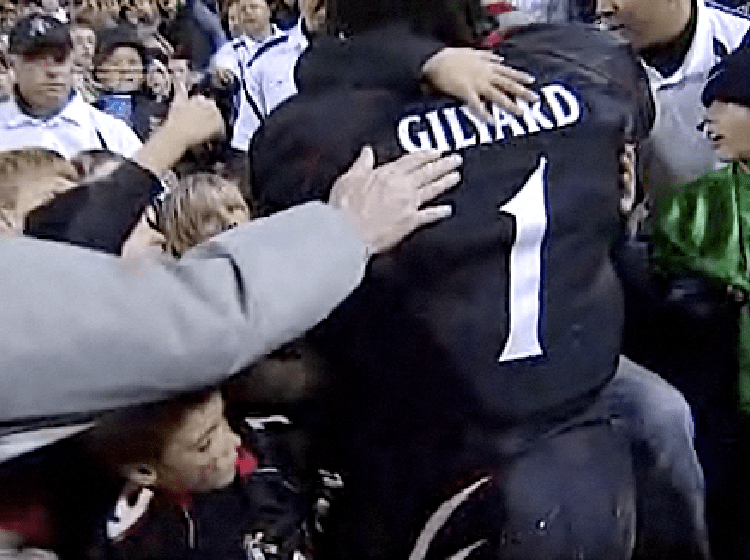
UPDATE: After seeing the video on SportsCenter several times, I can see that the play made an impression on more than just me. The player involved was Cincinnati’s Mardy Gilyard and his unintentional victim was 7-year-old Garrett Monroe. For his trouble, Garrett was interviewed during the game by ESPN’s Erin Andrews and then signed autographs for fans around him. No one interviewed Gilyard, but it was a classy gesture on his part. Click on the image below to see it. The play itself and the interview are a ways into the highlight, so be patient.

In this video highlight from ESPN, Cincinnati receiver Marty Gilyard shows some tenderness for a fan who happened to be in the wrong place at the wrong time.
In this video highlight from ESPN, Cincinnati receiver Mardy Gilyard shows some tenderness for a fan who happened to be in the wrong place at the wrong time.

I just saw a college football player from the University of Cincinnati go crashing into the stands after trying to make a touchdown catch.

The cool part was when we realized that he had run over a small child he quickly removed his helmet and gave the tearful boy a hug to comfort him.

This gesture spoke volumes to me. Way more than any celebration, taunting, dancing or yelling. Just a beautiful moment.

And now back to the cruel world.