The Screwtape Letters come to life in audio drama once more

I have enjoyed reading C.S. Lewis’ “The Screwtape Letters” several times over the years. At the local library, I was even able to find this audiobook version, performed well by John Cleese. So I was very excited to hear that Focus on the Family has produced a new audio version, which will be out Oct. 15. Especially intriguing is that Andy Serkis, who made Gollum come to life so vividly in the “Lord of the Rings” movies, will be performing the role of Screwtape. Visit the link below the video clip to learn more.

Here is the description of the production from the Focus on the Family site:

From the award-winning audio drama team that brought you Radio Theatre’s Amazing Grace and The Chronicles of Narnia. In his enduringly popular masterpiece The Screwtape Letters, C. S. Lewis re-imagines Hell as a gruesome bureaucracy. With spiritual insight and wry wit, Lewis suggests that demons, laboring in a vast enterprise, have horribly recognizable human attributes: competition, greed, and totalitarian punishment. Avoiding their own painful torture as well as a desire to dominate are what drive demons to torment their “patients.” The style and unique dark humor of The Screwtape Letters are retained in this full-cast dramatization, as is the original setting of London during World War II. The story is carried by the senior demon Screwtape (Andy Serkis) as he shares correspondence to his apprentice demon Wormwood. All 31 letters lead into dramatic scenes, set in either Hell or the real world with humans—aka “the patient,” as the demons say—along with his circle of friends and family. This Radio Theatre release also stars Geoffrey Palmer (Tomorrow Never Dies), Laura Michelle Kelly (Sweeney Todd), Eileen Page (The Secret Garden), and other world-class actors.

Handle with care and wisdom: Sharp words, harsh words, and words that offer praise

Click on image to view video

James 3:10 says: Blessing and cursing come from the same mouth. My brothers, these things ought not to be.

This video is really discouraging in a way because it is a reminder of how we can deliver a load of garbage with the same mouth we deliver praises, all within the same day. It is a hard thing to realize how far we fall short.

The 2008 Desiring God National Conference, The Power of Words and the Wonder of God, dealt with how we use our words. Now a new book of essays based on that conference is available. Here is what the blurb at Desiring God says about it:

Words carry immeasurable significance: The universe was created with a word; Jesus healed and cast out demons with a word; rulers have risen and fallen by their words; Christians have worshiped through words of song, confession, and preaching. Even in our technological age, politics, education, business, and relationships center on words. Since the tongue is such a powerful force—for good or evil—we are wise to ask: What would homes, churches, schools, even the public square be like if we used words with Christian intentionality and eloquence?

The Power of Words and the Wonder of God seeks to answer this difficult question. In these chapters, derived from Desiring God’s 2008 national conference, John Piper, Sinclair Ferguson, and Mark Driscoll team with worship pastor Bob Kauflin, counselor Paul Tripp, and literature professor Daniel Taylor to help readers harness their tongues and appropriately command their silences for the glory of God and the ministry of the gospel.

We live in a charged age where our words can fly off our tongues (or fingertips) to a wide audience in a moment’s notice. The subject addressed in this book is important. We have a great and deadly tool at our disposal. We need wisdom in using it.

Thank God today for John Calvin, a man who treasured God’s glory

Today is the 500th anniversary of the birth of reformer John Calvin, an important man in the history of the Christian church. To help mark the occasion, the Desiring God blog is doing a nine-part series on his biography. Here is the first part:

Five hundred years ago today, he was born Jean Cauvin in Noyon, France—about 70 miles north of Paris. His father was Gerard, son of a barrelmaker and boatman. Gerard was a lawyer, and it was his law practice that brought him into the everyday sphere of the church.

The young Jean benefitted immensely through his father’s ecclesiastical connections. He was able to be educated privately with the children of the wealthy De Montmor family and eventually garnered church support for his further studies.

Gerard originally planned a career for his son in the church. But when things later soured with the dioceses, he would redirect his son toward law.

When Martin Luther nailed his 95 theses to the church door in Wittenberg on October 31, 1517, and unknowingly launched the Reformation in earnest, the young Calvin was a mere 8 years old. He likely heard very little, if anything, about the rebellious German monk until he left for university in Paris at age 14. There he would hear more.

Portrait of CalvinAs part of the celebration, Desiring God is, today only, offering THL Parker’s 1954 biography of John Calvin, called “Portrait of Calvin,” for only $2. You can also download it for free. Why care about a man who lived hundreds of years ago and is not without controversy? I think John Piper gives good reason in his foreward to “Portrait of Calvin.”

“I am eager for people to know Calvin not because he was without flaws, or because he was the most influential theologian of the last 500 years (which he was), or because he shaped Western culture (which he did), but because he took the Bible so seriously, and because what he saw on every page was the majesty of God and the glory of Christ.”

And now, some words for the nonrevolutionaries among us

Ted Kluck, by way of coauthor Kevin DeYoung’s blog, has some words for you in an excerpt of their latest great book, Why We Love the Church:

A search on a popular Christian bookseller’s Web site revealed no less than sixty-two items with the word manifesto in the title and hundreds containing the term revolutionary. There are revolutionary books for teens. Ditto for stay-at-home moms. There’s a book about how Jesus was a revolutionary communicator, and how you can use His revolutionary communication skills in your home/business/church. The question then becomes, If we’re all revolutionaries, are any of us an actual revolutionary? Being a revolutionary used to mean that you overthrew a government; now it means that you’re a courageous enough visionary to have church on a golf course or in someone’s living room.

My point in all of this is not to make not-so-subtle jabs at revolutionary culture (maybe a little bit); rather, it is to encourage the scores of nonrevolutionaries in our midst, of which I am one. I want to encourage those of us who try really hard to pray for our families and friends, try to read our Bibles consistently, and share the gospel with those around us. Those of us who aren’t ready to chuck centuries worth of church history, and years of unglamorous but God-glorifying growth in the name of revolution.

I’m also a part of the generation that has produced more memoirs before the age of thirty-five than any other in history. We’re crazy about Christian narrative nonfiction, especially those “on the road” stories, no matter how trite or contrived they may be. We’re journeyers. We’re wanderers. We still haven’t found what we’re looking for. Jack Kerouac’s (or Donald Miller’s…or Lauren Winner’s) wayward children are all over the Christian book landscape.

These narrative titles all follow a similar pattern, in that in them experiences are had (a cross-country road trip, a self-finding excursion through Europe, a documentary chronicling the lameness of American Christians, a chronicle on how the author dropped out of church and subsequently “found” Jesus), and then those experiences are shared in book form. Many of these books are supposed to tell us that “community” is the answer, and individualism is bad, but at the end of the day these books are largely about the individual and his or her discoveries.

I am looking forward to this book. Both Ted and Kevin have a great way of getting right to the point in a helpful way. Don’t go find yourself. Find God and love the church.


Great technology at your fingertips

ESV Study BibleIn these heady days of new technology, it is easy to get caught up in the latest great must-have new gadget. As Exhibit A I would present myself. Ignoring the gentle jabs lobbed my way, I tote my MacBook to men’s Bible study on Friday mornings so I can view the ESV Study Bible online and quickly jump to passages. I love it.

That said, I can appreciate this post by Tim Challies talking about how he fell out of love with his Kindle. It did it’s job, but couldn’t quite match the technology it was trying to replace:

Something changed between then and now—I came to see that all of the things that frustrated me about the Kindle were things that made it not like a book. It’s book-like qualities were it’s best qualities; it’s non-book-like qualities were the ones that got to me. All of the things that annoyed me were the things that made the experience more like operating a computer and less like reading a book. Pages took too long to turn; I could not splash yellow highlighter on the pages; I could not skim through the book looking quickly for a word or phrase or note; I could not scrawl notes in the margins. Sure, there were a few advantages—the notes I did take (saved in a text file on the Kindle) could be exported to my computer simply by plugging in a USB cable; books were less expensive and instantly added to my collection; hundreds of classics were available for free. But overall, the Kindle experience paled in comparison to the happy, familiar, comforting experience of sitting down with a book. Everything I wanted the Kindle to do, a book could do better.

He goes on to list more reasons why the book is the perfect technology. Perhaps this will change one day, but for now I can see his point. I work at a newspaper, which I hear every day is a dying industry. Yet, there is a feeling of holding a newspaper in your hand or the anticipation of picking up the day’s news off your front porch (or wherever it lands!) or handing a section to your wife so you can have the sports pages that so far has not been replaced. A common joke in our family is that an e-mail doesn’t exist for my in-laws until it is printed out and held in their hands. Some things are hard to replace.

So, we can appreciate new technology, but don’t be so quick to trash the old technology (or the people who are devoted to it). God works in mysterious way.

The ESV Study Bible now available as an ePub book

Crossway Books announced Tuesday that the English Standard Version (ESV) Study Bible is now available for $14.99 as an ePub book for the iPhone, iPod Touch or other portable devices. To read it (if you have an iPhone or iPod Touch) use the free application Stanza. And, if you don’t have one of those devices, you can also download the free e-reader for your desktop or laptop (if you’re on a Mac) to have the ESV there if you wish.

If you think taking your tunes with you is cool imagine taking God’s word and the comprehensive, complementary material included with the ESV Study Bible. So, this is what we’re talking about:

  • 2 million words of Bible text and insightful teaching.
  • 20,000 notes-focusing especially on understanding the Bible text and providing answers to frequently raised issues.
  • Over 50 articles-including articles on the Bible’s authority and reliability; on biblical archaeology, theology, ethics, and personal application.
  • 200-plus charts-offering key insights and in-depth analysis in clear, concise outline form; located throughout the Bible.*
  • Over 200 maps-created with the latest digital technology, satellite images, and archaeological research; throughout the Bible.
  • 40 all-new illustrations-including renderings and architectural diagrams of the Tabernacle, the Ark of the Covenant, Solomon’s temple, Herod’s temple, the city of Jerusalem in Jesus’ time and throughout the history of Israel, and many more.

Overcome the fear of living

I have mentioned it earlier, but I can’t recommend high enough Kevin DeYoung’s excellent “Just Do Something: A Liberating Approach to Finding God’s Will.” This little book will have a deep impact on your view of approaching God’s will and what it means. Here is how DeYoung puts it:

The will of God isn’t a special direction here or a bit of secret knowledge there. God doesn’t put us in a maze, turn out the lights, and tell us, “Get out and good luck.” In one sense, we trust in the will of God as His sovereign plan for our future. In another sense, we obey the will of God as His good word for our lives. In no sense should we be scrambling around trying to turn to the right page of our personal choose-your-own-adventure novel.

God’s will for your life and my life is simpler, harder, and easier than that. Simpler, because there are no secrets we must discover. Harder, because denying ourselves, living for others, and obeying God is more difficult than taking a new job and moving to Fargo. Easier, because as Augustine said, God commands what He wills and grants what He commands.

Thank you to Kevin DeYoung for writing this book. Just do something. Buy this book and read it.

Inflicting pleasure: Perhaps Huxley was right?

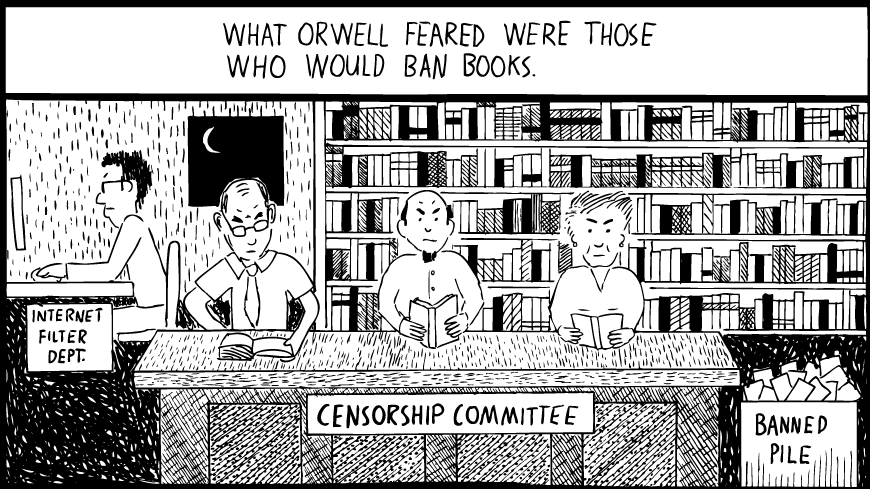
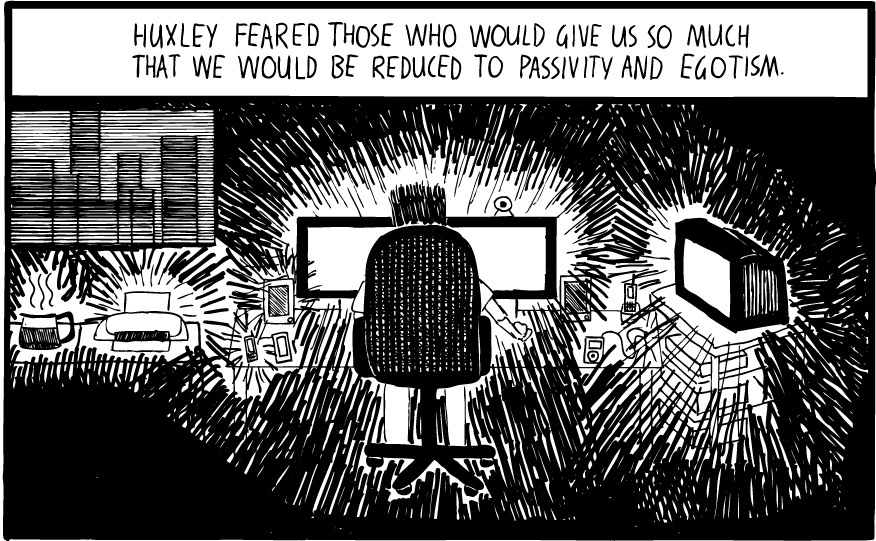
From the foreward of Neil Postman’s Amusing Ourselves to Death: Public Discourse in the Age of Show Business, where he suggests that Aldous Huxley may have had a better idea of what the future held than George Orwell did in his classic 1984:

But we had forgotten that alongside Orwell’s dark vision, there was another – slightly older, slightly less well known, equally chilling: Aldous Huxley’sBrave New World. Contrary to common belief even among the educated, Huxley and Orwell did not prophesy the same thing. Orwell warns that we will be overcome by an externally imposed oppression. But in Huxley’s vision, no Big Brother is required to deprive people of their autonomy, maturity and history. As he saw it, people will come to love their oppression, to adore the technologies that undo their capacities to think.

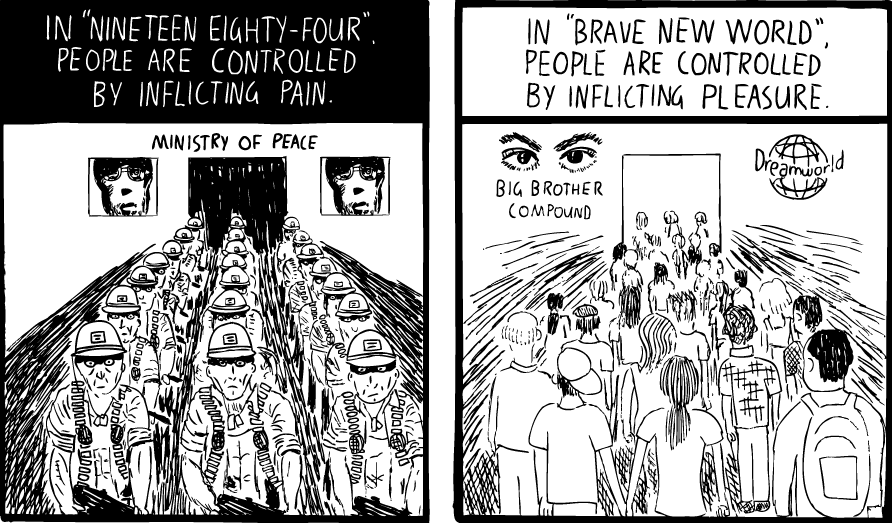
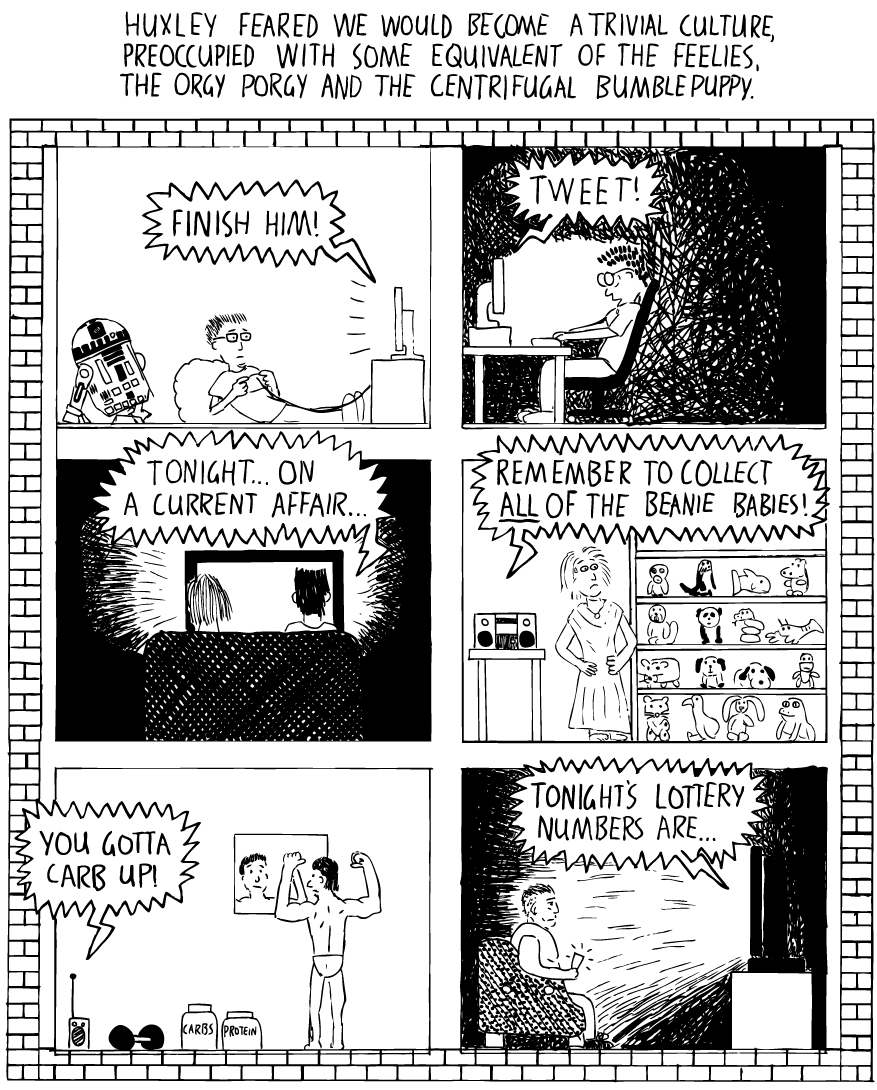
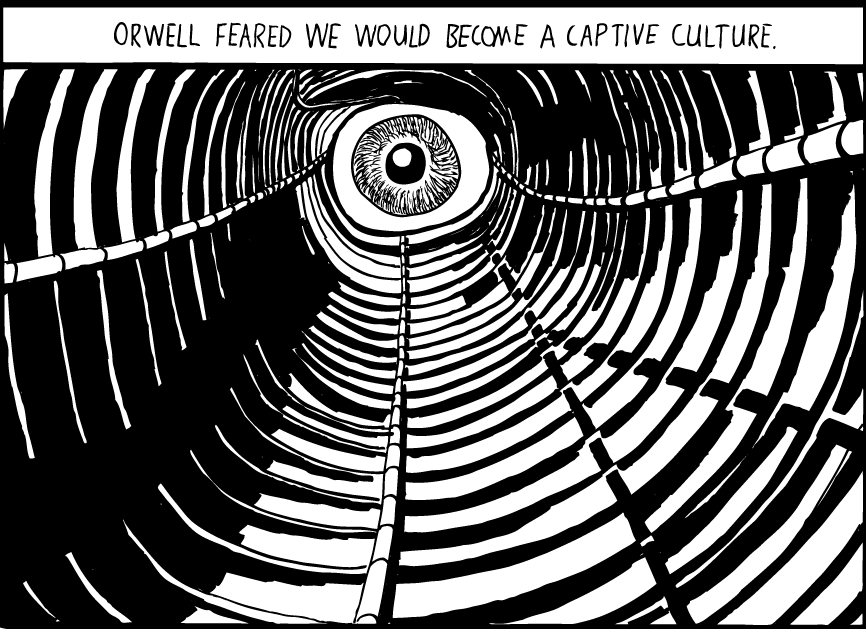
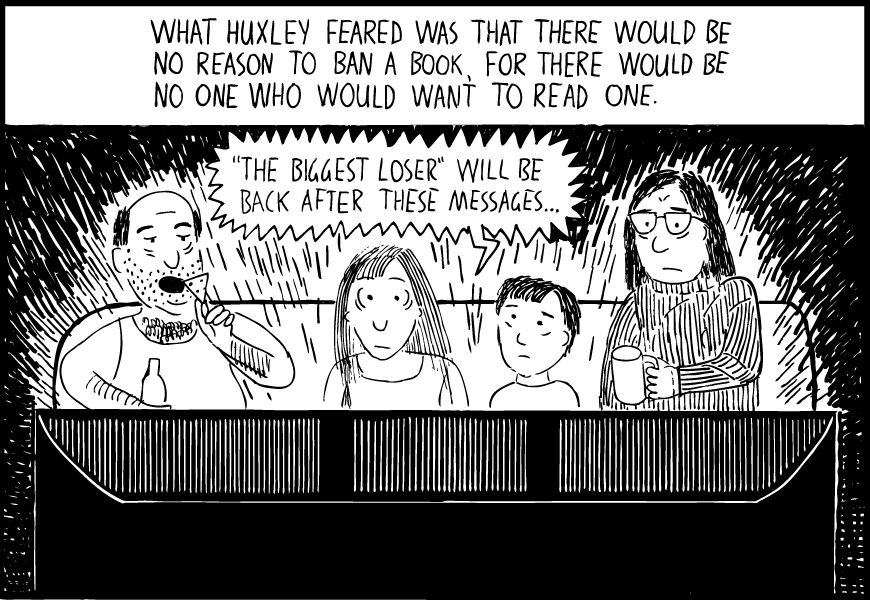
What Orwell feared were those who would ban books. What Huxley feared was that there would be no reason to ban a book, for there would be no one who wanted to read one. Orwell feared those who would deprive us of information. Huxley feared those who would give us so much that we would be reduced to passivity and egoism. Orwell feared that the truth would be concealed from us. Huxley feared the truth would be drowned in a sea of irrelevance. Orwell feared we would become a captive culture. Huxley feared we would become a trivial culture, preoccupied with some equivalent of the feelies, the orgy porgy, and the centrifugal bumblepuppy. As Huxley remarked in Brave New World Revisited, the civil libertarians and rationalists who are ever on the alert to oppose tyranny “failed to take into account man’s almost infinite appetite for distractions”. In 1984, Huxley added, people are controlled by inflicting pain. In Brave New World, they are controlled by inflicting pleasure. In short, Orwell feared that what we hate will ruin us. Huxley feared that what we love will ruin us.

This book is about the possibility that Huxley, not Orwell, was right.

Drawings by Stuart McMillen, Recombinant Records


“Do not lay up for yourselves treasures on earth, where moth and rust [1] destroy and where thieves break in and steal, but lay up for yourselves treasures in heaven, where neither moth nor rust destroys and where thieves do not break in and steal. — Matthew 6:19-20


HT: Justin Taylor

The Truth About ‘Angels and Demons’

Westminster Theological Seminary has put together a comprehensive Web site in response to the movie based on Dan Brown’s book “Angels and Demons.” Some of the questions from “Angels and Demons” it addresses are:

Other topics addressed on the site include Church &  Bio-Ethics, Facts About Antimatter, Illuminati Ambigrams, Hidden Archives, The God Particle, CERN & Religion, Popular Questions and an Angels and Demons Quiz. All in all, it’s a great site for those who have questions about Christianity raised by the movie.

Graduation special from Desiring God

The fine folks at Desiring God are offering significant discounts on some great material.


The Essential Piper Trilogy: Desiring God, Future Grace

and The Pleasures of God
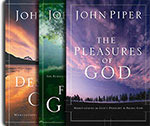
EssentialPiper

DESIRING GOD:The message of Desiring God is that God is most glorified in us when we are most satisfied in him. In this book, Piper calls this worldview “Christian Hedonism” and explains why pursuing maximum joy is essential to glorifying God. He discusses the implications of this for conversion, worship, love, Scripture, prayer, money, marriage, missions, and suffering.

FUTURE GRACE: What is future grace? It is all that God promises to be for us from this second on. Saving faith means being confident and satisfied in this ever- arriving future grace. This is why saving faith is also sanctifying faith. The power of sin’s promise is broken by the power of a superior satisfaction; namely, faith in future grace. Gratitude for past grace was never meant to empower future obedience. Tomorrow’s crisis demands tomorrow’s grace. And faith that future grace will be there is the victory that overcomes the world. Future Grace contains 31 chapters – one for each day of the month – including practical chapters on how faith in future grace defeats anxiety, pride, shame, lust, despondency and more.

THE PLEASURES OF GOD: One way to see the glory of God is to meditate upon the object of his delight. In this reissued version with a new cover design, John Piper unfolds for us a vision of God through the lens of his happiness. What most delights the happiest Being in the universe? God’s gladness in being God. If God’s excellencies can be admired in his pleasures, and if we tend to become like what we admire and enjoy, then focusing on these pleasures can help us to be gradually conformed to his likeness. In other words, we will be most satisfied in God when we know why God is most satisfied in God.

Don’t Waste Your Life Book and DVD Set

DWasteYLife

DON’T WASTE YOUR LIFE STUDY EDITION: In this book John Piper describes his journey toward one great, single passion—endless joy in the crucified Christ—and challenges the reader to the same pursuit. The cost is great. But the joy is worth any cost.

DON’T WASTE YOUR LIFE 3-DVD SET: In this 3-DVD set, John Piper challenges viewers to wake up from the American dream to the soul-saving reality that “to live is Christ and to die is gain.”

* Disc 1: Book Study Edition DVD with ten 15-minute teaching sessions. These lessons are designed for smaller groups and work in tandem with the Don’t Waste Your Life group study materials (book, study guide).

* Discs 2-3: Conference Edition DVDs with four new, hour-long messages. These messages enable you to conduct your own Don’t Waste Your Life event or class.

The Complete Romans Series
Romansseries

After 18 years of preaching at Bethlehem Baptist Church, John Piper felt the time had come to preach through Paul’s letter to the Romans. “The glory of Christ, who is the image of God (2 Corinthians 4:4), seems more glorious to me now than it ever has. And there is no greater exposition of the Gospel of God than the book of Romans… I have a deep confidence that the best way to be lastingly relevant is to stand on rock-solid, durable old truths, than jumping from one pragmatic bandwagon to another. Romans is as solid and durable and reliable and unshakable as truth can get.” Come and worship through the Book of Romans with us!

Note on the format: MP3 DVDs can be played in computers with DVD drives and some DVD players. For best results put this DVD in the computer’s DVD drive and copy the MP3 files to your computer’s media player. They will not play in standard CD players.

As it says at the Desiring God site, there is always more to learn, always more to be excited about and more to love God for. As young men and women go off to school next fall, these resources can help them grow even more. Go here to see more information.


In this book John Piper describes his journey toward one great, single passion—endless joy in the crucified Christ—and challenges the reader to the same pursuit. The cost is great. But the joy is worth any cost.