What makes parenting hard: There are no easy times, but there is hope

The biggest problem we face in this world, John Piper preached this past Sunday, is not politics or culture or choices we make but the power of sin. Because sin entered the world, childbearing and childrearing, for one example, became hard. There are no easy times for parents, Piper said, although some times may be harder than others. “If you think (parenting) is easy, you’re dreaming,” he said. “Or wait a few days.”

His sermon, “Parenting with Hope in the Worst of Times,” looked at the situation the prophet Micah was in around 700 years before Jesus was born. What we see in Micah 7 is parenting in the worst of times, where the situation in his culture and at home is bleak. There is no one he can trust, whether it’s in his community or even his own home. In verse 5: “Put no trust in a neighbor; have no confidence in a friend; guard the doors of your mouth from her who lies in your arms.” And it goes further in verse 6: “For the son treats the father with contempt, the daughter rises up against her mother, the daughter-in-law against her mother-in-law; a man’s enemies are the men of his own house.”

Is this uncommon? No. Many have families that are torn with strife, broken in some way either by corruption or some other problem. Or even something else. Jesus in Matthew 10:34 quotes this very passage where he talks about the way he divides one family member from another because of his calling. He does it. Not because he loves to break up families, but because there is something so radical about what Jesus demands that it causes disruptions in families. You know what this looks like. The family that doesn’t get that call accuses the one called of being “arrogant” or “too good” for them. Jesus wants them all, but the split can happen over Jesus. The point is is that the tear is not always over some evil.

What is the response? What can we learn from what Micah says? Here are his words from Micah 7:7-10:

7 But as for me, I will look to the LORD; I will wait for the God of my salvation; my God will hear me. 8 Rejoice not over me, O my enemy; when I fall, I shall rise; when I sit in darkness, the LORD will be a light to me. 9 I will bear the indignation of the LORD because I have sinned against him, until he pleads my cause and executes judgment for me. He will bring me out to the light; I shall look upon his vindication. 10 Then my enemy will see, and shame will cover her who said to me, “Where is the LORD your God?” My eyes will look upon her; now she will be trampled down like the mire of the streets.Read More »

Hopeful harmony: Salve for the weary soul

I love to sing, and I love to hear good singing. While it is always a blessing for me to sing with other believers in church, it is especially sweet to hear those who sing harmony. A couple of weeks ago, I stood next to (we stand when we sing at my church) my wife at church and enjoyed singing while also listening for the sweet sounds of her harmonizing with the songs. She usually sings with the worship team and so I don’t always get to experience that.

Sadly, it is a sound that is going away it seems because fewer and fewer people sing harmony. I would point to the increasing use of PowerPoint and the decreasing use of hymnals as one theory. I don’t want to go down the path of arguing against the use of PowerPoint because we can still lift our voices and sing and praise God. But when you don’t see notes, you may not think of different singing parts and therefore little harmonizing happens. I miss it.

Thankfully, I had my spirits raised this morning by a wonderful clip that Robert Cottrill posted on his Wordwise Hymns site. On this date composer Joseph Philbrick Webster was born. Among many compositions, he wrote the music for Sweet By and By. I nearly cried when I heard this  — for the beauty of the words I was hearing and because it had been a long time since I had sung in a group that way: people singing parts with no accompaniment! I just savored that. Today, it was a salve for me as I live between two worlds.

We shall sing on that beautiful shore
The melodious songs of the blessed
And our spirits shall sorrow no more,
Not a sigh for the blessing of rest

In the sweet by and by,
We shall meet on that beautiful shore;
In the sweet by and by,
We shall meet on that beautiful shore.

The executive order is bogus: More hypocrisy from Obama

Andrew McCarthy at The Corner blog at National Review Online summarizes the final bit in a long line of trickery in the effort to ram the Obama health care monstrosity on America. The latest is an executive order to pacify pro-life Democrats (do those even exist any more?) to vote yes on the measure in the House of Representatives:

We spent the eight years through January 19, 2009, listening to Democrats complain that President Bush had purportedly caused a constitutional crisis by issuing signing statements when he signed bills into law. Democrats and Arlen Specter (now a Democrat) complained that these unenforceable, non-binding expressions of the executive’s interpretation of the laws Bush was signing were a usurpation Congress’s power to enact legislation.

But now Democrats are going to abide not a mere signing statement but an executive order that purports to have the effect of legislation — in fact, has the effect of nullifying legislation that Congress is simultaneously enacting?

The Susan B. Anthony List observation that EOs can be rescinded at the president’s whim is of course true. This particuar EO is also a nullity — presidents cannot enact laws, the Supreme Court has said they cannot impound funds that Congress allocates, and (as a friend points out) the line-item veto has been held unconstitutional, so they can’t use executive orders to strike provisions in a bill. So this anti-abortion EO is blatant chicanery: if the pro-lifers purport to be satisfied by it, they are participating in a transparent fraud and selling out the pro-life cause.

But even if all that weren’t true, how do we go from congressional Democrats claiming that signing statements were a shredding of the Constitution to congressional Democrats acquiescing in a claim that the president can enact or cancel out statutory law by diktat?

The dissent of the populace: When does Romans 13 not hold?

Let every person be subject to the governing authorities. For there is no authority except from God, and those that exist have been instituted by God. Therefore whoever resists the authorities resists what God has appointed, and those who resist will incur judgment. For rulers are not a terror to good conduct, but to bad. Would you have no fear of the one who is in authority? Then do what is good, and you will receive his approval, for  he is God’s servant for your good. But if you do wrong, be afraid, for he does not bear the sword in vain. For he is the servant of God, an avenger who carries out God’s wrath on the wrongdoer. Therefore one must be in subjection, not only to avoid God’s wrath but also for the sake of conscience. For because of this you also pay taxes, for the authorities are ministers of God, attending to this very thing. Pay to all what is owed to them: taxes to whom taxes are owed, revenue to whom revenue is owed, respect to whom respect is owed, honor to whom honor is owed. — Romans 13:1-7

Douglas Wilson, over at Blog and Mablog, is about to do a series of posts looking at Romans 13. It is hard to sit by and watch the way our government is working in ways that is highly objectionable. Indeed, in ways that seem criminal. Yet, as Christians, we are to look to God’s word as our guide. We are Christians first and then citizens. Wilson takes up the issue in part:

(Evangelicals) have come to believe that “not allowed” is the necessary meaning of — all together now! — Romans 13. When you get back to the Shire, whatever the sallow-faced thug leaning against the gate says you have to do, you have to do. He is leaning against the gate, isn’t he? I know there is nothing in the Constitution about that, but the Supreme Court said there was. And they are leaning against the gate too.

The doctrine is a convenient one, and it comports well with those who would make cravenness into a theological virtue. A great deal can be said about Romans 13 (which I hope to do, Lord permitting, in the weeks to come), but in the meantime, let this suffice.

Although the populations of different nations and cultures have different threshholds for what they will put up with, the consent of the governed is still a bedrock principle. At a certain point, it becomes obvious that the “consent of the governed” is not an ideal for democracies to strive for, but is rather an unalterable reality under every form of government.

Read the rest of Wilson’s post. I look forward to what he has to say. In the meantime, we will see which way our government proceeds with our business.

The tax in sheep’s clothing: How abortion funding sneaks into the health care bill

Charmaine Yoest, the President and CEO of Americans United for Life, recently wrote an editorial in the March 4 edition of the Wall Street Journal about the health-care proposal that is headed for a Sunday vote in the House of Representatives. One of the reasons the bill has been delayed in its return to the House is that a group of Democrat senators are withholding their approval based on the bill’s abortion language. As you may recall, when the bill passed in the House earlier this year, attached to it was a provision known as the Stupak Amendment. In simplest terms, it said that no federal funds would be used to pay for abortions. This amendment was proposed by Michigan representative Bart Stupak, a Democrat.

When the bill went to the Senate and was approved there, the Stupak amendment was not part of the bill. Another form of that amendment, not as strong in its terms, was a part of the bill. Likewise, the reconciled bill, written by the White House, has language similar to the Senate version. In her editorial, Yoest argues that this kind of deception is deliberate by President Obama and his administration:

Over the past year, language similar to the Hyde Amendment [banning federal funding for abortions] was crafted by Reps. Bart Stupak (D., Mich.) and Joe Pitts (R., Pa.) and inserted into the health-care bill that passed the House. When asked about the Stupak-Pitts Amendment in November, Mr. Obama talked around the issue. He said that “there is a balance to be achieved that is consistent with the Hyde Amendment.” When asked if Stupak-Pitts struck this “balance,” the president replied “not yet.”

That’s an odd reply. The question of abortion funding doesn’t have any Zen to it: The funding is either prohibited or it’s not.

In November, presidential adviser David Axelrod, on CNN’s “State of the Union,” also talked around the Hyde Amendment, saying that the president “doesn’t believe this bill should change the status quo as it relates to the issue of abortion.” But then Mr. Axelrod claimed that “this shouldn’t be a debate about abortion” before concluding that there were discussions in Congress about “how to adjust [the abortion language bill] accordingly.”

Apparently, his definition of “adjust” means opening up the spigot for the abortion lobby. The president’s latest proposal mirrors legislation that has passed the Senate, which doesn’t include a Hyde Amendment, and would inevitably establish abortion as a fundamental health-care service for the following reasons:

• It would change existing law by allowing federally subsidized health-care plans to pay for abortions and could require private health-insurance plans to cover abortion.

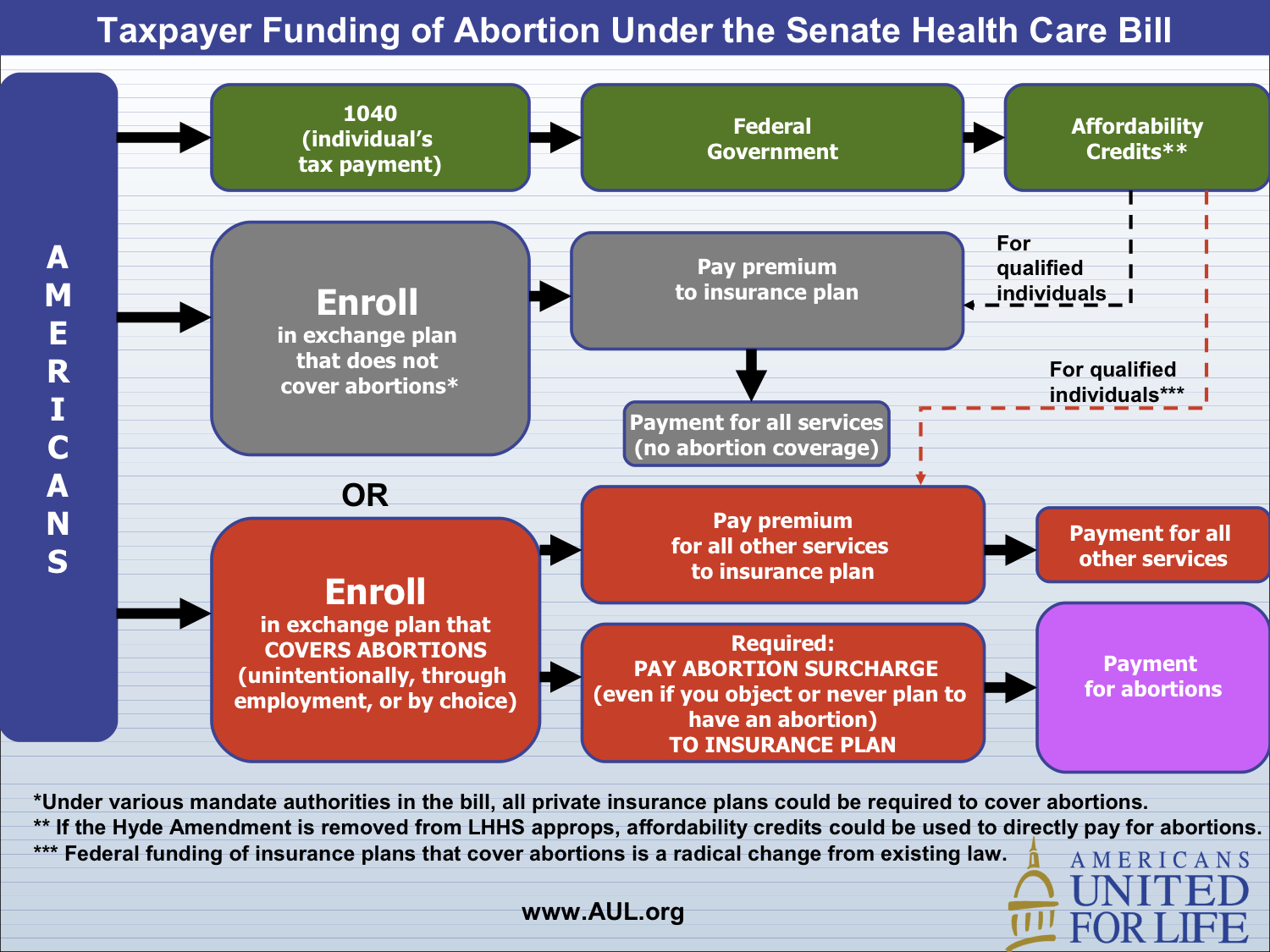
• It would impose a first-ever abortion tax—a separate premium payment that will be used to pay for elective abortions—on enrollees in insurance plans that covers abortions through newly created government health-care exchanges.

• And it would fail to protect the rights of health-care providers to refuse to participate in abortions.

The president’s plan goes further than the Senate bill on abortion by calling for spending $11 billion over five years on “community health centers,” which include Planned Parenthood clinics that provide abortions.

The president, in his zeal to get this bill passed, feels comfortable saying that there is a lot of misinformation out there. Perhaps that’s the information coming from the president. At the AUL Web site, there is a chart that explains how your tax dollars can be used to fund abortions even without having them go directly to abortion services (click on the image to see it larger).

Yoest, in an interview below last week on the Albert Mohler radio program, goes on to explain how this can all take place under the new legislation. This may seem hysterical to some, but there are some principles that are too important to be brushed aside, even for something that may be considered worthwhile. And this health care bill is hardly worthwhile.

http://idisk.mac.com/thebrott4-Public/CharmaineYoestinterview.mov

Still in school: Learning from a book about failures

And he began to teach them that the Son of Man must suffer many things and be rejected by the elders and the chief priests and the scribes and be killed, and after three days rise again. And he said this plainly. And Peter took him aside and began to rebuke him. But turning and seeing his disciples, he rebuked Peter and said, “Get behind me, Satan! For you are not setting your mind on the things of God, but on the things of man.” — John 8:31-33

There is a tendency for me not to get it. And not only to I not get it, I do what I don’t want to do again and again. That is why I am encouraged when I take up the Bible and read it. Why? Because over and over I see people who fail miserably yet are able, with God’s help, to come back to God. I agree with Scotty Smith, who prays “As you dealt with Peter, so deal with me. Give me all the life-giving rebukes I need to keep me living in gospel-sanity.”

We have not graduated from the gospel. We need it each day. The hard lessons are a good thing for me. I am glad for the imperfect people of the Bible who are there to show me that only God can make me what I need to be, what I hope to be.

Scotty’s prayer is a great one. Read it all and let it soak it.

Jesus, Proverbs and American idols: An appeal to be humble, open-minded, generous, obedient and patient

Tim Keller, digging through Proverbs 3, has come up with five guides to godly living that are useful to pray about for ourselves, our families and our church leaders. They are good checks to see if we are putting these things in our hearts.

1. Put your heart’s deepest trust in God and his grace. Every day remind yourself of his unconditioned, covenantal love for you. Do not instead put your hopes in idols or in your own performance.

Let love and faithfulness never leave you; bind them around your neck, write them on the tablet of your heart. Then you will win favor and a good name in the sight of God and man. Trust in the LORD with all your heart (Prov 3:3-5a)

2. Submit your whole mind to the Scripture. Don’t think you know better than God’s word. Bring it to bear on every area of life. Become a person under authority.

Lean not on your own understanding; in all your ways acknowledge him, and he will make your paths straight. (Prov 3:5b-6)

3. Be humble and teachable toward others. Be forgiving and understanding when you want to be critical of them; be ready to learn from others when they come to be critical of you.

Do not be wise in your own eyes; fear the LORD and shun evil. This will bring health to your body and nourishment to your bones. (Prov 3:7-8)

4. Be generous with all your possessions, and passionate about justice. Share your time, talent, and treasure with those who have less.

Honor the LORD with your wealth, with the first fruits of all your crops; then your barns will be filled to overflowing, and your vats will brim over with new wine. (Prov 3:9-10)

5. Accept and learn from difficulties and suffering. Through the gospel, recognize them as not punishment, but a way of refining you.

My son, do not despise the LORD’s discipline and do not resent his rebuke, because the LORD disciplines those he loves, as a father the son he delights in. (Prov 3:11-12)

Keller goes on to say that this wisdom is personified in the New Testament in Jesus, who did all this by 1) trusting God, 2) being saturated in and shaped by the Scripture, 3) being meek and lowly, 4) becoming poor for us, though he was rich, and 5) patiently enduring suffering on our behalf. These are good, solid truths to think on, pray about and ask God to put in your life and others’.

HT: The Gospel Coalition and Redeemer City to City

With God on your side is better than at arm’s length

I’ve been reading through “A Praying Life” by Paul E. Miller. In it, he says that prayerlessness “is rooted in a core unbelief that can shape our lives, even as Christians. Because of prayerlessness, our lives are often marked by fear, anxiety, joylessness, and spiritual lethargy.” There is a lot about prayer that we either don’t understand or else we understand and don’t like. In a recent chapter I read, Miller talks about how there is a tendency  we have to avoid intimacy with God.

Why would we do that? Well, for one, we don’t really want God nosing around in our business. Miller says there is a reason, perhaps, that we keep God at arm’s length, even with our prayers to him:

Frankly, God makes us nervous when he gets too close. We don’t want a physical dependence on him. It feels hokey, like we are controlling God. Deep down we just don’t like grace. We don’t want to risk our prayer not being answered. We prefer the safety of isolation to engaging the living God. To embrace the Father and thus prayer is to accept what one pastor called “the sting of particularity.” (A Praying Life, p. 125)

The very human prayer of Jesus asking that “this cup pass from me.” is much different than what Miller sees as the Buddhist and Neoplatonic attitudes that have crept into the church. That is, the attitude that we need to resist our own desires and deny physical urges. Those kind of simple, intimate prayers are the ones we hear children saying because they are more humble than “wiser” adults.

I don’t have it all together. The thing I want to battle against is the attitude that I will not lay it all on the line when I pray. That is to deny a personal God, and it doesn’t honor him.

Help from the government: The introduction of ‘therapeutic nihilism’

Joe Carter, writing last week at his First Things blog, takes a hard look at how the Netherlands has fallen steeply into the pit that is assisted suicide. It’s not a pretty picture, as he examines how the Netherlands has consistently expanded the ways doctors can help you kill yourself — or kill you without your permission — with government approval. The latest foray is legislation that would allow assisted suicide for anyone who has reached the age of 70 and has grown tired of living:

In any other country, such a proposal might be considered radical and shocking. But in the Netherlands—the country that first legalized euthanasia—the change in the law will merely decriminalize a practice that has been occurring for decades. An examination of how this formerly conservative, tradition-bound culture could adopt what the modern Hippocratic Oath refers to as “therapeutic nihilism” is useful for understanding how the other nations will begin to accept euthanasia in the near future.

Carter goes on to explain how this has crept into Dutch law little by little to the point where the medical community has been given the benefit of the doubt to the point where it is the one doing the policing authority when it comes to reporting abuses, if at all.

According to the Dutch Ministry of Justice, of the 135,675 deaths recorded in 1995, 3,600 (2.4%) were the result of a doctor-assisted termination of life while another 238 (0.3%) were cases of assisted suicide. The most disturbing statistic, however, is that 913 (0.7%) were terminations of life without the express request of the patient. For every three lives ended at the request of the patient, one person was killed without consent. While it is assumed that these cases consisted of terminally ill patients with no chance of survival, no one in the Netherlands knows for certain. Because the numbers are based on self-reporting by physicians, no accurate data exists to determine exactly how many Dutch citizens have been killed against their will.

Another comprehensive survey by Dr. Paul J. van der Maas in 1996 showed that the situation had indeed worsened since 1990. The total number of cases of euthanasia and assisted suicide had risen by a third from 2,700 to 3,600, with an estimated 60 percent not being officially reported. The number of cases of euthanasia without request by the patient also remained high, with 900 cases being reported. Although the government passively accepted the practice, doctors were still legally susceptible to prosecution if a disgruntled family member disagreed with the killing of their relative. Legislation to decriminalize euthanasia, which had been repeatedly proposed since 1984, was finally passed on April 10, 2001. A criminal liability exclusion was added for doctors who willingly reported their actions and demonstrated that they have satisfied the criteria of “due care.”

This is the kind of “culture of death” that not only exists, but exists with the approval of the government. If you are shocked by this, then that is good. When “tired of living” — aside from any physical illness — becomes an accepted reason for ending a person’s life, then we know that something has gone horribly wrong.

Believing is the evidence of new birth

Everyone who believes that Jesus is the Christ has been born of God, and everyone who loves the Father loves whoever has been born of him. — I John 5:1