From Rasmussen Reports comes an interesting poll revealing the public’s opinion about the Supreme Court. Of particular interest was this portion of the report there:
During his acceptance speech last night at the Republican National Convention in Minnesota, John McCain told the audience, “We believe in a strong defense, work, faith, service, a culture of life, personal responsibility, the rule of law, and judges who dispense justice impartially and don’t legislate from the bench.” Most American voters (60%) agrees and says (sic) the Supreme Court should make decisions based on what is written in the constitution, while 30% say rulings should be guided on the judge’s sense of fairness and justice. The number who agree with McCain is up from 55% in August.
While 82% of voters who support McCain believe the justices should rule on what is in the Constitution, just 29% of Barack Obama’s supporters agree. Just 11% of McCain supporters say judges should rule based on the judge’s sense of fairness, while nearly half (49%) of Obama supporters agree.
When you have people who’s idea of “fairness” includes a fundamental right to kill unborn babies you can see why elections are so critical. The people who make these decisions serve for life, but the people who appoint them don’t.
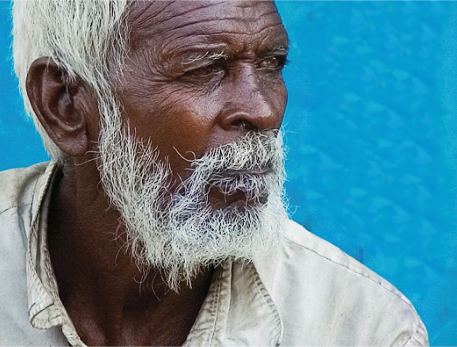
The Dalits make up 25 percent of India's population and are the poorest caste group in Hinduism. They are severely discriminated against and oppressed.
I would be remiss if I failed to mention that I’m not always thinking about elections and hurricanes. In fact, this is something I’ve been watching and praying about lately. This was from a report in The Guardian from Aug. 31:
Thousands of terrified Indian Christians are hiding in the forests of the volatile Indian state of Orissa after a wave of religious ‘cleansing’ forced them from their burnt-out homes with no immediate prospect of return.
A mob of Hindu fundamentalists rampaged through villages last week, killing those too slow to get out of their way, burning churches and an orphanage, and targeting the homes of Christians. Up to 20 people were reported dead, with at least two deliberately set alight, after the murder of a Hindu leader last Saturday provoked the violence.
In some districts, entire villages lay deserted, abandoned by Christian populations who would rather shelter in the forests than return to face the risk of death. Some villagers attempted to return to their homes yesterday despite threats of further violence.
But Christian leaders who had spoken to those who have fled said that even among the trees they were not safe. Some of their tormenters have pursued them, trying to finish the job.
While the portion of the story above indicates the killings are in response to the killing of a Hindu leader the week before, the story goes on to say that Maoist guerrillas have in fact claimed responsibility for the killing. Still, there is tension between the groups:
Underlying the violence is a long-simmering dispute between Hindus and Christians in the state over the conversion of low-caste Hindus to Catholicism. The success of the Christian churches has fuelled resentment among hardline Hindus. The Vatican has condemned the violence. Most of India’s billion-plus citizens are Hindu, while just 2.5 per cent of them are Christians.
With that in mind, I would like to point out a resource that I use called Global Prayer Digest. From its site, the Global Prayer Digest:
(I)s a unique devotional booklet. Each day it gives a glimpse of what God is doing around the world, and what still remains to be done. Daily prayer for that still-unfinished task is at the heart of the Adopt-A-People movement. Condensed missionary stories, biblical challenges, urgent reports, and exciting descriptions of unreached peoples provide a digest of rich fuel for your own times of prayer for the world.
The Global Prayer Digest is a key tool in a movement to help fulfill Christ’s commission to make disciples of all the peoples of the earth. This movement involves a daily discipline of learning, praying, and giving to help reach the world’s nearly 9,000 ureached people groups. Unreached peoples are those groups which do not yet have a strong church in their own cultural and social setting.
This month’s guide is on the Dalits of India. They are the poorest caste group in India and face severe discrimination. In the story above, many of those are from this group. Each day GPD has a prayer topic related to that month’s guide. It is a valuable resource and one that I would encourage anyone who calls himself a Christian to explore. As it says on the site, “when man works, man works, but when man prays, God works.”
Recently, on “Meet The Press,” Joe Biden said that, as a Roman Catholic, he’s “prepared to accept the teachings of the church” and that “I’m prepared as a matter of faith to say that life begins at the moment of conception.” Yet he also says he is unwilling to impose his religion on anyone.
First question: What, specifically, is Biden’s religiously based conviction on abortion? Since he said in the interview that he was “prepared to accept the teachings of his church”—and he specifically confirmed his belief that human life begins at conception—then I take it he thinks abortion ends the life of an innocent human being and is therefore an act of homicide. If not, why oppose it?
Second question: Does Joe Biden believe that his belief is true? Does he hold that his conviction is correct, that as a matter of fact human life actually does begin at conception and that abortion really does snuff out the life of a defenseless human person?
Koukl, who admits that his second question is really a trick question, but says he does that to bring up an important point about what passes for political discussion these days:
The reason for this question is tactical. I’m taking away the weasel-room that this way of talking affords to duplicitous politicians. The query sets up a logical dilemma to show that the modified pro-choice view is simply political double-talk.
If Biden denies his beliefs are true, then I have no idea what he means when he says he believes anything, whether religiously motivated or otherwise. If he doesn’t believe his beliefs are true, then what is the difference between believe and make-believe, between fantasy and reality?
But if Biden actually believes abortion truly takes the life of an innocent human being before birth in a way that is not morally distinct from killing a newborn immediately after birth, why would he not vote against such a thing? Would it make any sense to say that as a matter of religious conviction I believe that all men are endowed with inalienable rights, but I could never impose such a personal belief on slave owners?
Here is Biden during his “Meet The Press” interview:
Jennifer Rubin at RealClear Politics details 10 ways Sarah Palin has shaken up the race for president since her introduction as John McCain’s running mate. Rubin notes:
Palin has taken the GOP faithful by storm, captured the attention of the largest audience ever to watch a VP acceptance speech, and potentially created an entirely new presidential race. If the Obama camp seems flummoxed and floundering, alternating between horrid insults and praise for the new Republican VP nominee, it is easy to see why: she has completely shaken up the race.
Only a few days after her landmark speech, we can spot at least ten ways in which she may have altered the political landscape.
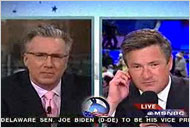
MSNBC anchor Keith Olbermann (left, seen with colleague Joe Scarborough) has been removed as co-anchor for political coverage along with Chris Matthews.
MSNBC, after enduring a public soap opera last week involving celebrity men-children Keith Olbermann and Chris Matthews, has decided to replace them as co-anchors of political night coverage, the Associated Press reports:
The change reflects tensions between the freewheeling, opinionated MSNBC and the impartial newsgatherers at NBC News. Throughout the primaries and summer, MSNBC argued that Olbermann and Matthews could serve as dispassionate anchors on political news nights and that viewers would accept them in that role, but things fell apart during the conventions.
Of course, they’ll still be around as commentators, so they won’t have to continue their weak act of pretending to be objective and unbiased. Is that harsh? Consider this from the same story:
Perhaps most embarrassing, Joe Scarborough was discussing positive developments in John McCain’s campaign at one point when Olbermann was heard on an offstage microphone saying: “Jesus, Joe, why don’t you get a shovel?”
Scarborough, a former Republican congressman and host of MSNBC’s “Morning Joe,” got in another nasty on-air exchange with MSNBC reporter David Shuster, and Matthews snapped at Olbermann on-air when it appeared Olbermann was criticizing him for talking too much.
The National Review’s John O’Sullivan, who wrote speeches for Margaret Thatcher, gives great insight into the complaints from those who belittle Sarah Palin’s speech at the Republican National Convention was little more than reading from the teleprompter:
Speakers have to make speeches their own. They have to feel the sentiments and know the facts. After all, if they get something wrong, it will be quoted against them for years — these days on YouTube.
Even then the most sincere speaker may lack the skills to put across a good speech well. Matt Scully is a superb speechwriter, but his best work was sometimes awkwardly delivered.
Not this time.
I devised a small test while watching.
Matt has a slightly aggressive sense of mischief. How would Mrs. Palin deliver his mischievous thrusts? So whenever I heard a hint of Matt’s mischief in the words, I would check out the Governor’s expression.
Invariably there was a glint of mischief in her eyes.
Matt, I think this is the beginning of a beautiful friendship.
What follows is the barebones outline, but if the topic is of interest, you’ll want to read the whole thing.
1. Ignore advice to “remake” yourself the first day you get to college.
2. Do something each week that puts you in contact with people older and younger than your peer group.
3. If you have a decent relationship with your parents keep it up.
4. If you are going to college, then go. You are in college to learn. In America, education often includes getting a job skill, but should also be about becoming a good, civilized citizen.
5. Find a faculty mentor during your first year.
6. Take classes that are hard from full-time professors that love to teach.
7. Secretaries and support staff are overworked, underpaid, and very powerful. You should be good to them out of virtue, but you must do it to thrive. The friendship you make with the department secretary now will pay dividends over the years. (One way I judge the character of a student is by how they treat the support staff.)
8. Books are not yet antiques. Go to the library. Talk to librarians. They are faculty members that are often under-utilized.
9. Don’t be too quick to pick a major, but try to do so by the end of the first year.
10. Live like an adult in college which includes moderating your passions.
Well, it depends on what you mean by nuances. If you mean the distinction between being judged according to works and being judged on the basis of works, that’s a huge and significant difference.
That’s because the Bible is so clear—and our own consciences bear witness—that if our acceptance with God is grounded finally in our performances of the law, in doing good deeds, then I’m not going to have any security here and I’m not going to be accepted with God in the end. God demands a perfect righteousness, which is what Christ provides for us in his own obedience; and he demands that we be forgiven for our sins, which is what Jesus’ blood provides for us on the cross.


 Rockstanding
You must be logged in to post a comment.